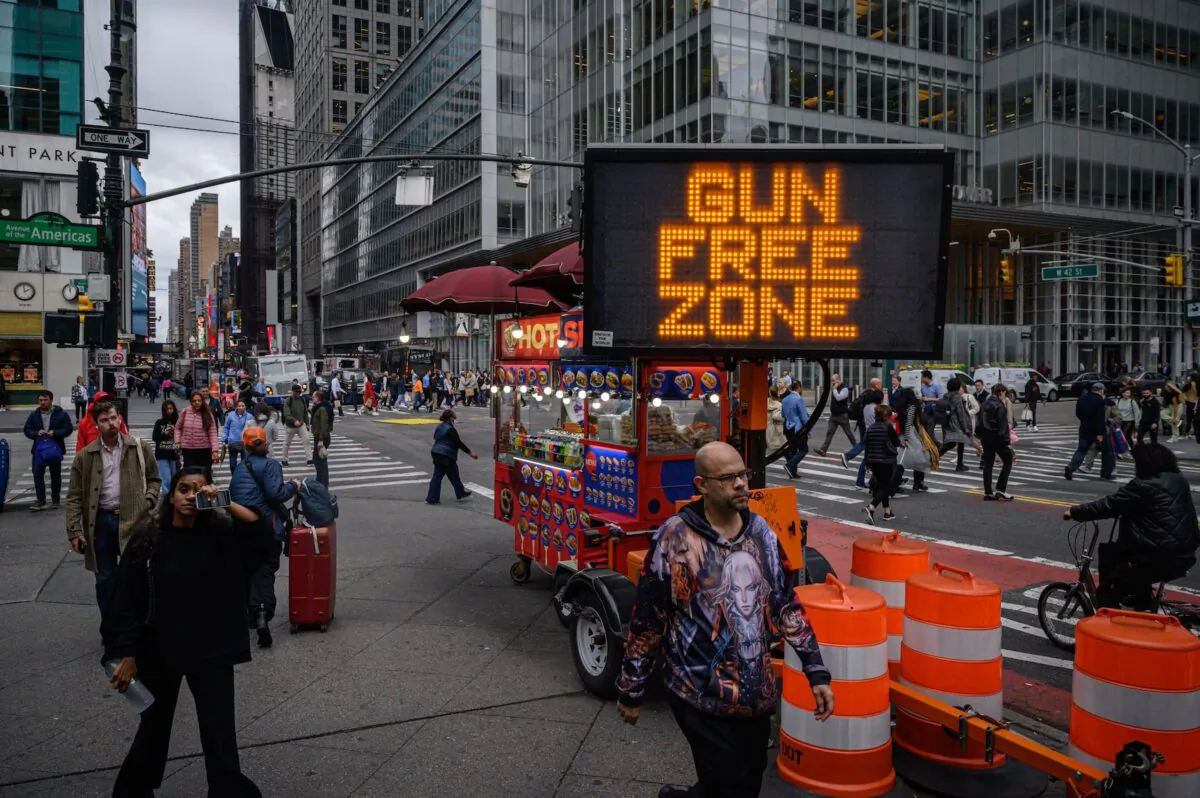
The Second Circuit Court of Appeals has struck down a major part of New York state’s restrictions on carrying firearms, handing gun rights advocates a partial victory in their challenge to a law they say drastically curtailed where licensed gun owners may carry in the Empire State.
In a decision issued on May 18, a three-judge panel of the Second Circuit affirmed a lower court ruling blocking New York from enforcing its ban on firearms on private property open to the public—such as restaurants, gas stations, and retail stores—without the owner’s express consent.
Under that provision, part of New York’s 2022 Concealed Carry Improvement Act, even people with valid concealed carry licenses cannot carry firearms on private property unless the property owner explicitly allows it.
Second Amendment advocates have called New York’s law, as well as similar measures in Hawaii and elsewhere, “vampire laws,” referencing folklore stating that a vampire cannot enter a private home unless expressly invited inside.
The judges, however, upheld the state’s ban on carrying firearms in public parks, another provision of the 2022 law.
In its 43-page opinion, the panel examined New York’s law under the standard set by the U.S. Supreme Court, which requires the government to show that its gun laws are consistent with the nation’s “historical tradition of firearm regulation.”
For New York’s private-property carry ban, the state failed to identify meaningful historical analogues, the judges concluded. In its argument, New York placed significant weight on a 1771 New Jersey law prohibiting trespassing with guns, but the panel said trespassing on someone’s home or farm is quite different from entering an inn or shop serving the public.
Writing for the majority, Judge Joseph F. Bianco said New York’s private-property provision not only does not align with the nation’s history and tradition, but also would likely “significantly hinder the ability of individuals to meaningfully exercise” their Second Amendment right to defend themselves in public.
“In other words, because many private property owners will likely not post signs indicating whether firearms are permitted or forbidden on their premises, rules like the ones promulgated by New York and Hawaii will effectively prohibit individuals from carrying firearms on any private property, even private property that is open to the general population,” Bianco wrote.
New York’s ban on carrying firearms in public parks, however, survived the same legal review. The judges noted that more than 60 laws nationwide have directly prohibited carrying guns in urban public parks and that none of those appears to have been invalidated by a court.
Among the historical examples cited was an 1858 ordinance tied to the creation of New York City’s Central Park, which required signs stating that firearms were forbidden inside the park.
“With the explosion of urban parks came contemporaneous regulations that, like the Central Park regulation, flat out prohibited gun carriage inside those parks,” Bianco wrote in the majority opinion.
Judge Steven Menashi dissented on that point, saying the court should have looked further back to the United States’ founding era.
“Regulations during the founding period restricted the misuse of firearms and the manner of carriage but did not prohibit carriage in public parks or other places reserved for recreation and public gatherings,” Menashi wrote. “In my view, the historical evidence from the founding period cannot be discounted.”
The Second Amendment Foundation, one of the gun rights groups challenging the state law, celebrated the court’s opinion.
“While today’s ruling strikes down a key pillar of New York’s carry ban law, there’s still plenty of work to be done, including on the issue of carry in parks,” Alan Gottlieb, the founder and executive vice president of the foundation, said in a statement to The Epoch Times.
Gun-control advocacy group Everytown for Gun Safety, meanwhile, praised the court’s decision to uphold the parks portion of the ban.
“By upholding New York’s parks law, the Second Circuit has made it clear that we have a right to protect our communities from the unique dangers of guns in sensitive places,” Janet Carter, managing director of Everytown’s legal arm, said in a statement.
The U.S. Supreme Court is reviewing the broader issue of whether states may ban guns on private property open to the public without the owner’s express consent, in Wolford v. Lopez, a case centering on Hawaii’s version of the carry ban.
 Friends Read Free
Copy
Facebook
Tweet
Friends Read Free
Copy
Facebook
Tweet