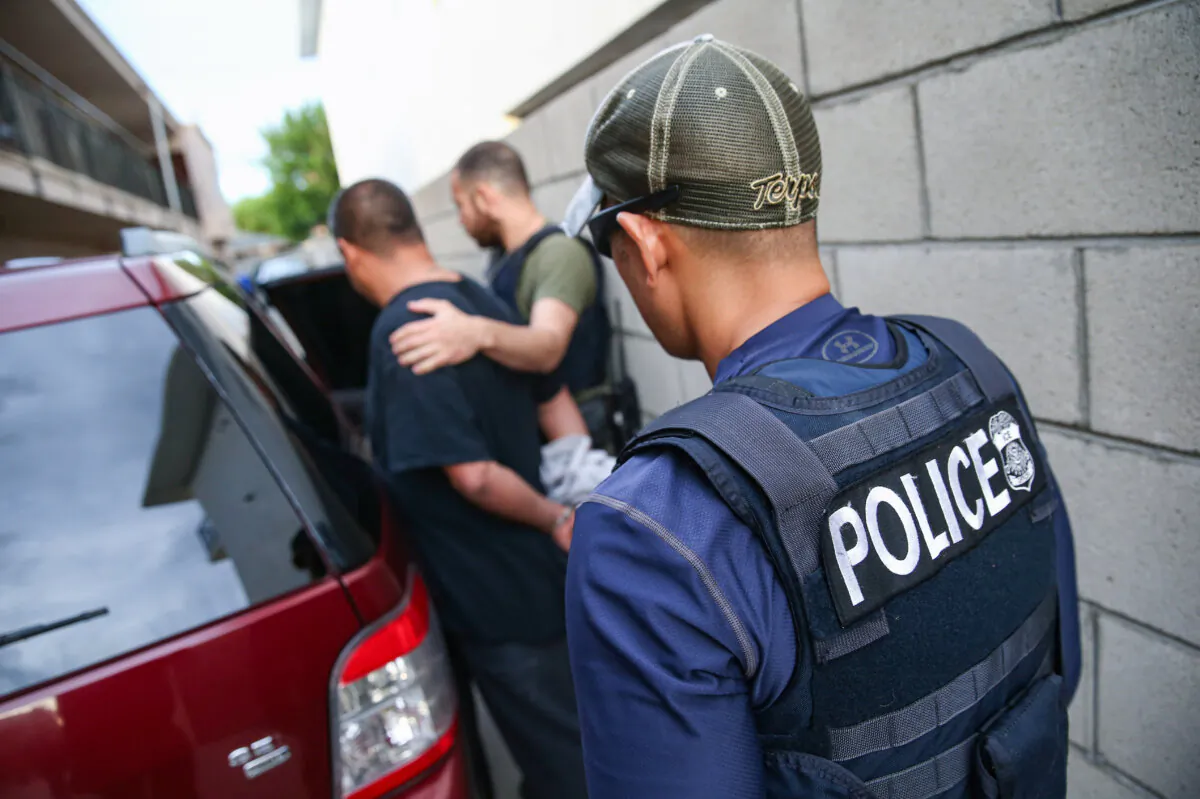

A federal appeals court on Aug. 18 denied a government attempt to remove an injunction that has been blocking immigration officers from arresting illegal immigrants at some houses of worship.
Judges on a U.S. Court of Appeals for the Fourth Circuit panel upheld a 2025 ruling from a federal judge based in Maryland finding that the churches had presented sufficient evidence to show that absent the injunction, the places of worship would experience reduced attendance.
“This decision reaffirms a fundamental promise of religious liberty: every person should be able to gather, worship, pray, and serve their community without fear that immigration enforcement will unlawfully disrupt sacred spaces,” Philadelphia Yearly Meeting of the Religious Society of Friends and other plaintiffs said in a joint statement.
A spokesperson for the Department of Homeland Security, which includes Immigration and Customs Enforcement (ICE), told The Epoch Times in an email that ICE targets criminals, rather than places of worship.
“Criminals are no longer able to hide in places of worship to avoid arrest,” the spokesperson said. “The Trump administration will not tie the hands of our brave law enforcement and instead trusts them to use common sense. If a dangerous illegal alien felon were to flee into a place of worship, there may be a situation where an arrest is made to protect public safety.”
The Trump administration in 2025 rescinded a policy that had labeled churches and schools as sensitive places. The move made it easier for immigration agents to arrest illegal immigrants at those locations.
The churches sued, alleging the development was causing them harm, including attendance declines, due to parishioners’ fear of being targeted.
U.S. District Judge Theodore Chuang sided with the plaintiffs, saying the new policy lacked “any meaningful limitations or safeguards” and likely violated constitutional requirements. He ordered officials not to carry out immigration enforcement at the churches.
Administration lawyers appealed, arguing the plaintiffs had not shown they would likely succeed in the case, meaning the injunction should be removed.
The Fourth Circuit panel unanimously upheld the earlier ruling. “The plaintiffs’ declarations cite concrete instances of decreased attendance and specific statements from congregants indicating that they are likely to stop attending the houses of worship because of the 2025 Policy,” Circuit Judge Barbara Milano Keenan wrote for the panel.
That includes a 66 percent drop in attendance at an English-as-a-second-language class at one of the places of worship.
At this stage in the legal proceedings, that is enough to warrant an injunction, the judge said.
The drops in attendance are also traceable to the updated policy, the panel said.
A different judge in a separate case challenging the administration’s rescinding of the prior policy ruled in favor of the administration and declined to enter a preliminary injunction in 2025. She said that plaintiffs had not shown they faced a credible threat of enforcement. That ruling has been appealed.
 Friends Read Free
Copy
Facebook
Tweet
Friends Read Free
Copy
Facebook
Tweet