
Authorities in northern Arizona are working with federal investigators to identify suspects linked to at least two “professional,” high-tech cargo burglaries believed to be connected to an organized criminal network.
In a May 6 statement, the Yavapai County Sheriff’s Office said investigators determined that the tactics used in both a truck burglary and a railcar burglary “resemble the operations of an illegal criminal alien organization based out of Southern California.”
The first burglary took place on April 14 in Ash Fork, about 50 miles west of Flagstaff, when a semitruck carrying high-value technology cargo from California stopped at a truck stop along Interstate 40.
Investigators said two Sprinter-style vans followed the truck into the parking lot.
“In a highly coordinated move, the suspects waited for the driving team to enter the store before breaching the trailer doors,” the sheriff’s office stated. “In just 11 minutes, the thieves transferred four pallets into the waiting vans.”
Yavapai sheriff’s detectives determined that both vans—a gray one and a white one—were involved in the heist. The driver of the white van was identified as a Hispanic man.
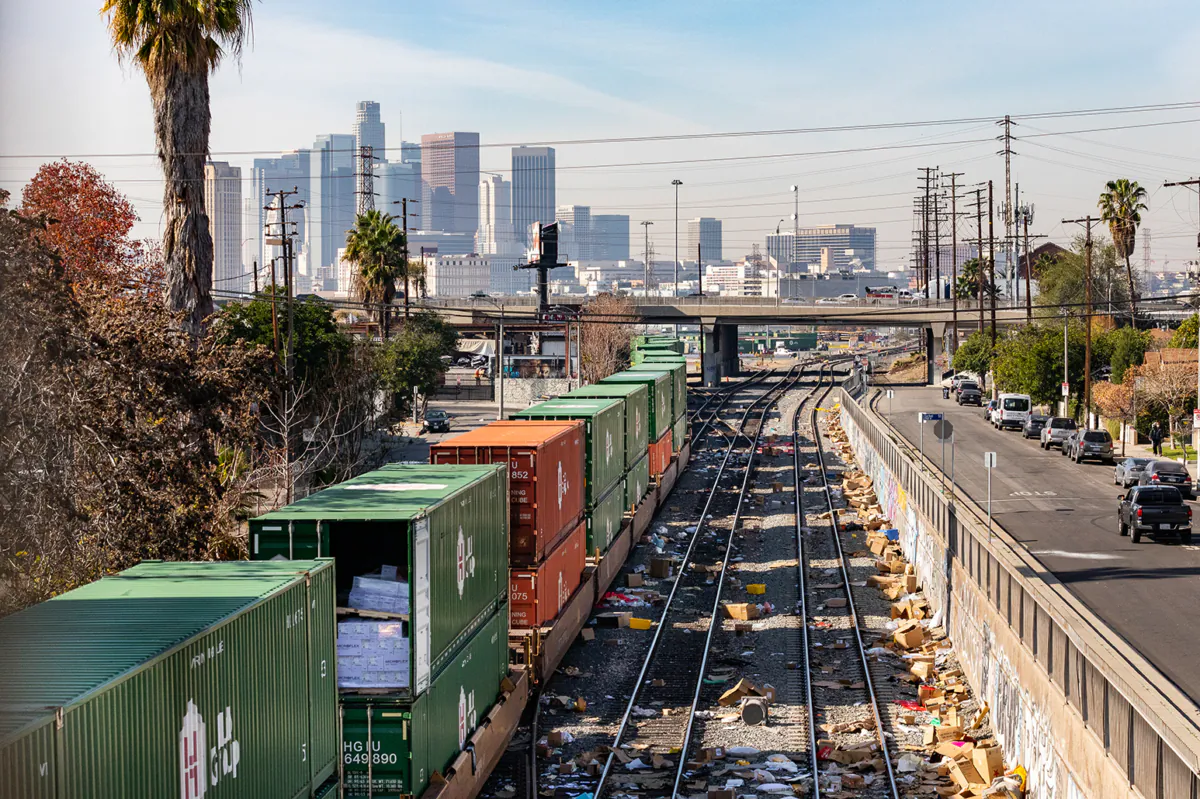
The second heist occurred on the morning of April 20, when authorities were called to a report from BNSF Railway about a burglarized railcar.
Investigators say the incident appeared to be a coordinated and carefully planned attack on the train.
Authorities estimated the value of the stolen merchandise at between $150,000 and $175,000.
“These dangerous and serious crimes continue to hurt the American economy,” the Yavapai County Sheriff’s Office said.
High-Value Crime
Verisk CargoNet, which tracks and works to prevent cargo theft, anticipates that high-value technology goods will remain a primary target in 2026, especially RAM modules, storage drives, and enterprise computing equipment.
CargoNet documented 3,594 supply chain crime incidents across the United States and Canada in 2025, a slight dip from 3,607 in 2024.
However, confirmed cargo thefts climbed significantly, rising by 18 percent to 2,646 cases from 2,243.
In 2025, the company reported that estimated losses rose to nearly $725 million, a 60 percent increase from 2024, as organized criminal groups focus on high-value shipments.
The company’s annual analysis found that the average value per theft rose to $273,990, a 36-percent increase from $202,364 in the previous year.
California remained the hardest-hit state, with 1,218 incidents recorded. However, activity shifted away from Los Angeles County, where the number of incidents declined by 11 percent, according to CargoNet.
Other notable gains were also reported in New Jersey, where the number of incidents increased by 50 percent; Indiana, where there was a 30 percent increase; and Pennsylvania, where there was a 24 percent increase.
On April 26, the FBI issued an alert warning about a surge in sophisticated, cyber-enabled strategic cargo thefts.
These thefts involve tactics used to impersonate legitimate businesses to hijack freight, steal high-value merchandise, and reroute deliveries so the contents can be stolen.
Since 2024, cyber threat actors have gained unauthorized access to the computer systems of brokers and carriers, typically through spoofed emails, fake URLs, and compromised carrier accounts, the FBI stated.
Meanwhile, investigations in Yavapai County remain active and ongoing, and the sheriff’s office is urging the public and trucking community to remain vigilant.
The agency is asking anyone with information about Sprinter-style vans operating without license plates or who may have observed suspicious activity near I-40 truck stops or rail lines to contact local law enforcement immediately.
 Friends Read Free
Copy
Facebook
Tweet
Friends Read Free
Copy
Facebook
Tweet