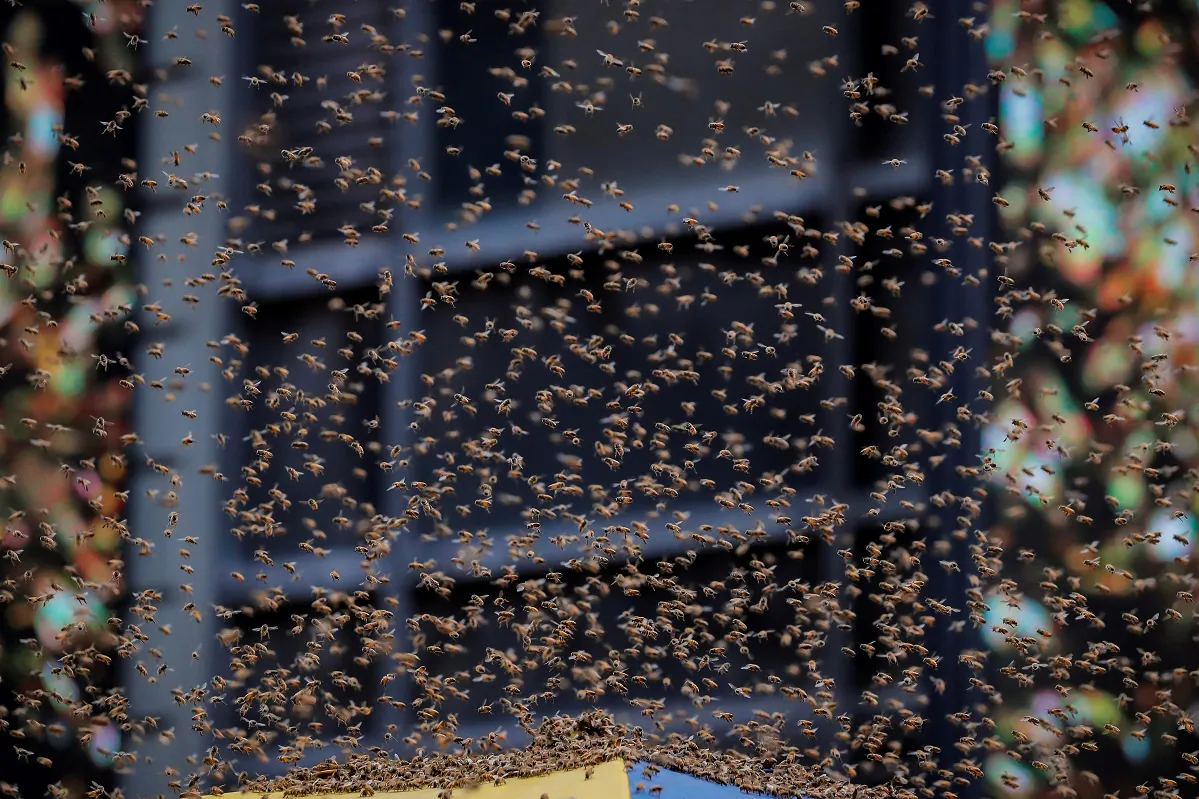

Phoenix fire officials say an Arizona man is in critical condition after being stung more than 100 times while hiking down Lookout Mountain.
On April 4, technical teams from Phoenix and Glendale responded at about 10 a.m. to the 1,670-foot mountain, where they found the man unable to continue his descent.
Firefighters hoisted the man using Firebird 10, a specialized rescue helicopter operated by the Phoenix Fire Department, and transported him to a waiting ambulance, the department said in a Facebook post.
The man, who remains unidentified, was taken to an area hospital in critical condition. Further updates on his status were not immediately available.
The department said the incident underscores the need for caution and safety outdoors during bee season, which runs from spring through summer, with peak activity from March through June.
Among the more common bee species in Arizona are European and Africanized honey bees, a later arrival.
According to the National Park Service (NPS), neither species is native to North America.
It’s unclear which species of bee attacked the Arizona man.
In 1956, honey bees in Brazil were crossbred with a more aggressive African species to boost honey production and improve survival in tropical climates. Several colonies escaped captivity during the experiment and began spreading.
The first U.S. sightings of Africanized honey bees were reported in 1990, and by 1993, their numbers had proliferated in Arizona.
The NPS said that because of their aggressive temperament and strong instinct to protect their hives when disturbed, they are commonly known as “killer bees.”
“In many cases, the attack lasts longer and covers more distance than that of European honey bees,” according to the NPS.
“Many victims of Africanized honey bee attacks have suffered hundreds of stings, and a few have been stung several thousand times.”
On March 28, at least five people were stung by bees during a women’s lacrosse tournament in Tempe, disrupting the game.
Roughly 100 people die each year from bee stings in the United States.
An estimated 2 million people—3 percent of them children—experience allergic reactions, with the most severe cases requiring treatment with epinephrine for anaphylactic shock, according to Boston Children’s Hospital.
The Phoenix Fire Department said it is important not to disturb hives or use scented products outdoors. It also advises wearing light-colored clothing and running away quickly if attacked.
The city of Chandler, Arizona, advises contacting a reputable bee control company for swarm and hive removal and relocation.
Residents should regularly check their homes and yards for bees. Swarms seek cavities in trees, eaves, and walls, which the city recommends sealing with solid covers or fine mesh.
“Bees are also attracted to urban areas; it is common to see bees near picnic tables and trash cans,” the city stated.
 Friends Read Free
Copy
Facebook
Tweet
Friends Read Free
Copy
Facebook
Tweet