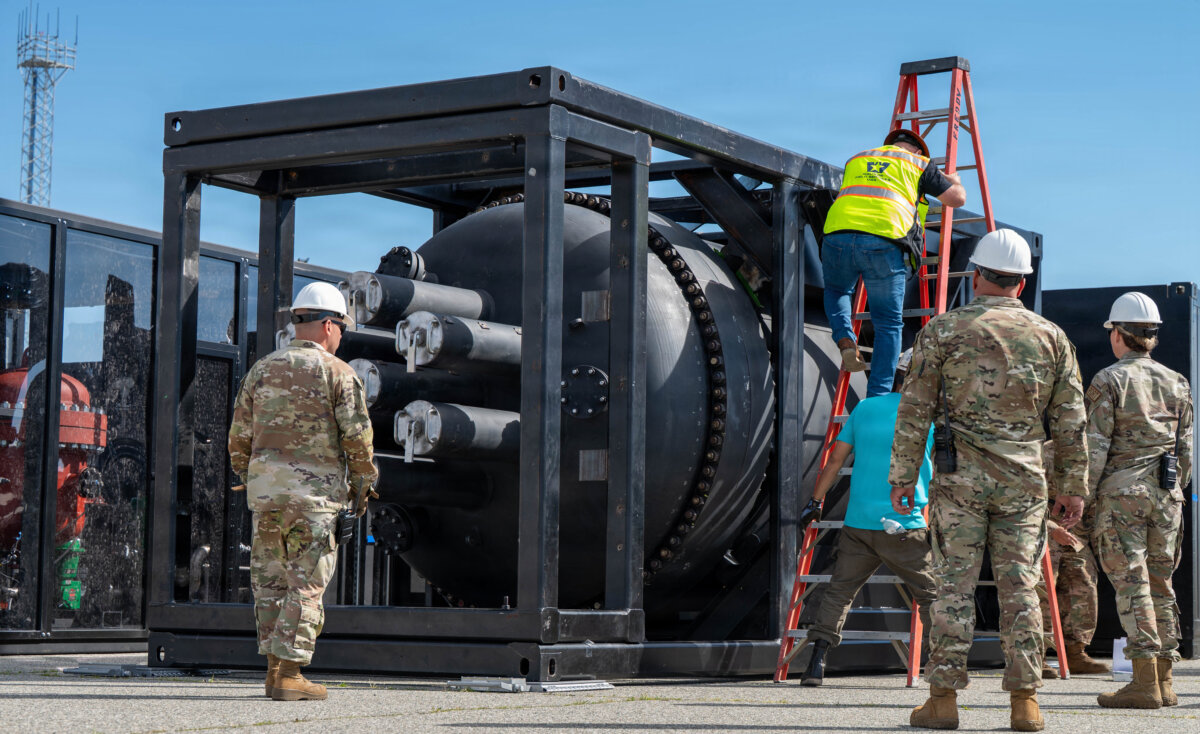

The U.S. Army, on Aug. 26, announced contract awards and site selections for its first five installations to receive nuclear microreactors.
Antares Nuclear, Inc. has been selected to deliver microreactors to Fort Bragg, North Carolina, and BWXT Advanced Technologies, LLC was selected to deliver to Fort Campbell, Kentucky.
General Atomics Electromagnetic Systems was selected to deliver to Fort Hood, Texas; Radiant Industries, Inc. was selected to deliver to Fort Benning, Georgia; and Westinghouse Government Services was selected to deliver to Fort Drum, New York.
The contract awards are part of the Army’s Janus Program. Although these new microreactors will be delivered to installations in the United States, the Janus Program is part of a broader effort to develop more mobile power-supply capabilities to support military operations in remote and austere environments.
These new contract awards are set to provide up to $2.2 billion in combined funding to the selected companies through fiscal year 2031. Total funding will depend on each of the selected companies meeting project milestones.
The Army is expecting the selected companies to deliver more than 20 nuclear reactors in total under these combined contracts.
“Awarding these contracts accelerates our ability to deliver safe, reliable baseload power directly to our installations,” Secretary of the Army Dan Driscoll said.
The Army is seeking delivery of at least one functioning microreactor at one of its installations by the end of fiscal year 2028.
“We are seeking not just reactors capable of turning on for a brief demonstration, but rather systems able to deliver power with high-capacity factors for years of operation,” said Dr. Jeff Waksman, principal deputy assistant secretary of the Army for Installations, Energy and Environment.
Waksman told reporters these initial contracts will cover the construction of these microreactors and the costs associated with running them through their first year, after which the Army would transition to long-term power purchase agreements with the reactor operators.
These nuclear microreactors will be tied in with existing local energy grids, and supplement the local supply rather than fully covering all of the power needs at any of the selected installations, Waksman said.
“The intent is that, if the grid fails, then this will provide resilient power to critical infrastructure on those installations,” Waksman said.
The Army is seeking to keep all components of the microreactor operation highly mobile. In addition to making the reactors road transportable, the Army expects that any nuclear waste can be removed within two years if a reactor is shut down.
Waksman said each of the five selected contract awards varies widely in terms of scope and funding. He did not specify how much funding each of the five companies is initially set to receive.
Antares, Radiant, and Westinghouse were previously selected to provide nuclear microreactors for U.S. Air Force installations.
“Between our contracts to deploy dozens of reactors under Janus for the Army, ANPI for the Air Force, and space nuclear for the Space Force, we now have a contract value on the order of $1B that is growing rapidly,” Antares CEO and co-founder Jordan Bramble told The Epoch Times in an emailed statement.
General Atomics declined to comment further on the value of its contract to support the Janus program.
“Our experience designing and deploying 68 reactors worldwide and supporting reactor technologies throughout their lifecycles positions us to deliver assured energy solutions that enhance operational resilience and strengthen mission readiness,” General Atomics Electromagnetic Systems Scott Forney said in an emailed statement.
BWXT also declined to comment directly on the value of its contract with the Janus program.
In an emailed statement, BWXT president and CEO Rex D. Geveden hailed the new contract with the Janus program and said BWXT’s advanced nuclear reactor technology is “purpose built for mission success, and we are driving forward with the discipline.”
Radiant and Westinghouse did not respond to requests for comment by publication time.
 Friends Read Free
Copy
Facebook
Tweet
Friends Read Free
Copy
Facebook
Tweet