
Several state and university leaders are poised to resist President Donald Trump’s order requiring proof that they don’t discriminate in student admissions, according to public comments submitted before the new regulations take effect next month.
Under the memorandum issued last year, additional information to include acceptance rates, enrollment figures, incomes, average applicant grade point averages, and standardized test or SAT (scholastic aptitude tests) scores by race and gender is due on March 18. The purpose is to show the federal government and the public that higher education institutions are complying with federal Civil Rights laws and the 2023 U.S. Supreme Court ruling that prohibits racial preferences in college and university admissions.
In recent years, many elite schools eliminated SAT requirements and instead mandated personal statements or essays from student applicants, raising concerns that they are attempting to ideologically, or even racially, screen applicants for entry. High school grade inflation was also scrutinized in comparison with consistently low state test scores for reading and math.
Websites for colleges and universities, as well as the National Center for Education Statistics, publish overall acceptance rates and break down enrollment by race and gender. Trump maintains that schools also have more information on accepted and rejected applicants but fail to share it. Under his order, Ensuring Transparency in Higher Education Admissions, those who don’t comply risk losing federal aid.
“Race-based admissions practices are not only unfair, but threaten our national security and well-being,” the president’s Aug. 7 memorandum says. “It is therefore the policy of my administration to ensure institutions of higher education receiving federal financial assistance are transparent in their admissions practices.”
More than 3,000 individuals and organizations submitted public comments on the measure in the fall. Based on documents posted on the Regulations.gov website, individuals who identified themselves as concerned citizens and taxpayers overwhelmingly support Trump’s order.
“Universities that receive our tax dollars have been repeatedly told that using race for admissions is illegal, yet it is unclear whether colleges have gotten the message,” Linda Warner-Smithson of Trabuco Canyon, California, wrote in a Sept. 23, 2025, message to the U.S. Department of Education. “We, the taxpayers, deserve to know that our money is being used to support fair institutions and just processes.”
Blue state leaders, college administrators, and progressive scholarly organizations such as the American Association of University Professors union, the American Council on Education, and the League of Latin American Citizens oppose it, an analysis of the comments indicates.
California Attorney General Rob Bonta’s Dec. 15 letter, co-signed by his colleagues from 16 additional blue states, as well as Wisconsin and Washington, D.C., called the requirement an “unnecessary, burdensome, data-fishing expedition that is unlikely to result in useful data, poses risk to student privacy, and appears designed to discourage institutions of higher education from pursuing lawful efforts to educate all students.”
This reporting requirement followed a series of executive orders aimed at eliminating illegal DEI (diversity, equity, and inclusion) practices in education for hiring, admissions, mandatory trainings, and affinity groups. Several elite universities have already been cited, sanctioned, and fined for violations, or have pushed back against Trump with lawsuits.
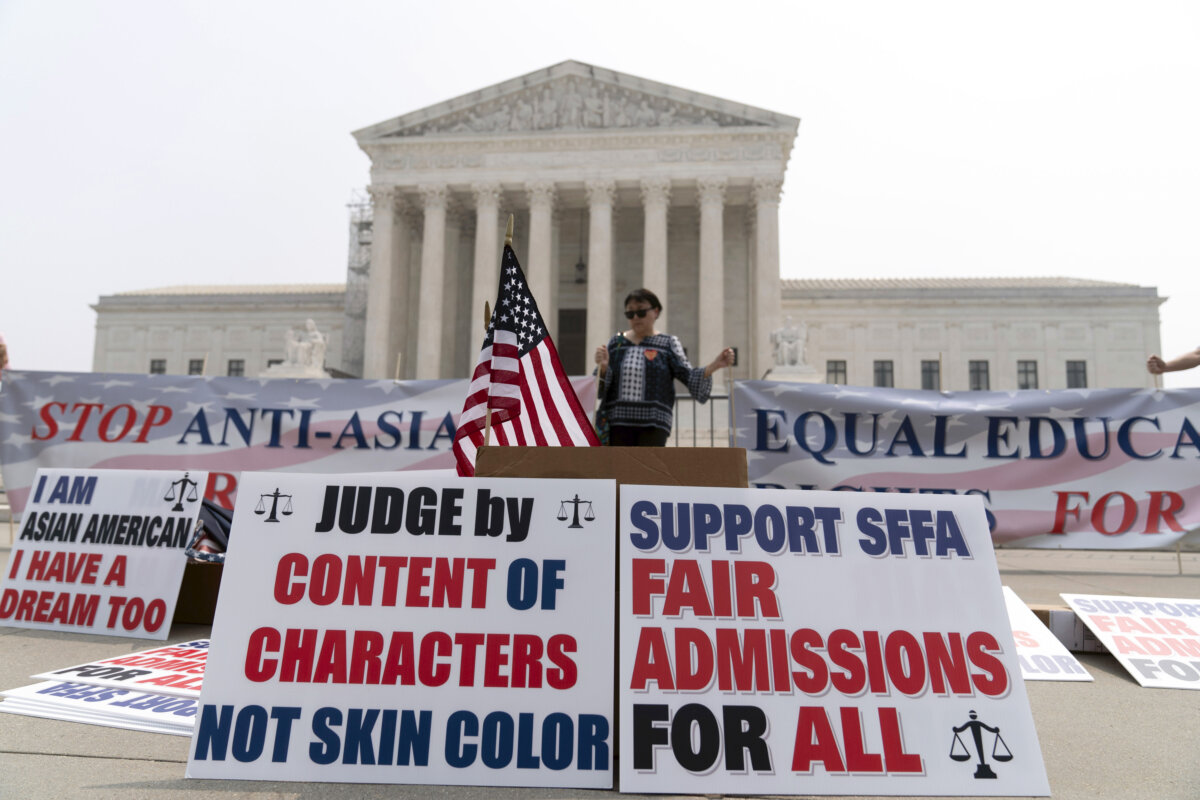
Harvard University was a defendant in the 2023 Supreme Court case that determined the Ivy League institution discriminated against high-achieving students of Asian descent to admit more black and Hispanic students. Harvard was already engaged in legal battles with the federal government before a Feb. 13 lawsuit from the Department of Justice seeking a court order for admissions data showing whether the highly selective university is still engaging in “affirmative action” admissions practices. Harvard officials maintain they’ve responded to the Trump administration’s inquiries in good faith.
Edward Blum, president of Students for Fair Admissions, which won that Supreme Court case and has litigated other colleges and universities for affirmative action practices, said a breakdown of average grade point averages, test scores, and household income by race is a necessary tool for enforcing the law prohibiting affirmative action. Many schools, he added, have used socioeconomic data, such as addresses, as “proxies for race.”
“We’re going to be able to analyze all this data very soon,” Blum told The Epoch Times.
 Friends Read Free
Copy
Facebook
Tweet
Friends Read Free
Copy
Facebook
Tweet