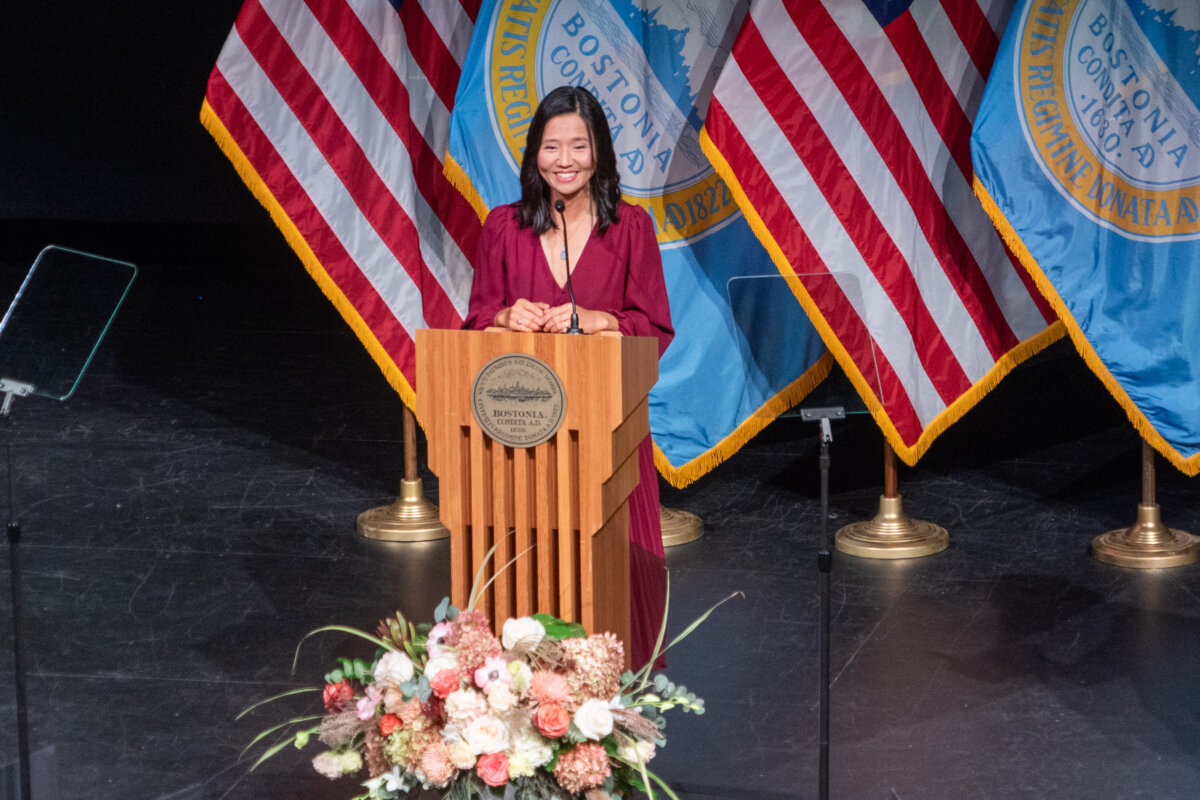

Boston Mayor Michelle Wu delivered her first State of the Schools address in Josiah Quincy Upper School on Oct. 28, reviewing achievements of Boston Public Schools (BPS), and pledging to offer before- and after-school programs to all students in the city.
“We know the day doesn’t end at 3 p.m. for kids or working families—so we’re ensuring students have the opportunity to be challenged before and after the bell rings,” Wu said.
She mentioned that currently, 17 percent of public schools in Boston do not offer before-and-after-school programs. While other schools do provide such programs, some of them do not have enough spots, and many families cannot afford the programs because they do not accept state vouchers.
Wu also promised to simplify the voucher policies. “If you qualify for a voucher, you can use it at the school your child attends,” she said.
Wu announced the launching of Wicked Math, a partnership with multiple organizations to start advanced math clubs, strengthen math pathways, and train 11th and 12th grade students as tutors for younger students.
She said that in the past, schools usually lowered their expectations for struggling students, settling for “easy wins instead of pushing every student to engage with rigorous, grade-level content.”
“When we shelter students from challenge, we stunt growth. When we expect less, they deliver less,” she said.
During her speech, the mayor praised Mary Skipper, the superintendent of Boston Public Schools, for raising expectations for students.
According to the mayor’s office, from 2015 to 2023, Boston ranged from the 5th to 8th percentile in the accountability percentile report published by the Department of Elementary and Secondary Education (DESE) of Massachusetts. That meant only 5 percent to 8 percent of school districts in the state had lower performance than Boston. But in 2024, Boston jumped to the 20th percentile.
Wu also mentioned that the Boston district is encouraging more students to take on college-level material. In 2022, only 179 high school students in the district took early college courses, but the number this year increased to more than 1,200. Also in 2025, Boston public school students took nearly 7,500 AP exams, more than two-thirds of which received a score of three or higher.
However, according to the Massachusetts Comprehensive Assessment System report updated in September, test scores of Boston students have not yet returned to pre-pandemic levels.
Skipper told reporters after the State of the Schools address that the city does see “positive progress” from last year. “The mayor and I are very honed in on driving our academics as high as possible,” she said.
Wu noted that the on-time rate for school buses has improved significantly, reaching 96 percent this year. She also mentioned that 96 percent of school meals are made fresh in-house by BPS kitchen staff, and the level will reach 100 percent after a central kitchen opens next month in Dorchester.
 Friends Read Free
Copy
Facebook
Tweet
Friends Read Free
Copy
Facebook
Tweet