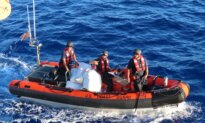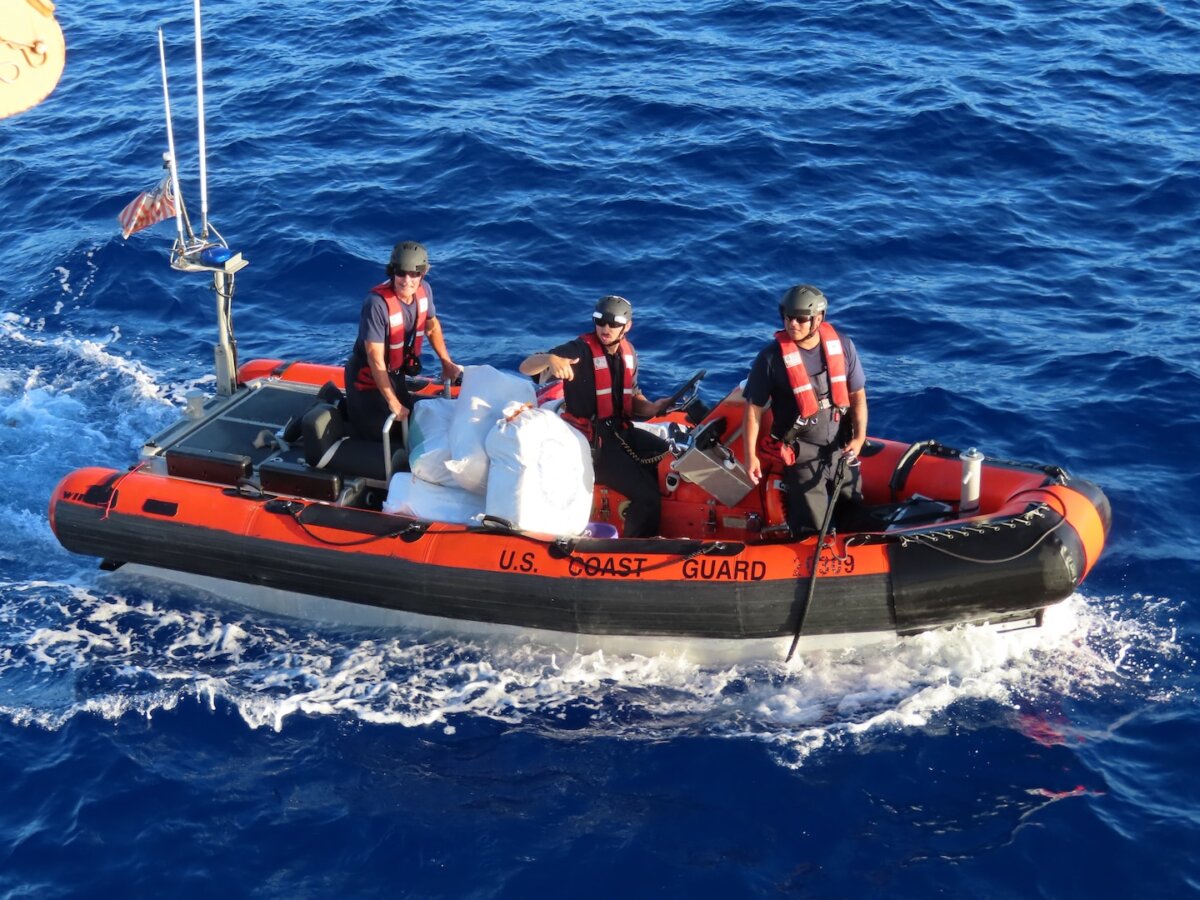

The U.S. Coast Guard (USCG) has offloaded an estimated $57 million worth of drugs that were seized in the Caribbean Sea in two interdictions.
In total, around 2,082 pounds of marijuana and 7,250 pounds of cocaine were confiscated in these operations and offloaded on Monday in Port Everglades, Florida, the Coast Guard said in a Sept. 21 statement. The drugs were seized by crews of USCG Cutters Escanaba and Richard Dixon.
“The excellent watchstanding and quick, crucial decisions enabled success in this interdiction,” Petty Officer 1st Class Douglas Strong, a boatswain’s mate assigned to Escanaba, said in the statement.
“A complete ship-wide evolution must go flawlessly for an interdiction like this to happen. It was a textbook team effort that ensured over 2,000 pounds of illicit narcotics never made it into our communities.”
According to the Coast Guard, its persistent operations have led to billions of dollars in illicit revenue being denied to criminal organizations while blocking narcotics from entering the United States.
Joint Interagency Task Force South (JIATFS) was part of the two recent interdictions. A Florida-based task force, JIATFS is an alliance of 20 international and 13 domestic partners that monitor and facilitate the interception of drug traffickers in air and maritime domains.
JIATFS was recently involved in another counterdrug operation in the Caribbean. The task force, along with enforcement partners from the Netherlands and the Dominican Republic, interdicted one vessel, seizing 24 bales of cocaine and detaining three individuals, the task force said in a Sept. 21 post on X.
The Caribbean was cited as a major drug transportation region in the Trump administration’s 2026 National Drug Control Strategy report released in May.
According to the report, the Caribbean is a “critical transshipment zone for illicit drugs,” specifically for cocaine originating in South America and destined for Europe and the United States.
“The region’s complex geography, comprising thousands of islands and vast maritime expanses, provides ample cover for TCOs to conceal their operations,” the report said, referring to Transnational Criminal Organizations.
“U.S. territories, particularly Puerto Rico and the U.S. Virgin Islands (USVI), are prime targets for traffickers, serving as a staging point from which drugs can be more easily moved to the continental United States.”
Military Strike Criticism
The United States recently faced criticism from the United Nations over its operations against drug traffickers in the Caribbean region.
In a Sept. 15 briefing note, a U.N. special rapporteur said that America’s military response to alleged narco-terrorism in the Caribbean Sea and Pacific Ocean has killed at least 223 individuals between September 2025 and August 2026.
The United States’ military attacks, “contrary to international law, violate the human right to life, and plausibly constitute crimes against humanity,” the rapporteur said. “There is no right to use force in self-defense against the criminal groups listed as terrorist organizations.”
During a press call on Sept. 1, a U.S. official told reporters that foreign terrorist organizations operating in Mexico and the entire Western Hemisphere were responsible for more deaths of Americans than any other adversary the United States has faced in recent memory.
The official was speaking amid the one-year anniversary of Operation Southern Spear, under which the U.S. military has conducted dozens of strikes on cartel-linked vessels in the Western Hemisphere.
According to officials, counternarcotics operations conducted by the U.S. Southern Command have resulted in record reductions in illegal maritime activity over the past year, including a 65 percent drop in the Western Caribbean and a 60 percent decline in the Eastern Caribbean.
Officials have indicated that Operation Southern Spear will be considered a victory when all territories of U.S. partner nations in the Western Hemisphere come under the control of their own governments rather than being controlled by foreign terrorist organizations and cartels.
“Our job is not acting in defense of those countries for their own sake—though they are our partners and we help them—but in defense of the United States; the president made clear we can and will strike wherever we need to,” a U.S. official said.
Timothy Frudd contributed to this report.
 Friends Read Free
Copy
Facebook
Tweet
Friends Read Free
Copy
Facebook
Tweet