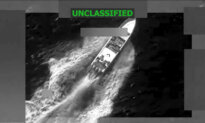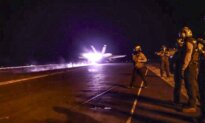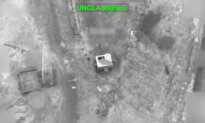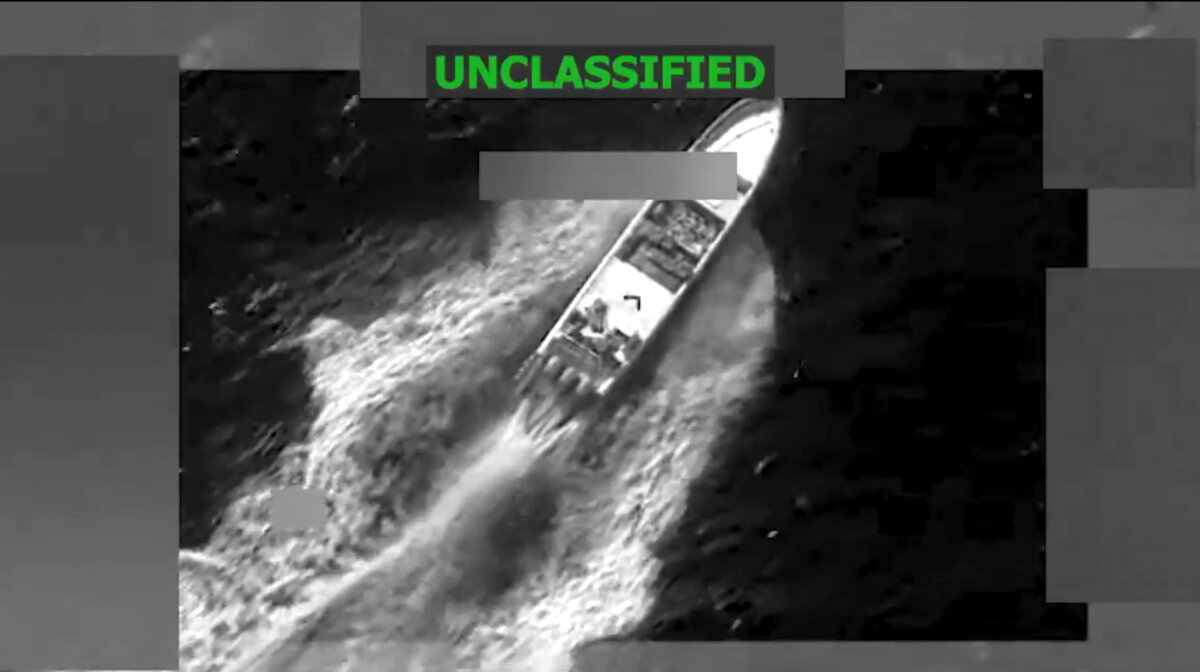

The U.S. military has continued to carry out attacks on suspected drug trafficking vessels in the Western Hemisphere as part of Operation Southern Spear, since first launching strikes on drug boats in September 2025.
The Trump administration has cited the terrorist designation of multiple drug cartels in the Western Hemisphere as justification for the U.S. military’s carrying out lethal strikes on drug traffickers in the Caribbean Sea and the eastern Pacific Ocean.
“The foreign terrorist organizations that operate in Mexico and across the Western Hemisphere are responsible for more American deaths than any other adversary that we have faced in recent memory,” a U.S. official told reporters during a press call on Sept. 1.
Under Operation Southern Spear, the U.S. military has carried out dozens of strikes on vessels in the Western Hemisphere linked to the cartels.
Here are three things to know as the operation hits the one-year mark.
Results of US Military Strikes on Drug Boats
The Trump administration started executing attacks on drug boats in the Caribbean Sea and the eastern Pacific Ocean on Sept. 2, 2025, when a military strike on a Venezuelan drug boat killed 11 members of the Tren de Aragua gang.
A U.S. official told The Epoch Times on Sept. 1 that 70 vessels were destroyed during the first year of the operation.
The vessels included 65 go-fast boats, three low-profile vessels, one semi-submersible, and one refueling station.
The U.S. official also noted that 227 narco terrorists were killed in the attacks.
Over the past year, U.S. Southern Command’s counter-narcotics operations have resulted in record reductions in illegal maritime activity, according to U.S. officials.
These include a 65 percent reduction in the western Caribbean, a 60 percent drop in the eastern Caribbean, and nearly 50 percent in key areas of the eastern Pacific
“Those numbers matter because every disputed route, every denied corridor, and every degraded network makes it harder, makes it more expensive, and more dangerous for narco terrorists to move their poison towards the United States of America,” a U.S. official said.
Officials credited the operation for resulting in the largest reduction of U.S. casualties caused by cartels in American history.
U.S. operations have interdicted 347.9 metric tons of cocaine, and America’s partner nations have disrupted 189 metric tons so far in fiscal year 2026, marking the highest total recorded, a U.S. official told The Epoch Times in an emailed statement.
The operations also resulted in approximately 1,000 metric tons of cocaine being kept off the market in fiscal years 2025 and 2026.
Meanwhile, narco-terrorist organizations were denied $11.5 billion in revenue in fiscal year 2025 and $8.8 billion in fiscal year 2026 as a result of the operations, the official said.
What Victory Looks Like
U.S. officials have indicated that victory in Operation Southern Spear would be achieved when all of the territory belonging to partner nations in the Western Hemisphere is under the control of their own governments instead of under the control of cartels and foreign terrorist organizations.
“Our job is not acting in defense of those countries for their own sake—though they are our partners and we help them—but in defense of the United States; the president made clear we can and will strike wherever we need to,” one U.S. official said.
In response to the military’s operations targeting drug trafficking in the Western Hemisphere, U.S. partners in the Southern Command region have started to take more action against the cartels, according to U.S. officials.
The Americas Counter Cartel Coalition, a U.S.-led multinational security and political alliance, pledged to use “hard power” to crack down on cartel operations earlier this year.
Last month, Secretary of War Pete Hegseth announced that Colombia, Guatemala, and Honduras agreed to allow the United States to launch joint military operations against criminal organizations on land.
Ecuador previously agreed to joint military operations on land, which were carried out for the first time earlier this year.
“Operation Southern Spear has restored deterrence against the narco-terrorist cartels that profit from poisoning Americans and killing our people and your people,” Hegseth told senior military leaders from 34 countries at the Western Hemisphere Chiefs of Defense Conference in February.
“Narco-traffickers know that the true cost of flooding our country with deadly drugs is death for themselves—a real deterrent.”
U.S. officials told reporters that mission accomplishment involved ensuring that foreign terrorist organizations cannot raise armies, control territory, or exert control over commerce in the Western Hemisphere.
Victory would also include ensuring that the cartels and foreign terrorist organizations could not import drugs and violence into the United States, the officials said.
Concerns With Drug Boat Strikes
The Trump administration’s drug boat attacks have been criticized by some U.S. lawmakers over the past year.
House Armed Services Committee Ranking Member Adam Smith (D-Wash.) called Operation Southern Spear an “unauthorized campaign” in a statement on Sept. 2.
He said that the administration and the War Department have demonstrated a lack of transparency regarding the use of lethal force to target alleged drug trafficking operations.
“Congress and the American people have yet to see any evidence to support the president’s unilateral determinations that these vessels, or the activities of those on board, warrant lethal military force rather than law enforcement-led interdiction,” Smith said.
“It remains unclear whether these operations have made any real difference in stopping illegal drugs from reaching the United States.”
Sen. Rand Paul (R-Ky.) has also expressed opposition to the Trump administration’s military strikes on drug boats.
“The Constitution requires Congress to authorize war,” he wrote in a statement on X. “Until then, treat this as law enforcement, not warfare.”
In October 2025, Sens. Tim Kaine (D-Va.) and Adam Schiff (D-Calif.) sponsored a resolution under the War Powers Act of 1973 to prevent President Donald Trump from using military force against suspected drug trafficking boats.
The Senate, however, ultimately voted against the measure in a 48–51 vote.
 Friends Read Free
Copy
Facebook
Tweet
Friends Read Free
Copy
Facebook
Tweet