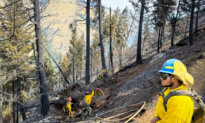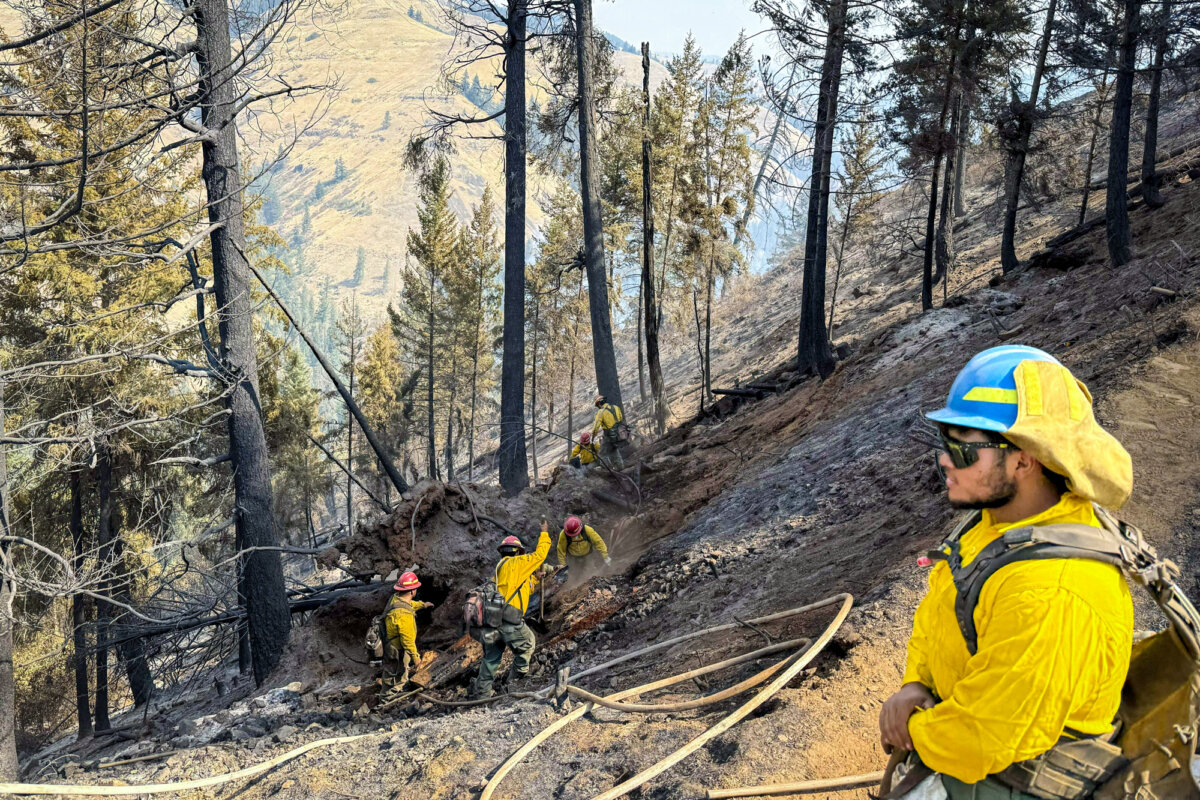
WALLA WALLA, Wash.—On a smoky hillside leading down a creek at the edge of Oregon’s Umatilla National Forest, hundreds of firefighters from across the United States made their stand on Aug. 26 against an almost entirely uncontained wildland fire spanning thousands of acres.
“We got a lot of resources doing a lot of hard work, and we turned the corner on the Paradise fire where we’re at now,” Operations Section Chief Brett Pargman told The Epoch Times.
That corner would go on to mark this fire’s northwestern point, with the Mill Creek running parallel to the north and Forest Service Road 65, also known as Tiger Canyon Road, along the west.
By Aug. 30, the line was secure enough to declare their corner of the fire contained. But it stands as just one scene in this fire season’s ongoing serial drama that has already smashed all the records and stretched international resources to their limit.
They used the creek as their initial containment line and then executed a tactical firing operation that brought fire partially down a steep hillside, eliminating any standing fuel and digging out a line down the road and away from the creek.
What looked like a small hiking trail was cut into the hillside leading down to Tiger Canyon Road, marking the intended physical border of fire activity, with a significant portion of it charred from fighting fire with fire.
“By doing that on our terms,” Pargman said, “we are staying ahead of the fire before it continues to back here.”
To “back” or “back down” refers to when a fire progresses downhill. The creek was flanked by small mountains on both sides. Since heat rises, a downhill fire is slower and lower intensity, but it could still creep its way across the river and then rush back uphill.
And right on that opposite bank sat a water intake facility responsible for feeding nearly 90 percent of the fresh water to the town of Walla Walla, Washington, and its population of more than 35,000.
Pargman said that the majority of the active fire was “up and away from … critical values at risk,” and from the intake facility, only a relatively small pocket of the actual fire was visible farther upstream along Mill Creek, close to the southern bank. Its flames flapped under the close observation of personnel and the constant bombardment of a heavy-duty sprinkler.
But appearances can be deceiving, and a quiet focus appeared to dominate the hazy air as firefighters continued to deliberately scatter across the landscape. The area was not yet truly contained.
“A section of line is declared contained when all lingering hot spots, embers, hazard trees, or other threats to the line have been dug up, extinguished, or fallen safely,” Jim Bartlett, a public information officer assigned to the Paradise fire, told The Epoch Times.
Enter “mop up” work, which was what Jose Ramos and his fire crew out of Salem, Oregon, were found doing high up on the corner of the ridge above the dug-out containment line.
His crewmates dug up and chopped through the remaining branches, trunks, and root systems searching for what Bartlett called “little dragons,” hidden embers and hot spots clinging to life with just enough oxygen, not unlike how an incense stick maintains its smolder.
It is long, labor-intensive work, but a crucial part of the containment process.
“If mop-up is not done properly, they can smolder along the roots, underground, get under your containment line and pop up in fresh fuel on the other side,” Bartlett said.
In the space between the dug-out containment line and the creek, Pargman pointed out individual soot-dusted yellow uniforms working their way through the brush, spraying hoses on plumes of smoke.
Sprinklers were also employed to dampen the area and stave off any slow-moving fires.
The water intake plant on the northern side of the creek sat in an area cleared by masticators under a constant spray of sprinklers. A diesel-powered generator kept it operating as power lines were proactively shut off and lowered.
“All of these drainages come into Mill Creek, which is where they draw their water, and then it comes from here and then down through their water treatment plant,” Bartlett said. “So this footprint was what we call a critical resource.”
Crews marched upriver from there with portable water tanks in search of any hot spots that may have already crossed the creek.
A Sikorsky Skycrane helicopter hovered over the facility and used the creek to fill a large bucket with water intended to be dropped on hot spots discovered in inaccessible areas upstream. Two personnel were on the ground to help guide the pilots in and out.
Bartlett explained that all of the firefighting tactics used follow MIST guidelines, short for minimum impact suppression tactics. As the name suggests, the aim is to inflict the least amount of long-term damage on the surrounding area as possible while continuing to execute effective fire suppression.
By Aug. 30, this corner of the Paradise fire was officially declared contained.
Record-Breaking Burnings
However, the 2026 Paradise fire was still only 15 percent contained at the end of August, affecting nearly 9,500 acres of land in Oregon and Washington state.
The fire is just one in a record-breaking fire season for the Pacific Northwest and the country overall.
Between Jan. 1 and Aug. 31, 52,466 wildfire incidents have burned 8,262,025 acres, according to the National Interagency Fire Center.
More than 21,000 personnel were assigned to fighting wildfires at that time, including more than 240 people from Australia and New Zealand and elements of the Air Force Reserve and National Guard.
For Oregon specifically, more than 1,700 wildfires have consumed more than 2 million acres this year.
Kent Romney, another public information officer assigned to the fire, told The Epoch Times that Oregon broke its state record for the amount of acres burned in an entire fire season at the start of August, which was only the beginning of what locals called the normal fire season.
Some of these fires are naturally occurring, triggered by lightning. They burn in wild lands away from major population centers and are considered beneficial and necessary for the ecosystem. In fact, some species of pine trees rely heavily on forest fires for cones to open and spread their seeds. The Paradise fire was one of those lightning-triggered wildfires, for which the goal of responding fire crews is not necessarily suppression, but rather containment.
This year’s fire season has been exacerbated by lightning storms and extreme drought in most areas of the state, compounded by a meager snowpack and lower water flows in the summer months.
However, many wildfires are man-made. This includes the ongoing Hawk fire on the outskirts of Reno, Nevada, which triggered the immediate evacuation of roughly 90,000 people and consumed more than 15,000 acres and dozens of homes before reaching 98 percent containment.
Assembling the Team
When a fire breaks out, Bartlett said the response generally begins with a 911 call and the most locally available fire station or district assigned to the area. The first responders then assess the situation and determine the additional resources they need to call in.
In the case of a wildfire such as the Paradise fire, that additional help comes from existing partnerships. The agencies involved include the Oregon Department of Forestry, the Department of the Interior’s Wildland Fire Service, and the U.S. Forest Service.
Other task-specific resources will also be called in when necessary, whether it be by government agencies or contractors.
Ultimately, the response takes the form of a quasi-military operation, featuring an incident commander, ground operation leaders, aerial assaults, fortifications, and ground campaigns.
Online databases keep track of fire crews and private contractors across the country that are available for deployment.
Ramos told The Epoch Times that the Paradise fire was the sixth or seventh fire his crew had battled so far this season.
In the past two seasons, he said that he averaged seven to eight fires and that he expects to go well beyond that average as this year’s season continues through September into mid-October.
More than 40 wildfires remain active across Oregon, but more than half of them are 90 percent contained or more.
As I-84 led drivers eastward across northern reaches of the high desert to Idaho on Aug. 27, Oregon’s Blue Mountains seemed to disappear behind a thick curtain of gray smoke.
 Friends Read Free
Copy
Facebook
Tweet
Friends Read Free
Copy
Facebook
Tweet