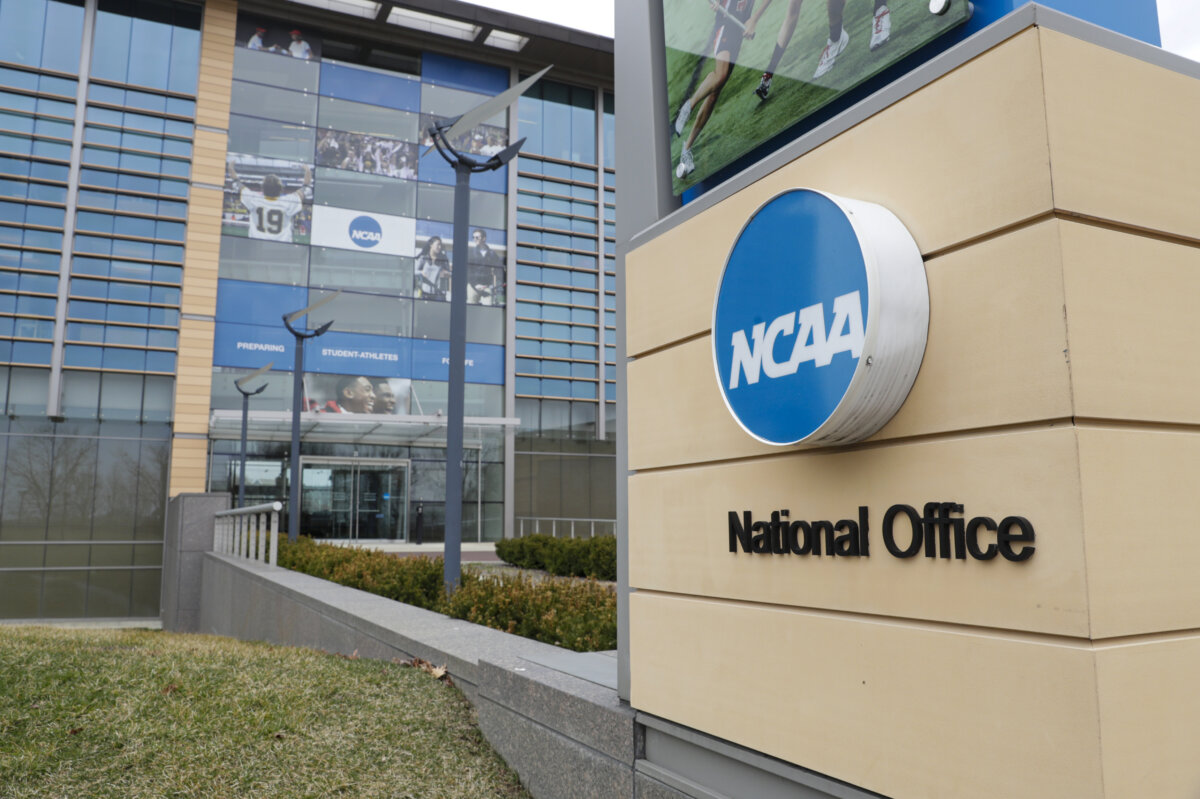

NCAA conference officials on June 12 called on Congress to intervene regarding the issue of Name, Image, and Likeness (NIL) following a court settlement.
The settlement created a salary cap, backpay, and other mechanisms for colleges, universities, and student-athletes.
However, witnesses who appeared before the House Commerce, Manufacturing, and Trade Subcommittee said that Congress should get involved,[series_posts_list][/series_posts_list] especially as there are different state laws governing NIL, and therefore, this creates confusing and unfair circumstances for numerous student-athletes who may not be able to benefit from their own brand.
“The hodgepodge of state laws remains a nightmare for student athletes who are often unsure of what rules apply, where, and to whom,” said Ashley Cozad, a former swimming student athlete at the University of North Florida.
“It is imperative that Congress take action to establish federal guidelines surrounding NIL, so that student athletes are on the same playing field across institutions over state lines as to diminish the confusion and competitive advantages created by conflicting state laws.”
“In the last two years, the NCAA and its member institutions have evolved and adopted warranted enhancements focused on meeting the needs of our student athletes, establishing the core guarantees that I know you all are familiar with,” said Big South Conference Commissioner Sherika Montgomery.
“Despite the positive and impactful change made thus far, there are areas that can only be addressed with the leadership of Congress. Those areas are affirming student athletes are not employees, providing safe harbor from select liability complaints and preempt state law.”
William King, associate commissioner for legal affairs and compliance at the SEC, said that “federal legislation is needed to codify the key elements of the settlement” and that such a law would form “a uniform national standard with meaningful enforcement and preempt state laws that conflict with the federal law.”
A bill being drafted, the SCORE Act, would create an antitrust exemption to college sports. It has not been introduced.
The National College Players Association opposes it.
“The NCPA is advocating that Congress refrain passing any federal legislation that does not mandate the enforcement of safety standards by a third party and other key protections,” said its executive director, Ramogi Huma.
“The SCORE Act does not address these critical issues and is instead modeled heavily after the unjust House vs. NCAA settlement.
“The SCORE Act would exclude college athletes from equal rights under antitrust and labor law. This would prevent unionization which could otherwise help bring forth key safety protections.”
The subcommittee’s chairman, Rep. Gus Bilirakis (R-Fla.), however, said in a statement that the upcoming legislation “will create stability and transparency while empowering student-athletes to benefit from their own NIL without compromising their academic mission or reclassifying them as employees.”
A federal judge on June 6 approved a settlement where NCAA Division I student athletes get a share of up to $20.5 million in revenue accumulated by the schools. That cap could increase annually. The money could be used to pay students, though they are not considered employees of the schools. There is also almost $2.8 billion in backpay to athletes who played between 2016 and 2024.
The settlement in House v. NCAA also allows for new roster limits and allows for anyone to get a scholarship, whereas there was a limit on the number of scholarships that could be handed out per team.
The deal is to “put the NIL genie back in the bottle,” anti-trust sports attorney Mark Levinstein told The Epoch Times.
The settlement is being appealed amid concerns over Title IX, which federally protects women on sports teams for colleges and universities that receive federal funding. There is criticism that most of the revenue sharing would go toward male athletes.
The NCAA has allowed students to profit off NIL since 2021.
Correction: A previous version of this article misspelled anti-trust sports attorney Mark Levinstein’s name. The Epoch Times regrets the error.
 Friends Read Free
Copy
Facebook
Tweet
Friends Read Free
Copy
Facebook
Tweet