OSHKOSH, Wis.—At first blush, the gathering in Room 212 of the Reeve Memorial Union on the University of Wisconsin at Oshkosh campus looks like any student activity. Students sit around tables in deep discussion. Several pizzas and a cooler of soft drinks are laid out buffet-style on a table in the back.
The group of almost 30 students could be a study group, a club meeting, or just friends unwinding after class. But these students are doing more than enjoying pizza and conversation.
They are intentionally discussing the most divisive topics of the day with people they know they disagree with as part of “Bridging the Divide,” a program of the Tommy G. Thompson Center on Public Leadership, a nonpartisan institute in the University of Wisconsin.
Its mission is “research, teaching, outreach, and needed policy reforms regarding effective public leadership that improves the practice of American government.”
According to a Pew Research Center October 2025 survey, 70 percent of Americans believe the U.S. higher education system is headed in the wrong direction.
Considering that the internet is littered with images of college students shutting down free speech on campus, sometimes violently, the meeting in Oshkosh may sound like a recipe for disaster.
Events such as the 2017 student takeover of Evergreen State College in Washington state, and videos of college students celebrating the assassination of conservative pundit Charlie Kirk, have raised concerns that free speech is no longer valued in America’s colleges.
A survey of college students this year by the Foundation for Individual Rights and Expression indicates those concerns may be valid.
Of the students who responded, 34 percent say violence is an acceptable way to silence others, and 72 percent are OK with shouting down speakers they disagree with.
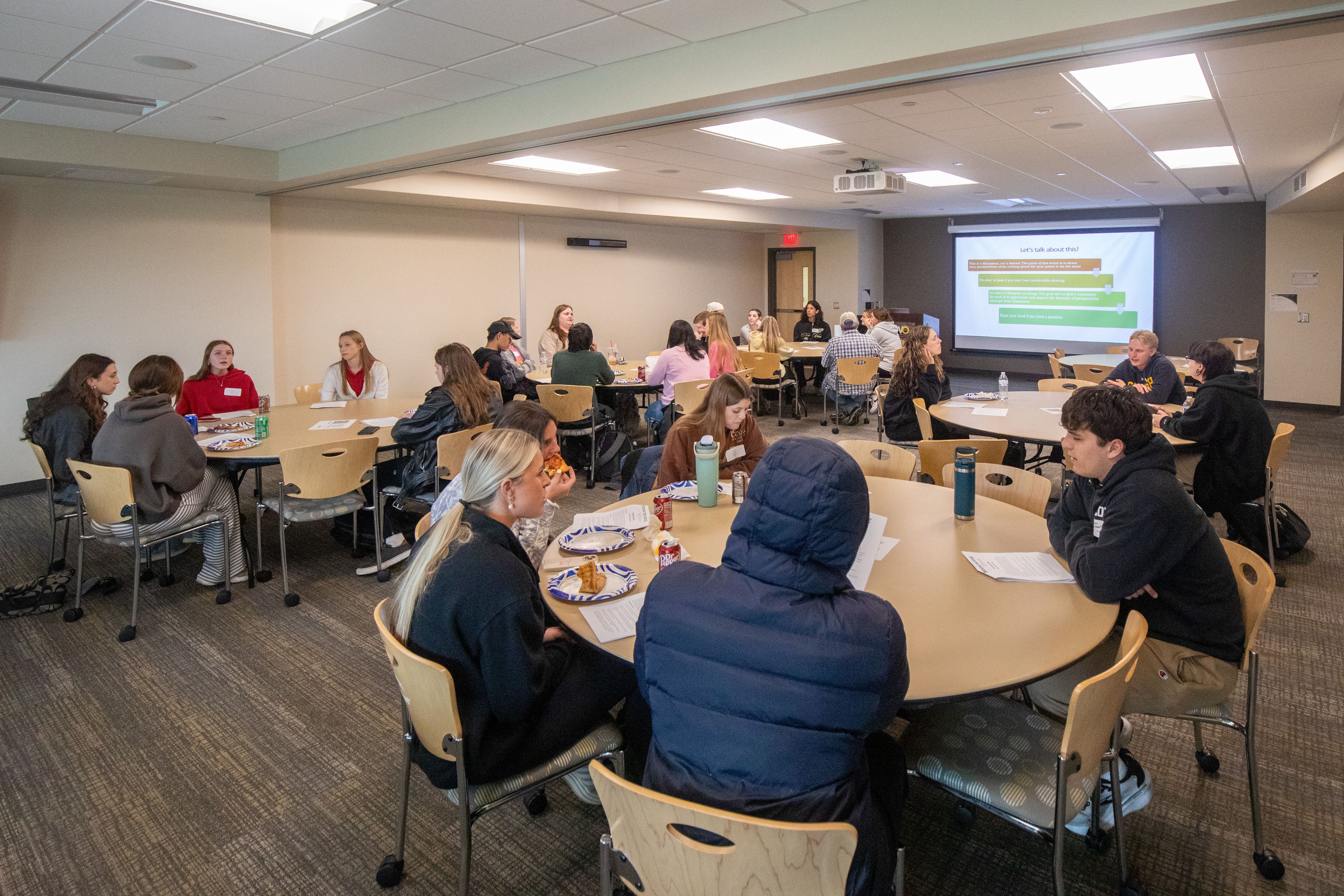 Students participate in the Bridging the Divide event at the University of Wisconsin, Oshkosh, on April 30, 2026. (Daniel Kramer for The Epoch Times)
The survey also showed that 24 percent of students self-censor when speaking in class, and 28 percent do so when speaking on campus. Twenty-seven percent said they don’t trust college administration to defend their First Amendment rights.
Cultural Identity
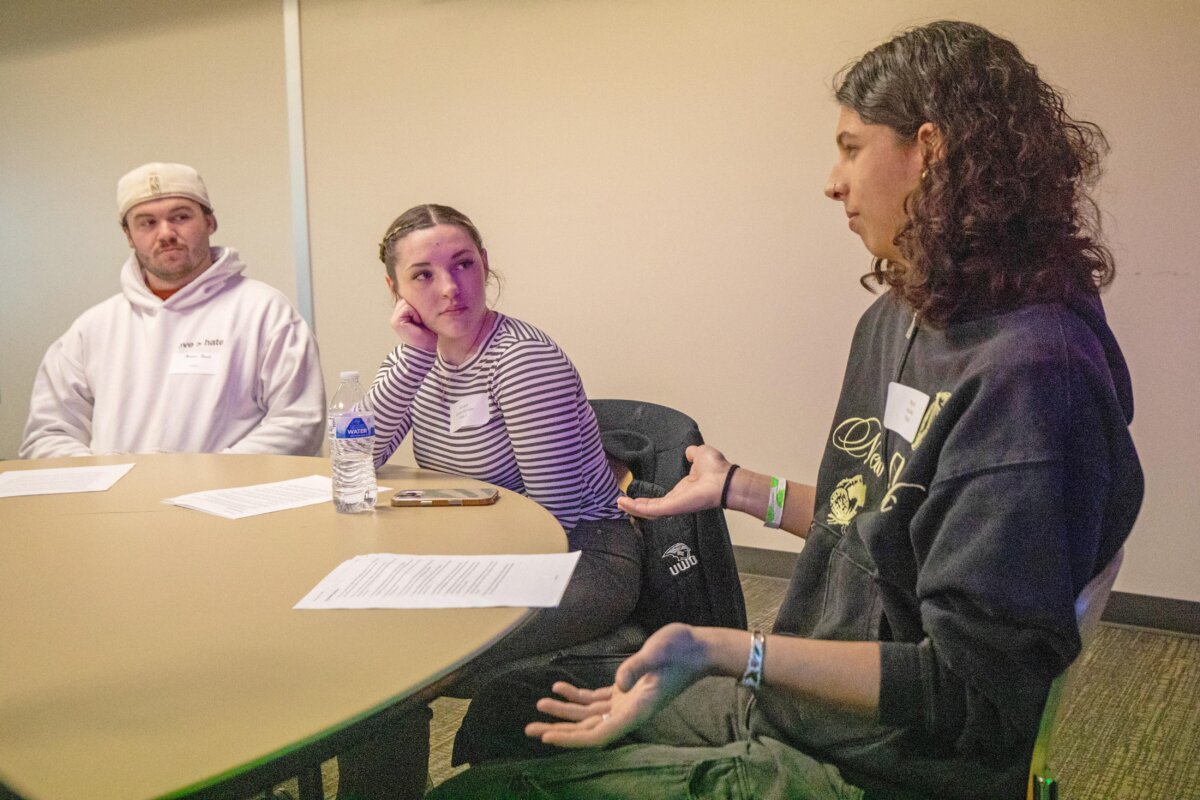
Back in Oshkosh, Nevaeh Serrano, a sociology student and descendant of immigrants, is tackling the topic of immigration and refugee assistance with people at her table. Specifically, they are discussing how migration impacts cultural identity.
Serrano said there are aspects of immigration that those born in the United States may not be familiar with. She told the group that children of immigrants often feel suspended between two cultures.
She pointed out that many people in the host country are often concerned that introducing immigrant culture will dilute local culture. On the other hand, she said her great grandparents never learned to speak English and were concerned that by assimilating, Serrano would lose touch with her family’s culture.
“It’s weird because you have this dichotomy, because it’s like at home you are your ethnicity, but in public you’re assimilated trying as hard as you can to fit in,” Serrano said.
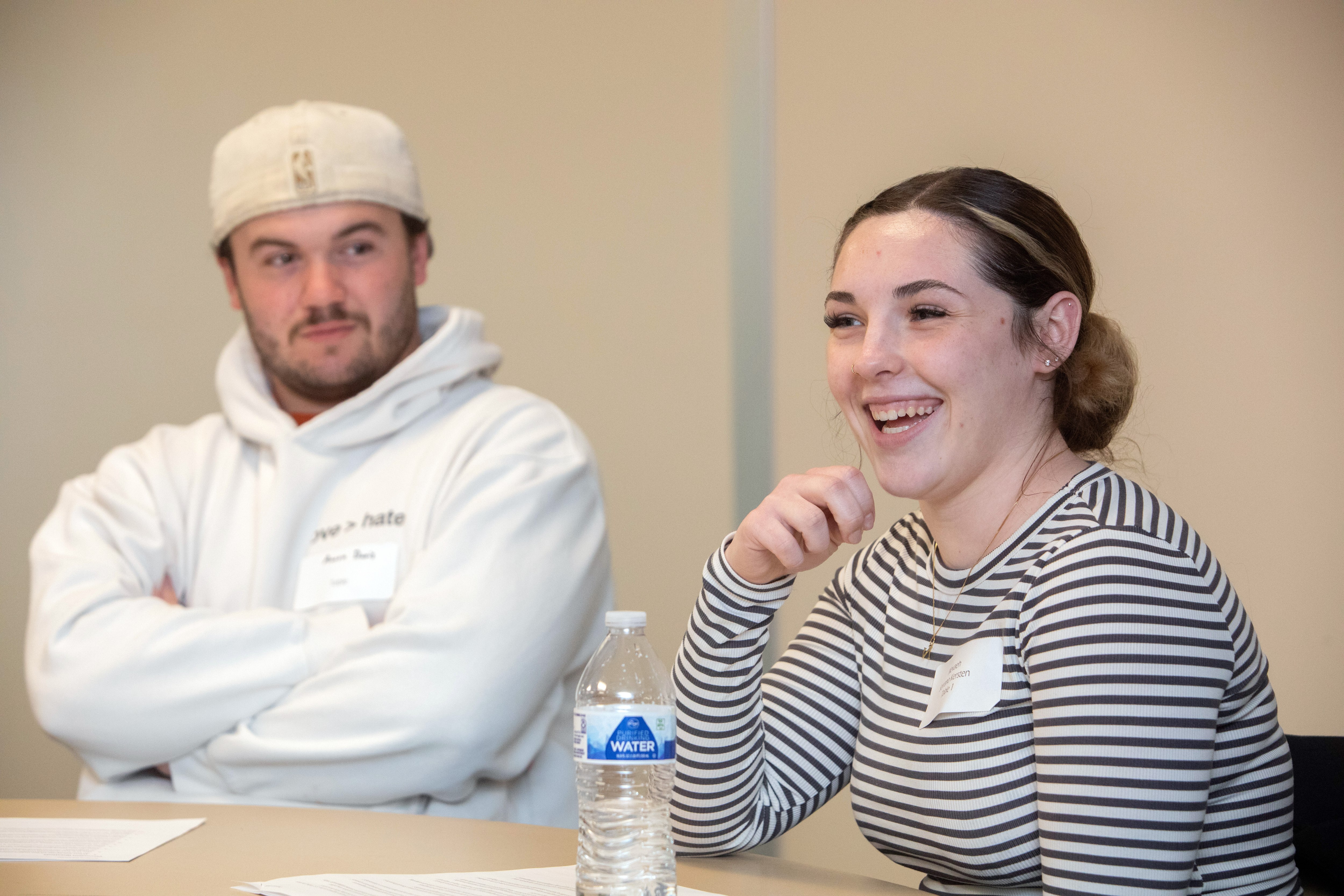 Nevaeh Serrano laughs during the Bridging the Divide event at the University of Wisconsin, Oshkosh, on April 30, 2026. (Daniel Kramer for The Epoch Times)
She asked the others at the table if they thought cultures could bleed over into one another enough to actually change one or both of them.
One young man in a hoodie and baseball camp said it’s certain that cultures may clash. He said it’s incumbent on each individual to be mindful of how they affect those around them.
“There may be things that are normal to them that to us would [be] completely taboo. There’s probably some things that we do that if we went somewhere, it would be the same exact way,” he said. “I think the big part of it is just being respectful.”
Finding Common Ground
Organizers of Bridging the Divide say their object is to defuse future conflict by teaching students the skills necessary for civil discourse. As she opened the meeting in Oshkosh, campus leader Abby Slief-Vogt told the group they were not there to win a debate.
“It’s about finding common ground,” she said.
Participants in Bridging the Divide complete a survey to determine their positions on social and political issues. Their answers are entered into a computer algorithm which assigns them to a table with people who have differing opinions.
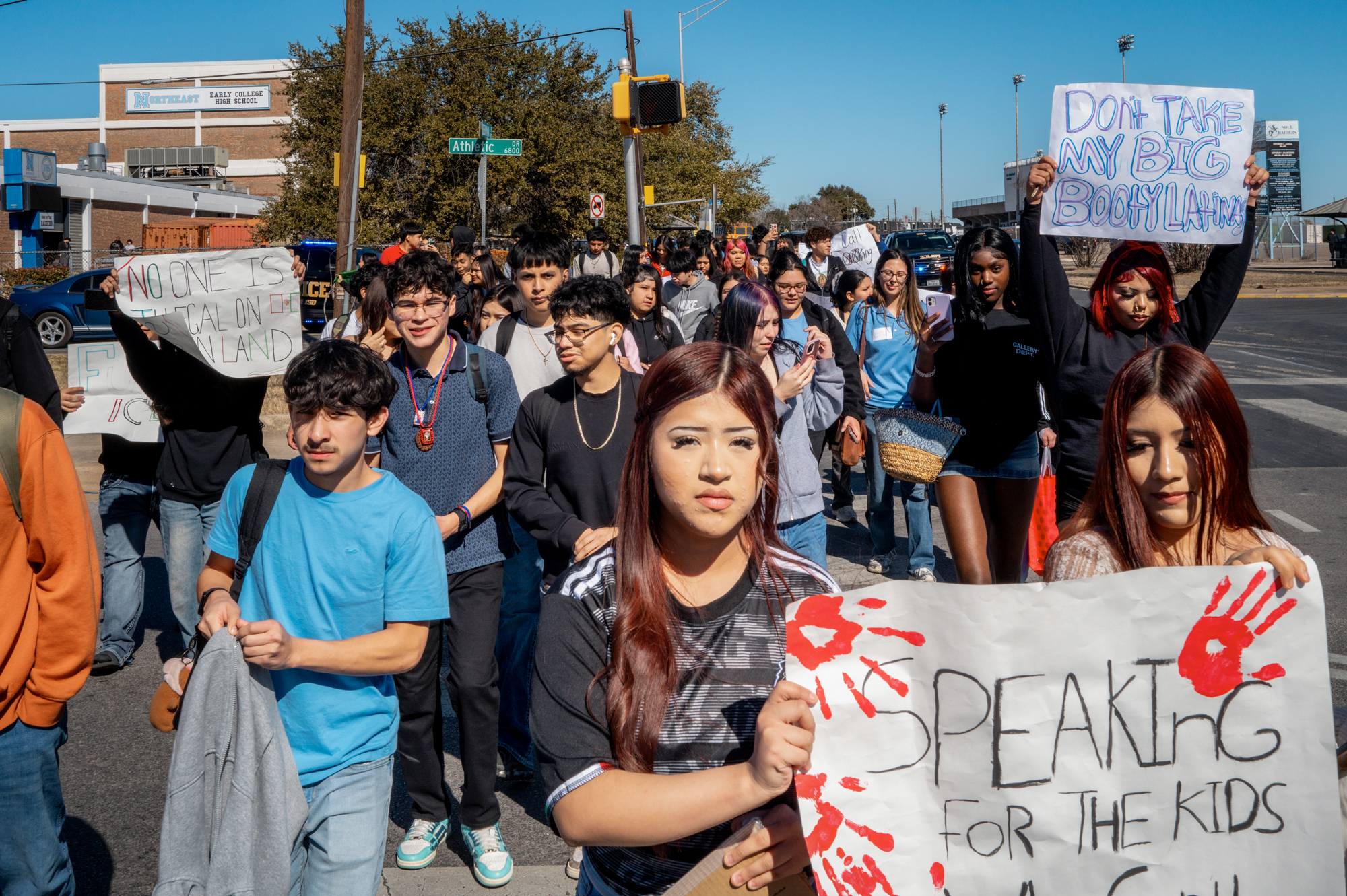 High school students protest Immigration and Customs Enforcement in Austin, Texas, on Feb. 6, 2026. (Brandon Bell/Getty Images)
Each group is provided a list of topics to discuss within certain parameters. Those include limiting discussion to the topics listed, refraining from personal attacks, and ensuring that everyone is allowed to speak without interruption.
Vogt first participated in Bridging the Divide two years ago and became a student leader in spring 2025. She’s always been interested in social justice and talking with people with different opinions. But sometimes those talks became tense and emotional. Bridging the Divide was an epiphany for Vogt.
“It’s not about a debate and one person winning. It’s about learning about other perspectives,” Vogt told The Epoch Times. “So it’s really emphasized to be respectful.”
Free Speech
A quick study of the history of free speech on American college campuses shows that things may be coming full circle. Many colleges had strict policies limiting public speech as recently as the early 1960s.
In 1964, the issue boiled over at the University of California at Berkley and began what is commonly called the Free Speech Movement.
That year students rebelled against the school’s prohibitions against political activity, social activism, and fundraising. These and similar policies—often implemented to prevent the spread of communism and subversive ideologies—had been enforced at various colleges since the mid-1930s.
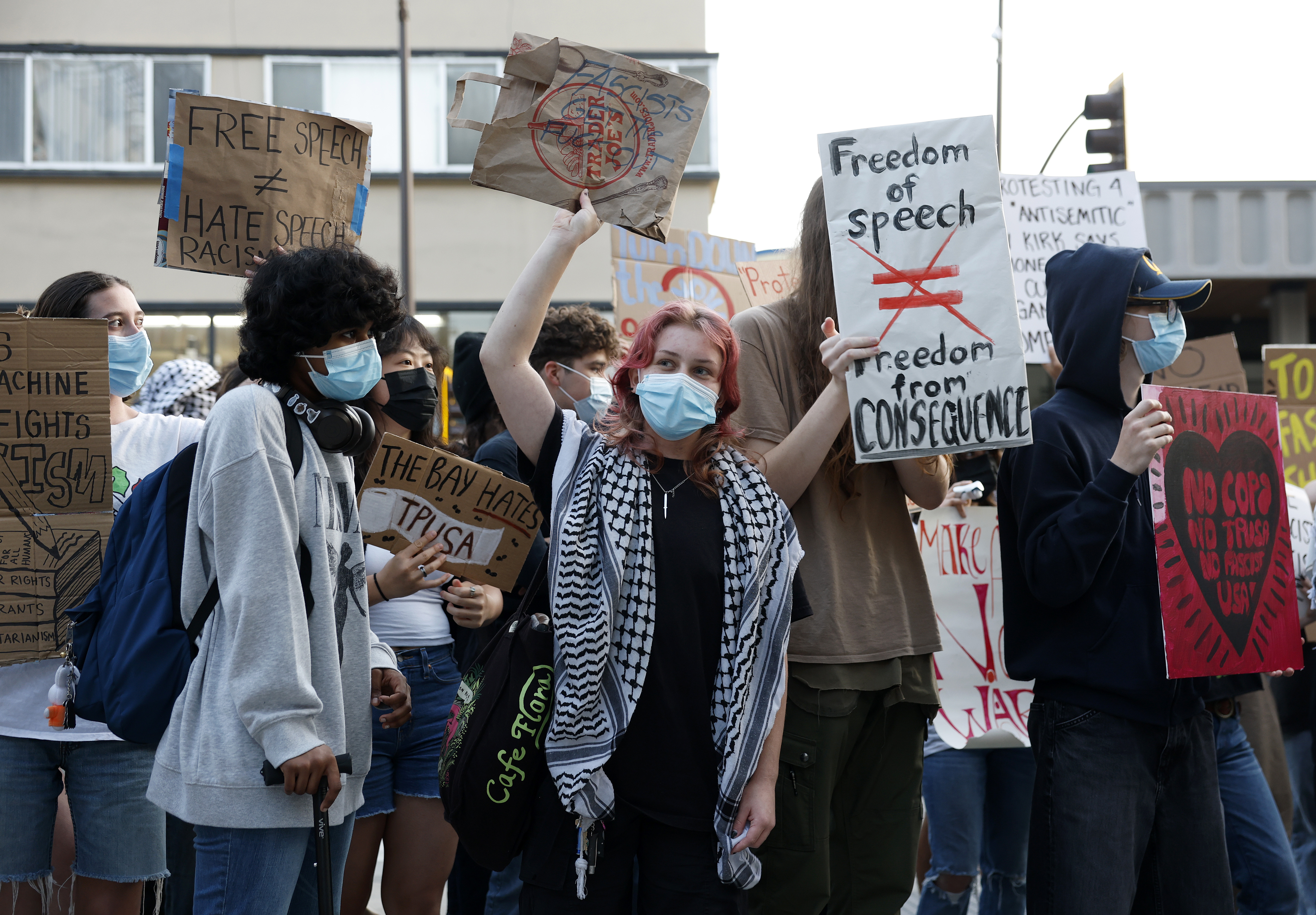 Protesters demonstrate outside a Turning Point USA event at the University of California, Berkeley, on Nov. 10, 2025, two months after Turning Point USA founder Charlie Kirk was fatally shot. (Justin Sullivan/Getty Images)
On Sept. 14, 1964, UC Berkley students began a series of protests, sit-ins, and negotiations with administrators that ran into January 1965. Eventually, the bans were lifted, and certain areas were designated free speech zones.
One expert promoting free speech on college campuses said technology may be taking institutions of higher learning back to the times when speech was regulated on campus.
Renewing Robust Discourse
Mary Kate Cary is an adjunct professor at the University of Virginia, where she oversees “Think Again UVA,” a program similar to Bridging the Divide. It is based on four pillars: free expression, viewpoint diversity, critical thinking, and intellectual humility.
Cary says social media fosters isolation and bias confirmation that she believes underlies much of the animosity on campus. She points to her college’s dining hall as evidence of the change.
In the past, she said, the average college dining hall was a noisy, even boisterous place, where students passionately debated the issues of the day.
Cary believes those discussions rarely got violent because of the humanizing effect of sharing a meal and looking a person in the eye. Today, people put in their earbuds and focus on a laptop or phone almost oblivious to the people around them as social media personalities demonize those with whom they disagree.
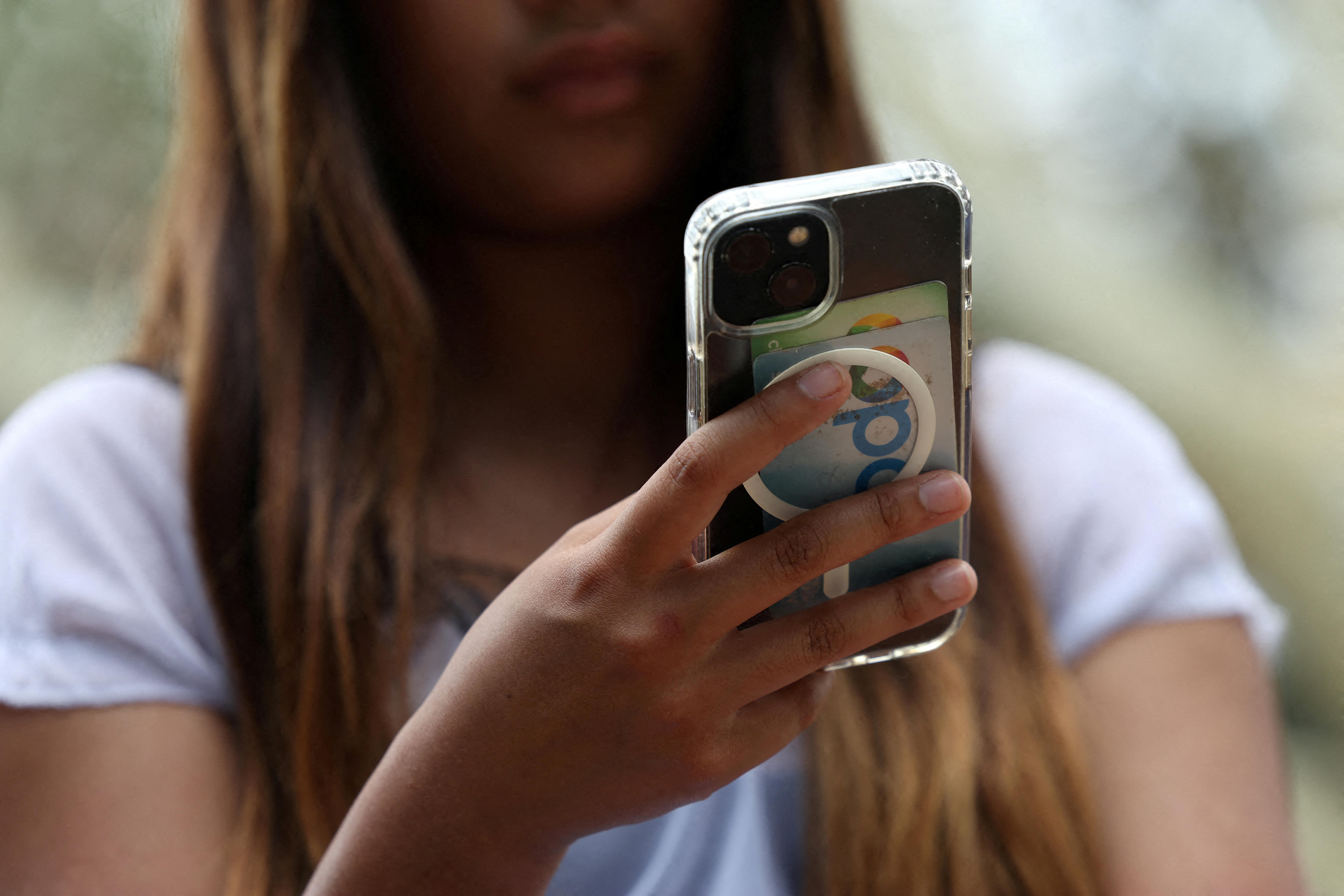 A teenager in Sydney, Australia, holds her phone as a national law banning social media for users under 16 takes effect on Dec. 10, 2025. (Hollie Adams/Reuters)
“I think social media has a lot to do with it. … We see it a lot in the dining halls, the dining halls are very quiet because they have headphones on. … I remember getting into all kinds of fun conversations in dining halls at college,” Cary told The Epoch Times.
Like Bridging the Divide, Think Again UVA was started to bring back those dining hall conversations. Cary said that at first, she thought Think Again UVA was unique. But at a gathering to commemorate the Free Speech Movement, she found that several colleges had started similar programs.
Cary founded the Campus Discourse Project (CDP), which enables the various groups to work together, share ideas and solve problems they run into.
“We started Campus Discourse Project and started figuring out what’s going on in all 50 states. How do we connect everybody and spread the word on what’s working well, and get people to grow this,” Cary said.
Hallie Haim moved to Wisconsin in 2024. The California native’s West Coast political and social opinions don’t always mesh with those of her Midwest classmates, but Haim said she relishes vigorous debate.
Still, she was a little concerned about how things might go when emotions are inflamed. Haim, who attends the University of Wisconsin, Madison, says Bridging the Divide enables her to express her views in a civil, academic atmosphere.
“You’re talking about ideas, not attacking the people behind them. And just laying down the foundations of respect, so that there can be productive conversations,” Haim told The Epoch Times.
Students who participated in the Oshkosh meeting said they enjoyed getting to know their classmates and hearing ideas rather than arguing over personalities.
Brandon Cobb is a senior majoring in supply chain management. He said the Bridging the Divide event was not what he expected.
Cobb said he had been to previous free speech events sponsored by other groups. In those cases, the discussions devolved into arguments. At one event, a faculty member publicly chastised members of Turning Point USA.
“[Bridging the Divide] was a lot less divisive than I expected. The conversations were pretty nice, there wasn’t really like, any arguing,” Cobb told The Epoch Times.
Correction: A previous version of this article misspelled Hallie Haim’s first name. The Epoch Times regrets the error.
 Friends Read Free
Copy
Facebook
Tweet
Friends Read Free
Copy
Facebook
Tweet