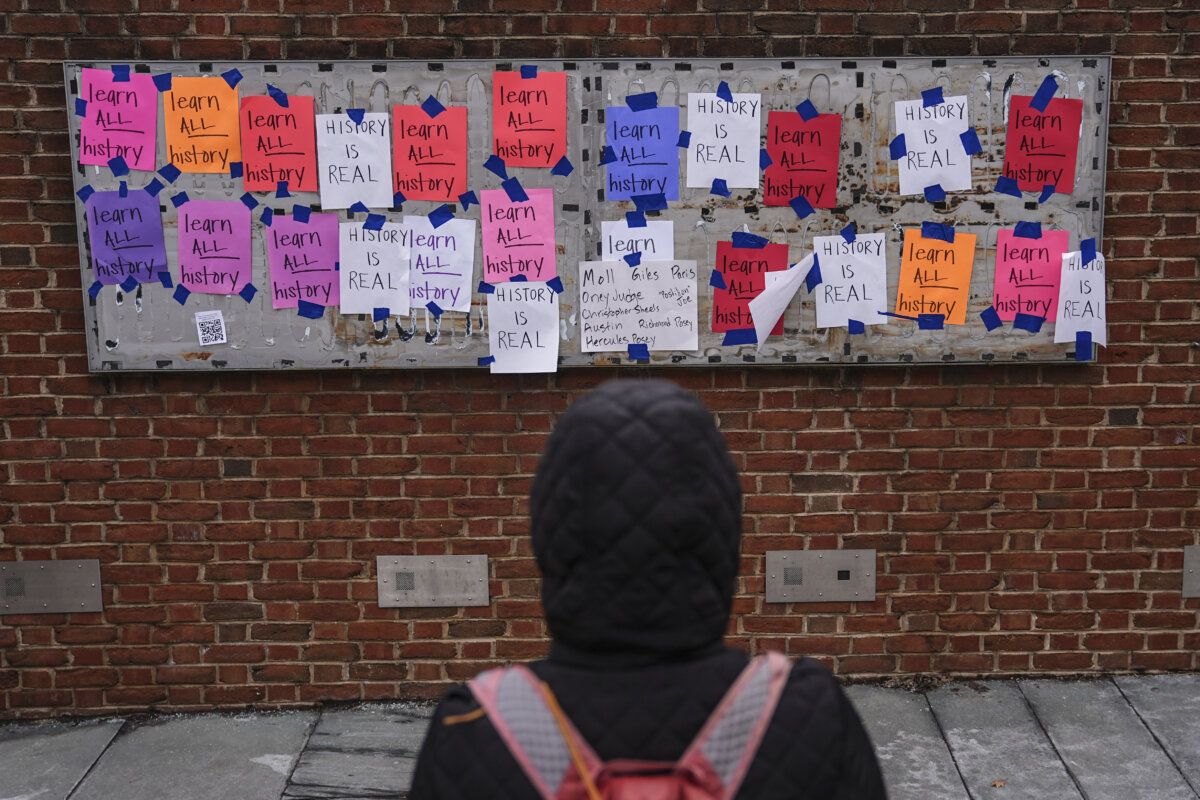

A federal appeals court has allowed the Trump administration to continue revising dozens of national park exhibits on slavery, climate action, and other subjects while it appeals an order requiring their restoration.
On July 2, a three-judge panel of the Boston-based 1st U.S. Circuit Court of Appeals put on hold a judge’s order requiring the National Park Service to reinstall exhibits that it removed under President Donald Trump’s directive on displays that “inappropriately disparage Americans past or living.”
U.S. District Judge Angel Kelley last month concluded that the displays were removed from the nation’s parks as part of the administration’s unlawful effort to “rewrite the nation’s history with a white-out pen.”
A panel of the 1st Circuit, composed solely of judges appointed by Democratic presidents, agreed to put Kelley’s ruling on hold while the administration appeals it.
The White House’s stated case is that some federal exhibits present those subjects through a politically loaded framework that disparages the United States, its founders, or Western civilization.
Trump’s March 27, 2025, executive order said federal museums and parks had adopted a “distorted narrative driven by ideology rather than truth.”
It said that there is a “revisionist movement” that “seeks to undermine the remarkable achievements of the United States by casting its founding principles and historical milestones in a negative light.”
On exhibits related to climate action, the White House does not name a particular approach, but it says signs and displays relating to natural features should focus on the landscape’s “beauty, abundance, and grandeur.”
The order said that “under this historical revision, our Nation’s unparalleled legacy of advancing liberty, individual rights, and human happiness is reconstructed as inherently racist, sexist, oppressive, or otherwise irredeemably flawed.”
“Rather than fostering unity and a deeper understanding of our shared past, the widespread effort to rewrite history deepens societal divides and fosters a sense of national shame, disregarding the progress America has made and the ideals that continue to inspire millions around the globe,” it added.
At least 51 exhibits from 37 sites have been removed or discarded from parks nationwide to comply with Interior Secretary Doug Burgum’s implementation of the executive order.
Democracy Forward, a progressive legal advocacy group that has brought numerous lawsuits challenging Trump administration policies, is representing the organizations contesting the removal of the park exhibits.
Democracy Forward characterizes the Trump administration’s actions as the “censorship and erasure of American history and science at national parks.”
One of the groups, the National Parks Conservation Association, listed some of the sites that had signs removed in February.
These included an exhibit about George Washington’s ownership of enslaved people at Independence National Historical Park in Philadelphia and climate action signs at Cadillac Mountain and Great Meadow in Acadia National Park.
Fort Sumter, the site of the start of the Civil War, also had climate action signs. Signs providing information about women and race from the Muir Woods National Monument have been removed.
Brooke Menschel, a lawyer for the plaintiffs at Democracy Forward, called the recent ruling a disappointing but “temporary procedural setback,” as the court did not decide the question of whether the administration’s actions were lawful.
“Unfortunately, for now, the decision allows the administration to continue removing and altering interpretive materials that are critical for millions of visitors to understand our nation’s history,” Menschel said.
A spokesperson for the Department of the Interior, which oversees the National Park Service, said in a statement that it has “encouraged Americans to visit our cultural and historic sites and engage in meaningful conversations about the moments that have shaped our country.”
Reuters contributed to this report.
 Friends Read Free
Copy
Facebook
Tweet
Friends Read Free
Copy
Facebook
Tweet