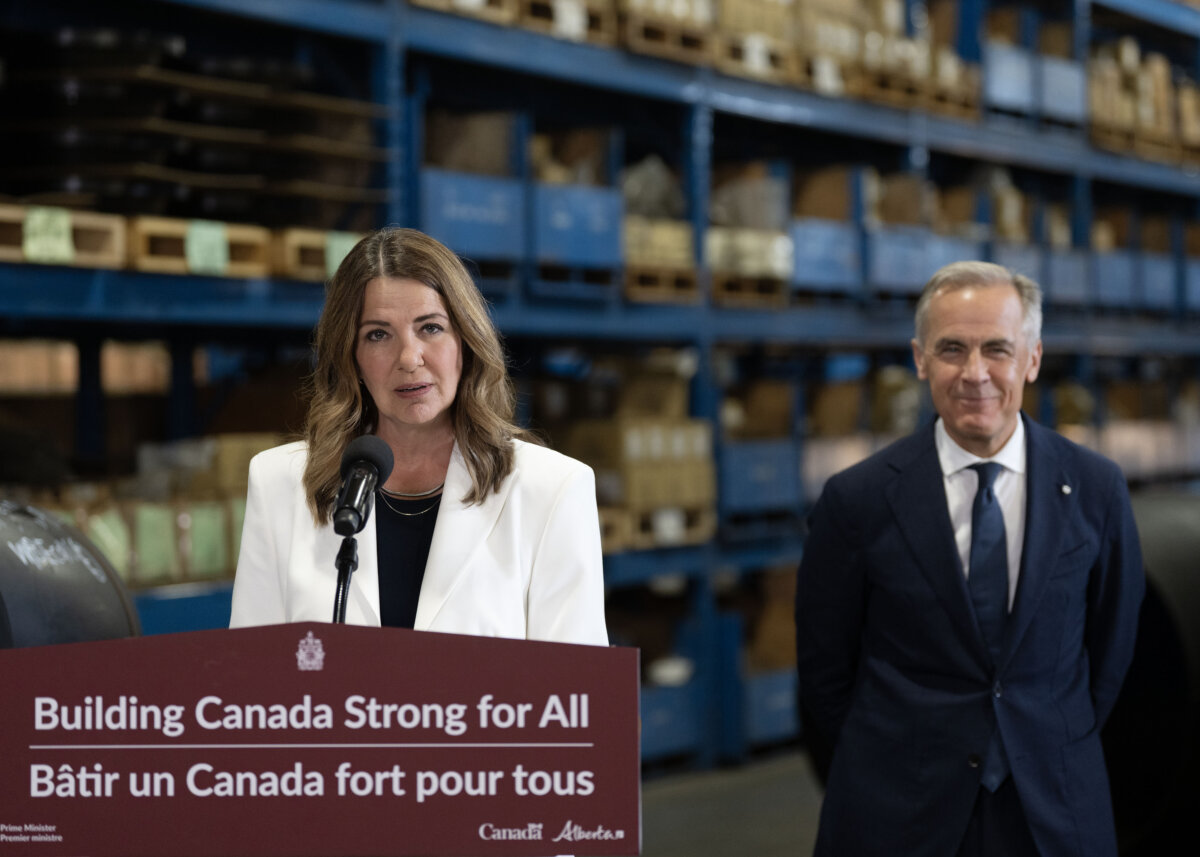

Alberta Premier Danielle Smith and Prime Minister Mark Carney announced an agreement on July 2 that they say will advance a proposed new oil pipeline from Alberta to the southern coast of B.C. and pair it with a carbon capture system.
Alberta had originally pushed for Ottawa to remove a tanker ban off the northern coast of B.C. brought in by the Trudeau government to enable shipment from that region, a move opposed by B.C. Premier David Eby. Earlier in the day, Carney announced that the tanker ban will remain in place.
The proposed pipeline route would largely follow the existing Trans Mountain pipeline route, which runs from the Edmonton area to Burnaby, B.C.
The pipeline, dubbed West Coast oil pipeline, would start from a receipt terminal in Bruderheim, Alta., northeast of Edmonton, where crude oil would be gathered, assessed, and stored before being carried in the new pipeline.
The government of Alberta is partnering with the federally owned Trans Mountain Corp. and Pembina Pipeline on the project.
The series of measures in the July 2 agreement between Alberta and Ottawa also include expanding oil sands production and giving indigenous communities opportunities to have equity stakes in the proposed pipeline.
Smith said the agreement represents a step toward realizing Alberta’s oil reserve wealth and its goal of doubling production to 8 million barrels per day in the next 10 to 15 years.
“Today marks an important step forward for Alberta and for Canada. Beneath our feet here in Alberta, we stand on oil reserves valued at more than $9 trillion. This resource wealth presents our nation with boundless opportunities,” she said.
“We’ve certainly come a long way from talk of phasing out Alberta’s oil and gas, haven’t we?” Smith added.
Carney said the new agreement signifies “cooperative federalism at work.”
“It’s the kind of unity and collaboration that Albertans and Canadians rightly expect. They expect it on principle, and they expect it because it’s required for Canada to prosper in a rapidly changing world,” he said.
Project Backing and Timeline
Alberta acted as chief proponent in submitting a proposal for the new pipeline on July 2 to Ottawa’s Major Projects Office. The office will determine by Oct. 1 whether it qualifies as a project in the national interest under the Building Canada Act.
Under the proposal, the pipeline would carry 1 million barrels of crude oil per day to export destinations, particularly in Asia.
Pembina would hold a 10 percent economic interest during construction, with the option to increase that by another 10 percent once the pipeline begins its commercial operations, while Trans Mountain Corporation and the Alberta Petroleum Marketing Commission would split the remaining ownership equally.
Carney said Pembina Pipeline Corporation would bring private-sector expertise and “capital discipline,” while Trans Mountain Corporation would plan, build, and operate the pipeline.
He said the “vast majority” of investment for the new pipeline will come from the private sector and that the government incentives are merely “catalytic.”
Smith said ongoing government involvement is required since past pipeline projects, such as Northern Gateway and Energy East, were derailed after significant spending and regulatory work, causing hesitation from private industry.
The Major Projects Office is expected to immediately start consultations with indigenous groups, provinces, and territories, while Ottawa and Alberta say they will also speak more in-depth to B.C. about the proposal, including its economic and financial benefits for residents of B.C.
Carney said the measures would “catalyze well over $200 billion in direct investments in Canada” and said they would also create upwards of 100,000 new jobs across Canada.
He also touted the accompanying Pathways Project for carbon capture and storage, which he said will result in 16 million tons of emissions reductions per year. Estimates for the cost of the Pathways Project range between $16.5 billion to $20 billion.
Carney said the emissions reductions would be “the equivalent of taking 90 percent of the cars in Alberta off the road.”
A recent study by the Fraser Institute said that the conditions outlined in the MOU signed by Alberta and Ottawa last year for the proposed pipeline, which include raising the province’s industrial carbon tax and carbon capture requirements, would make it less competitive than energy-producing U.S. states.
Ottawa–BC Agreement
The July 2 announcement from Carney and Smith came following the release earlier in the day of an agreement between Ottawa and B.C. In the agreement, Ottawa agrees to a number of conditions set out by B.C. in return for its agreement for a new pipeline from Alberta to the West Coast.
“Although B.C. does not seek this project, it recognises its constitutional obligations and commits to acting in good faith to engage in the necessary routing and permitting discussions, within its jurisdiction, provided the following reciprocal commitments are met,” the agreement reads.
It goes on to list a number of conditions including that the oil tanker ban on B.C.’s north coast remain unchanged and that First Nations must be fully consulted and be given economic opportunities and possible ownership stakes as well as the ability to buy equity along the pipeline route via loan guarantees from the federal government.
Earlier on July 2, prior to Smith and Carney’s joint press conference, Eby said he was “proud to say” that discussions with Ottawa had kept the oil tanker ban in place, “protecting British Columbia’s pristine northern coast and the $2 billion-plus economy that relies on it.”
Ottawa and B.C. also agreed to sign a legally binding framework for determining how B.C. can benefit more from the pipeline, including a possible annual royalty payment to B.C. from the pipeline operator and a reserve fund for the province and First Nations in the case of an oil spill or environmental damage. Ottawa also commits in the agreement to renew investments in protecting whales and spill response capacity.
In addition, B.C. stated that it will cooperate with Ottawa to avoid duplicate reviews on projects under federal jurisdiction, and is asking for more fiscal and economic profit from the planned further expansion of the Trans Mountain pipeline throughput from roughly 890,000 barrels per day to 1,190,000 barrels per day.
Conservative Leader Pierre Poilievre criticized the Liberal government’s decision to maintain the tanker ban.
“Mark Carney’s announced today that he is keeping the Liberal shipping ban on Canadian oil, while American tankers are free to ship in the same waters,” Poilievre said.
“That is a costly and nonsensical decision.”
 Friends Read Free
Copy
Facebook
Tweet
Friends Read Free
Copy
Facebook
Tweet