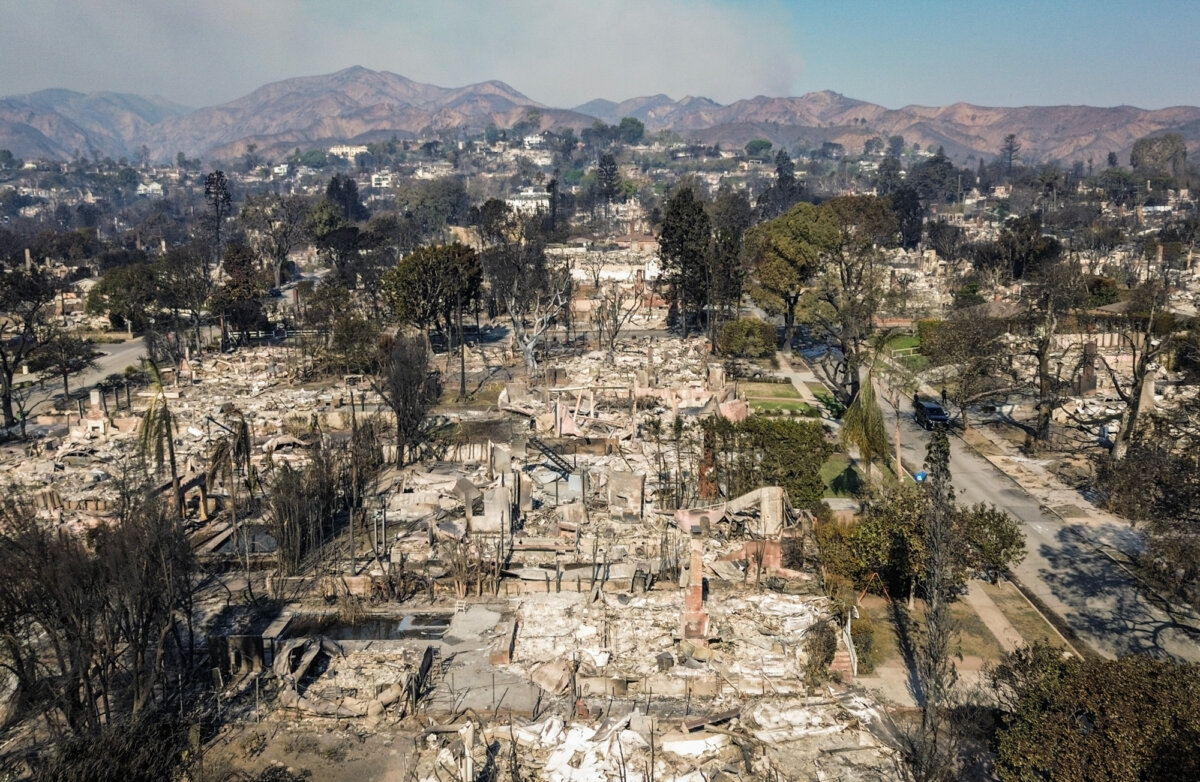
LOS ANGELES—More than a year after one of the most destructive fires in U.S. history, attorneys on Wednesday offered opening salvos in a federal jury trial accusing a 29-year-old man of sparking the initial flame that would lead, a week later, to the catastrophic inferno that claimed the lives of 12 people and reduced thousands of homes to ash in the wealthy coastal enclave of the Pacific Palisades.
“He wanted revenge—revenge against society because he blamed society for all his troubles,” U.S. Attorney Mark Williams told the court.
Dejected and alone on New Year’s Eve, driven by resentment, Jonathan Rinderknecht set fire to the hills surrounding an upscale Los Angeles neighborhood where he had once lived a better life, prosecutors charged.
Prosecutors alleged that Rinderknecht intentionally lit a small brush fire just after midnight on Jan. 1, 2025, near a clearing atop a popular hiking trail in the Santa Monica Mountains, then attempted to cover his tracks by constructing a digital record of a less sinister alibi.
Firefighters quickly suppressed that blaze, dubbed the Lachman Fire–but it smoldered among underground roots for a week before erupting to the surface via a single tree, where powerful Santa Ana winds whipped it into the Pacific Palisades Fire, investigators claim.
The two fires may have different names, Williams said of the so-called holdover fire, “but they were actually the same continuous fire.”
Investigators identified Rinderknecht as a person of interest by matching geolocation cellular data, local security cameras and Flock police camera networks identifying his vehicle and license plate, as well as the defendant’s own 911 call records.
“There was one phone that provided more geolocation data for the exact time we were looking for than the other ones,” Michael Montevidoni, a special agent with the U.S. Bureau of Alcohol, Tobacco, and Firearms (ATF), told the court.
Steve Haney, an attorney for Rinderknecht, offered an alternate narrative for his client’s proximity to the incident.
“The government says that’s the voice and actions of a man who started a fire,” Haney said of a recording, one of more than a dozen calls Rinderknecht placed to 911 in the minutes after the Lachman Fire erupted, played in court by the plaintiff. “It’s the voice and actions of a man who was trying to stop a fire.”
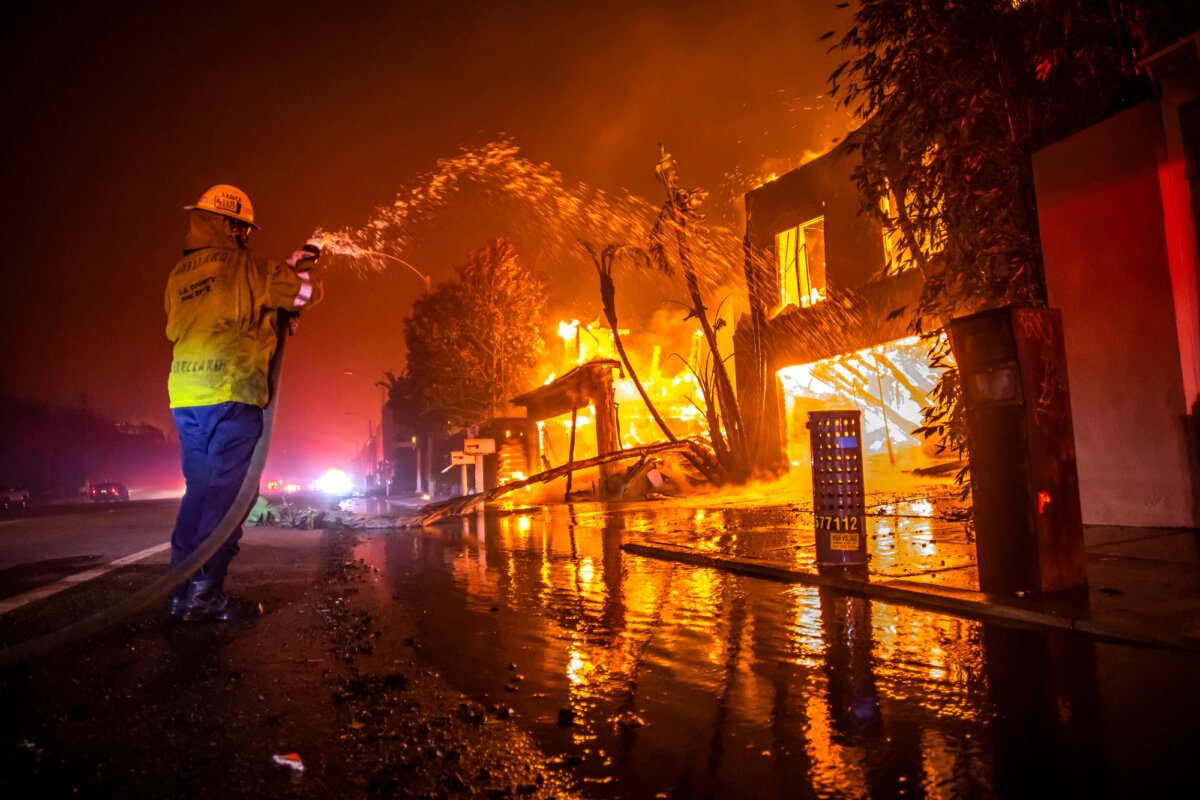 A firefighter battles the Palisades Fire as it burns homes on the Pacific Coast Highway during a powerful windstorm in Los Angeles on Jan. 8, 2025. The wildfire lasted for 24 days, resulting in the deaths of 12 residents, forcing thousands to evacuate their homes, and rendering entire neighborhoods uninhabitable. (Apu Gomes/Getty Images)
Haney said the fact that his client was in the area at the time—he was an Uber driver who had just dropped a ride off in the adjacent neighborhood—is not in dispute.
But the government has offered no “reliable evidence” showing Rinderknecht started the Lachman Fire, Haney said, much less that he is responsible for the Palisades Fire that followed it a week later.
“It’s up to the government to prove to you how somehow these two fires with two different names, two different dates, and two different ignitions, somehow are not two fires, but one continuous fire that Jonathan should be responsible for,” Haney said.
“The government has never charged or accused Jonathan of willfully starting a fire on Jan. 7,” Haney said of the day the Palisades Fire ignited. “And they can’t because he wasn’t anywhere near the Pacific Palisades on Jan. 7, 2025.”
Haney said the evidence will show the government investigated the two fires as separate events with two separate sets of suspects—and that the likely cause of the Lachman blaze was fireworks, not arson.
“After eight months, the government abandoned the two-fire theory. They replaced it with a single combined one-fire theory. … It took over eight months to charge Jonathan with arson,” he said, noting Rinderknecht was charged in October 2025, 10 months after the Lachman Fire.
The high-profile trial opened just as a contentious Los Angeles mayoral primary drew to a close, in which incumbent Karen Bass narrowly advanced to a November runoff after fending off attacks from both left and right over her handling of the fire response and aftermath.
Dressed in a dark suit, Rinderknecht wore a neutral expression but watched his attorney and witnesses intently throughout the day.
Driven by a fascination with fire and a resentment toward the wealthy, prosecutors claim, Rinderknecht started the fire intentionally with a lighter, then attempted to preserve evidence of “a more innocent explanation” when he recorded himself calling 911 and queried ChatGPT, “Are you at fault if a fire is lift [sic] because of your cigarettes?”
According to the state’s case, arson investigators ruled out other potential causes of the Lachman fire, including fireworks, lightning, power lines, refracted sunlight—and cigarettes, in the last case performing more than 500 experiments at a specialized lab.
Prosecutors say evidence including eyewitnesses, a cache of GPS data from Rinderknecht’s phone carrier geolocating his movements, video footage, his own 911 calls—as well as ChatGPT queries and even a song he repeatedly listened to—illustrate his alleged motive and attempted cover-up.
U.S. District Judge for the Central District of California Anne Hwang has excluded some of that evidence, including AI images Rinderknecht allegedly prompted of a class-war inferno months before the fire.
In a ChatGPT prompt cited in the complaint, Rinderknecht asked the chatbot to create a “dystopian painting” featuring people running from a burning forest, with “hundreds of thousands of people in poverty” separated by a giant gate from a “conglomerate of the richest people” who watch as the world burns. “They are laughing, enjoying themselves and dancing.”
Prosecutors said the defendant, an Uber driver, was angry after failing to secure an invitation to a New Year’s Eve party, and acted on long-simmering fantasies and resentments he’d harbored in a place he knew intimately.
“He definitely knew the area well. He had lived there a few years earlier with his boyfriend, who was renting a large house with a pool,” Williams said. “You’ll hear the defendant enjoyed living there—he was happy, in good shape, and people treated him well.”
All of that changed, the prosecutor claimed, when the defendant’s relationship ended, and he moved to a small apartment in Hollywood.
“His life started to deteriorate. … In 2024, the defendant was lonely with no real friends. He lived by himself and was withdrawn,” Williams said, adding “his own words will show how angry this made him.”
Montevidoni, the ATF special agent, told the court he conducted close to 100 interviews during the course of the investigation, including those of the defendant’s family, romantic partners, and acquaintances.
Investigators also conducted a fine-grained digital dragnet, extracting evidence from the defendant’s iCloud, Gmail, OpenAI accounts, his Uber records, and multiple phone and phone carriers.
Rinderknecht’s social views, personal life, and interior thoughts are irrelevant, Haney argued.
“This case is not about whether you like Jonathan or not, whether you approve of the way he uses his computer or activates his ChatGPT,” Haney said. “The question is whether the government can prove beyond a reasonable doubt whether Jonathan set the fire on Jan. 1, 2025.”
Despite extensive searches of his home, vehicle, and all of his digital records, Haney said, the state failed to produce evidence that his client intended to start a fire.
“The evidence will show … that just after midnight, a fire began on a hillside. It will show panic, it will show confusion, it will show a frightened young man reporting it and desperately calling for help,” Haney said.
The jury will consider whether evidence shows, beyond a reasonable doubt, that Rinderknecht committed three counts of arson, related to three different types of property that burned during the fire.
If found guilty, Rinderknecht faces up to 45 years in prison.
 Friends Read Free
Copy
Facebook
Tweet
Friends Read Free
Copy
Facebook
Tweet