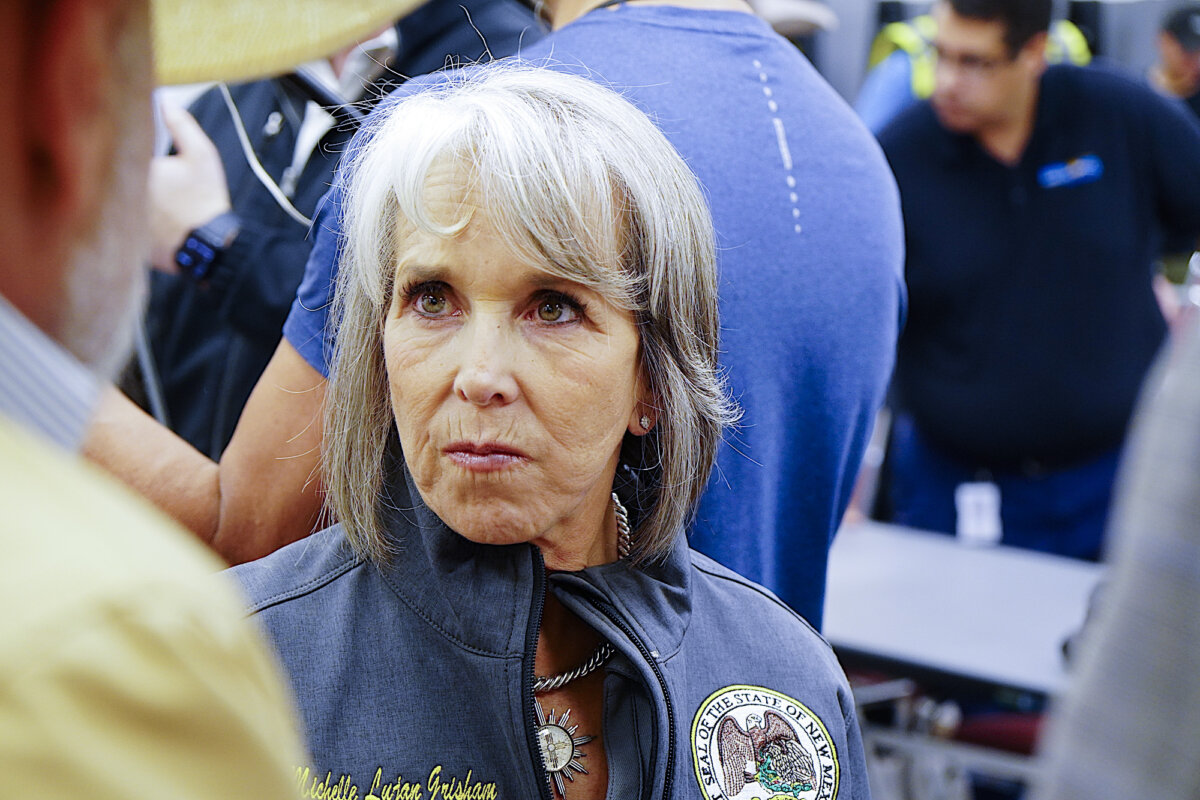

New Mexico Gov. Michelle Lujan Grisham has declared a state of emergency in Rio Arriba County, the city of Española, and the nearby pueblos of Santa Clara and Ohkay Owingeh, citing a sharp rise in violent crime, drug trafficking, and other public safety threats.
With a population of more than 10,000, Española is the largest city in Rio Arriba County—which itself has a population of about 40,000 people, according to the Census Bureau—and is located about 25 miles north of Santa Fe.
The county stretches to the Colorado state line and has long struggled with opioid use and high drug-overdose death rates, with homeless encampments emerging in recent years in more populated areas, according to state officials.
The declaration, issued on Aug. 12 through Executive Order 2025-358, follows requests for assistance from local governments and authorizes up to $750,000 in emergency funding for the state Department of Homeland Security and Emergency Management.
The order also allows for the deployment of the New Mexico National Guard and directs all state agencies under gubernatorial control to assist in response efforts.
According to the governor’s office, police calls in Española have more than doubled over the past two years, while dispatches to businesses in Santa Clara have quadrupled.
Rio Arriba County currently has the state’s highest overdose death rate, driven by fentanyl and other illicit drugs. The surge in crime has been linked to rising homelessness, family instability, and fatal overdoses.
In a July letter to Grisham, Santa Clara Pueblo Gov. James Naranjo urged the state to act, citing the “direct and negative” effects of fentanyl and alcohol abuse on children and warning that the crisis extends beyond the pueblo to the wider community.
“When our local leaders called for help to protect their communities, we responded immediately with decisive action,” Grisham said in a statement.
“We are making every resource available to support our local partners on the ground and restore public safety and stability to these areas that have been hardest hit by this crisis.”
Recent deaths in the region linked by medical investigators to fentanyl and alcohol use include that of Rio Arriba County Sheriff Billy Merrifield.
The governor’s order will remain in effect until all authorized funds are spent or emergency assistance is no longer needed, according to her office. Emergency funds may be used for law enforcement overtime, equipment, and coordinated police responses, her office said.
Grisham has previously declared similar emergencies, including in April in Albuquerque, where she authorized National Guard assistance to address rising crime.
In 2023, she temporarily suspended the right to carry firearms in certain public places in response to a series of shootings that left children dead.
The move in New Mexico comes as President Donald Trump has indicated interest in expanding federal control over local police departments in other cities, following his 30-day takeover of Washington’s Metropolitan Police Department earlier this week.
Under the District of Columbia Home Rule Act, the president can take control of the Washington police for two days and extend it to 30 by notifying Congress. Any further extension requires congressional approval.
Trump has said he would seek “long-term extensions” and suggested declaring a national emergency if Congress does not act. National Guard troops were deployed to Washington on Aug. 12 to assist federalized police.
Grisham recently criticized Trump’s approach in Washington, calling it “executive overreach” and contrasting it with New Mexico’s strategy of addressing crime through coordinated state and local action.
In 2020, Trump sent federal agents, including Homeland Security officers, to Albuquerque as part of an effort to contain violent crime.
While both actions address crime surges, the legal authorities differ. Grisham’s emergency order draws on state law to direct resources and personnel within New Mexico, including state-controlled agencies and the National Guard.
Trump’s action in Washington relies on federal powers under the Home Rule Act, with time limits and congressional oversight built into the statute.
The Associated Press contributed to this report.
 Friends Read Free
Copy
Facebook
Tweet
Friends Read Free
Copy
Facebook
Tweet