
House Democrats opened their 2026 issues conference on Feb. 25 with a unified pitch to voters: The party that lowers costs wins in November.
The yearly conference, held this year in Leesburg, Virginia, under the theme “Fighting for an Affordable America,” came the day after President Donald Trump’s State of the Union address.
Virginia Gov. Abigail Spanberger focused on affordability in giving the party’s official response to the president’s address on the evening of Feb. 24.
At the issues conference, House Democratic leaders used Spanberger’s speech as a backdrop to draw a contrast on kitchen-table economics heading into the midterm elections.
“Democrats are laser-focused on lowering costs and improving the lives of hard-working American families,” Democratic Caucus Chair Pete Aguilar (D-Calif.) said in opening remarks. “While Republicans have used their majority to give billionaires tax breaks, our caucus is working tirelessly to bring solutions to drive down costs.”
Aguilar challenged the economic achievements Trump highlighted in his State of the Union address, pointing to two recent inflation reports.
He noted that the monthly core consumer price index accelerated from December 2025 to January. However, the annual inflation rate fell to 2.4 percent in January, its lowest level since May, according to Bureau of Labor Statistics data.
Aguilar also cited the personal consumption expenditures index, the Federal Reserve’s preferred inflation gauge, which rose above expectations to 3 percent in its most recent reading.
“The American people can either believe what Donald Trump says, or they can believe their monthly bills,” he said. “They cannot do both.”
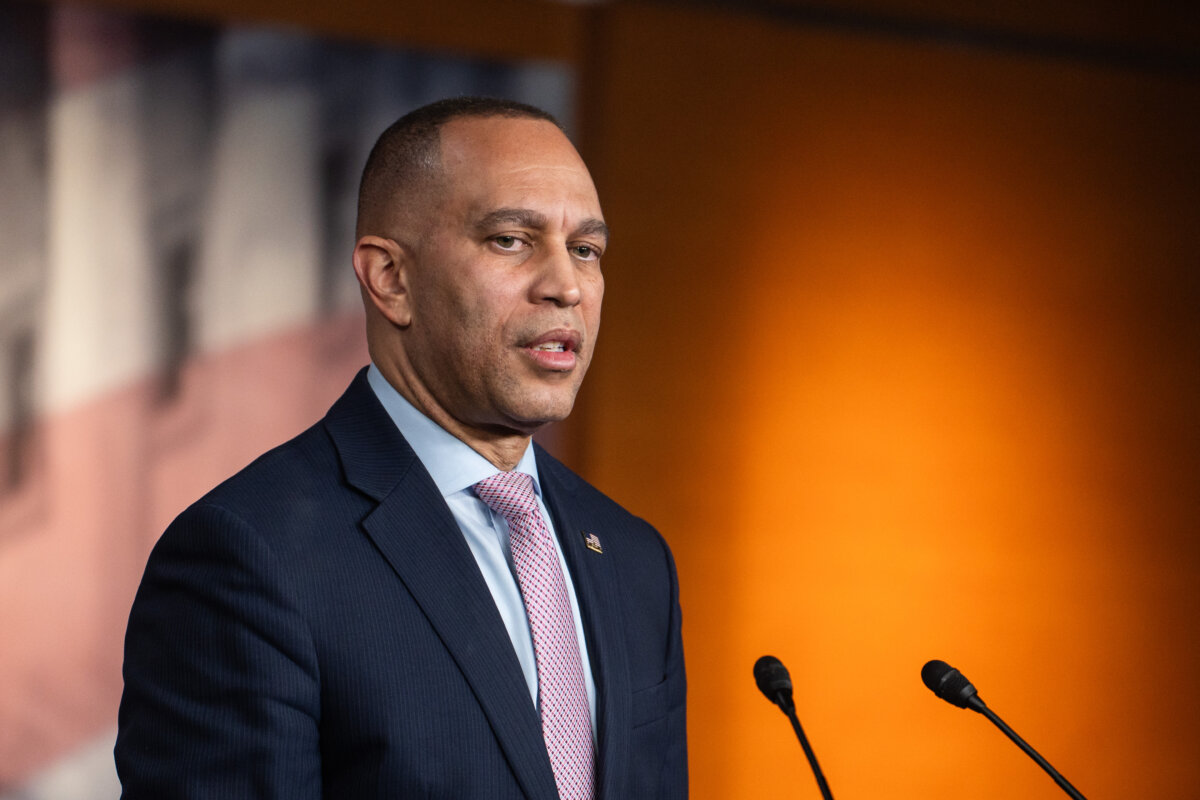
Minority Leader Hakeem Jeffries (D-N.Y.) described the conference as the start of a final push toward November, calling the president’s State of the Union “a disgraceful performance.”
“It’s gonna be a sprint to November 3rd,” Jeffries said.
Jeffries pointed to what he described as a strong Democratic track record in elections held since Trump took office in January 2025, a period in which the party says it has won or overperformed in the vast majority of contests.
“I know people are struggling to find a reason to pierce the fact that the American people have clearly decided it’s time to throw the MAGA extremists overboard and elect Democrats,” Jeffries said.
Democratic Whip Katherine Clark (D-Mass.) outlined a five-point policy agenda that the party plans to run on. She listed capping child care costs at $15 per day, making pandemic-era health care premium tax credits permanent, expanding affordable housing construction, reducing utility costs by requiring large corporate users to pay a greater share, and expanding union access to boost wages.
“Republicans have chosen to break their promises to regular families,” Clark said.
“Democrats are offering a different choice.”
She credited Democratic Congressional Campaign Committee Chair Suzan DelBene (D-Wash.) with building a “big blue wave” ahead of the midterms.
DelBene noted that the committee recently expanded its competitive map to 44 districts. The committee also rolled out its first round of 12 “Red to Blue” candidates—top-tier recruits in the most competitive races. Democrats need a net gain of three seats to win the majority.
“We have the candidates, the message, and the public support to win back the majority,” she said.
Leaders also previewed what a Democratic-controlled House would prioritize on the oversight front.
Aguilar called the Trump administration “a target-rich environment” for congressional investigation but said Democrats would pursue both oversight and a proactive affordability agenda.
“We have to do all of the things,” he said. “We have to do oversight and accountability, and we have to talk about the affordability agenda and how we’re going to make life better for people if we’re given the opportunity to lead.”
State of the Union Fallout
The Democrats also addressed their reaction to the State of the Union during questioning from reporters at the press conference.
In response to Reps. Ilhan Omar (D-Minn.) and Rashida Tlaib (D-Mich.) yelling at him during his address, President Donald Trump posted on Truth Social on the afternoon of Feb. 25, calling the two congresswomen “lunatics” and writing that “when people can behave like that … we should send them back from where they came—as fast as possible.”
Jeffries criticized Trump’s remarks as “xenophobic,” “unpresidential,” “unpatriotic,” and “un-American.”
Aguilar said: “These are U.S. citizens, members of Congress who are duly elected federal officeholders.
“Where they come from is their districts.”
House Speaker Mike Johnson (R-La.) told reporters following Trump’s speech that he almost ejected Omar and Tlaib from the House chamber.
“I came about this close from banging the gavel and having them escorted off the floor, but the president handled it very well,” Johnson said. “And I thought, you know, let them put that on display.”
Jeffries noted that some Democratic members attended the address in “silent defiance” while others skipped it. He described both as legitimate expressions of opposition, noting that Clark, who did not attend, spent the evening hosting a virtual meeting with small-business owners and teachers in her district.
“There is no space between us,” Clark said.
“Whether it’s going there and being in silent defiance, or whether it’s choosing to do what I did.”
The midterm elections are scheduled for Nov. 3.
Jackson Richman contributed to this report.
 Friends Read Free
Copy
Facebook
Tweet
Friends Read Free
Copy
Facebook
Tweet