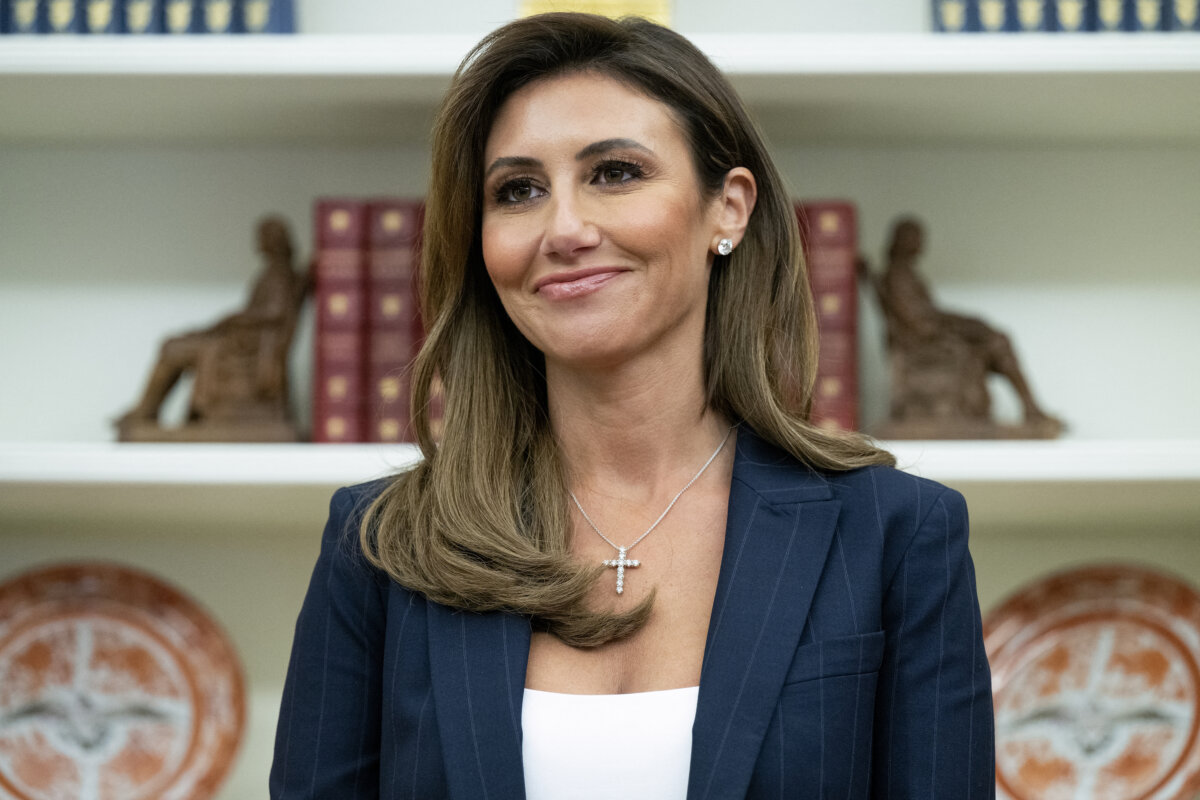
The Justice Department has asked an appeals court to reconsider its earlier ruling that Alina Habba was not validly serving as acting U.S. attorney for the District of New Jersey.
In a petition on Jan. 14, the Justice Department asked the U.S. Court of Appeals for the Third Circuit for a rehearing en banc, or one with the whole 14-member court. A panel of three judges decided last month to affirm a lower court’s decision disqualifying her based on its reading of the Federal Vacancies Reform Act, which governs how acting officials may be appointed.
Accompanying the department’s petition was a declaration in which Habba said she would return to leading the U.S. attorney’s office if the en banc court ruled in her favor.
The three-judge panel ruled that, because Habba was appointed first assistant U.S. attorney amid a vacancy for U.S. attorney, she could not ascend to act in that position, as the law required an existing officer to take the job.
“Only the first assistant in place at the time of the vacancy automatically assumes acting status under the FVRA,” wrote the court, referencing the Federal Vacancies Reform Act.
The government objected to this reasoning.
“The panel’s interpretation of the FVRA would hobble Presidential transitions and has been routinely violated by the last four administrations without any court holding the practice unlawful. Rehearing en banc is warranted,” the government wrote.
The Third Circuit held that the Act did not permit Habba to act in the position.
Habba was appointed to the role of acting U.S. attorney by Attorney General Pamela Bondi at the direction of President Donald Trump on July 24, 2025. On Aug. 21, 2025, the U.S. District Court for the District of New Jersey held that Habba’s appointment was unlawful, but the judge stayed his order pending appeal. After the court of appeals’ decision on Dec. 1, Habba resigned from the U.S. attorney’s office to take a new position as “special attorney” in Bondi’s office.
Habba gained political prominence in 2023 and 2024 as a personal attorney to Trump during a civil trial against him in New York regarding fraud charges. After Trump took office for a second time in 2025, she was appointed “counselor to the president” and served in that role for three months.
On March 28, 2025, Habba was appointed to be the interim U.S. attorney in New Jersey. However, the law required a majority of judges of the U.S. District Court to vote in favor of her continuance for longer than 120 days. On July 22, 2025, they declined to do so.
U.S. attorneys are officers of the United States who are typically appointed by the president after nomination to the Senate, and with its advice and consent. They serve four-year terms. The case that led to Habba’s removal involves a prosecution where the defendant sued to dismiss his charges, asserting that Habba was unlawfully appointed.
 Friends Read Free
Copy
Facebook
Tweet
Friends Read Free
Copy
Facebook
Tweet