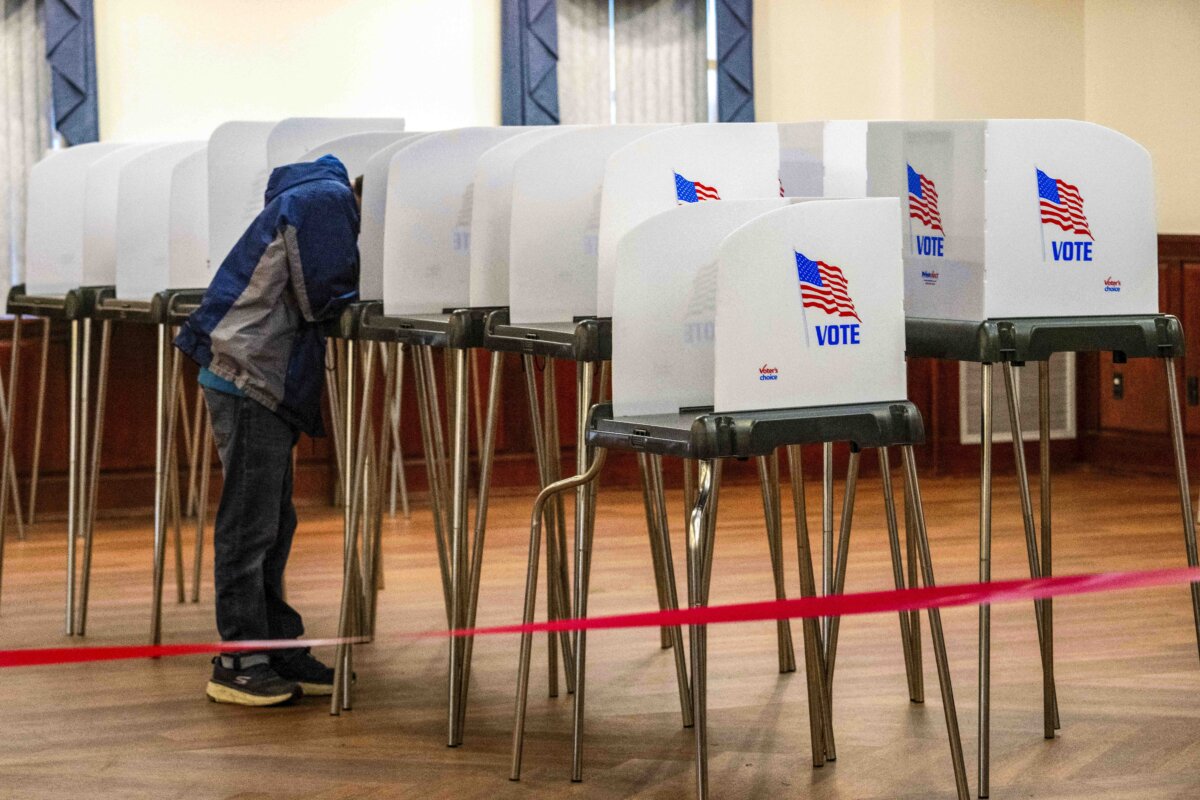

Early voting for the November midterm elections kicked off in Virginia on Sept. 18 as voters decide which party controls Congress and key state-level offices.
Voters in some other states, including South Dakota, Minnesota, and Idaho, can cast absentee ballots in person, usually at a local election office or voting center. More expansive early voting will begin in those and other states in the coming weeks.
Twenty-seven states offer voting on Saturday. One of those states is Nevada, where there is a competitive gubernatorial primary between incumbent Republican Gov. Joe Lombardo and Democratic Attorney General Aaron Ford.
In the spotlight ahead of the midterms was President Donald Trump’s executive order to tighten regulations on mail-in voting. It would have given federal agencies a greater role in verifying who should get a mail-in ballot and how those ballots are processed by the postal service. The Supreme Court upheld an injunction from a federal judge blocking a postal service rule in the administration of mail-in ballots. The executive order was to prevent noncitizens from voting, a top issue for the president.
Trump on Sept. 15 criticized the Supreme Court decision, saying it “will go down, in a very negative way, in the annals of History.”
Currently, 47 states and the District of Columbia allow no-excuse early voting. The states that do not are Alabama, Mississippi, and New Hampshire. New Hampshire is a key state in the midterms with competitive Senate and House races.
California, Colorado, Hawaii, Nevada, Oregon, Utah, Vermont, and Washington state send out ballots to all voters unsolicited.
Thirteen states allow for voting on Sunday. They include key states such as Alaska, Florida, Michigan, Minnesota, Ohio, Texas, and Virginia. There are crucial Senate races in Alaska, Michigan, Minnesota, Ohio, and Texas. Republicans look to flip seats in Michigan and Minnesota, while Democrats look to gain seats in Alaska, Ohio, and Texas.
Voters will cast their ballots amid the high cost of living, a war in Iran, the rise of data centers and artificial intelligence, and other top issues.
In Virginia, residents will vote for the House and Senate. The House race to watch is in the state’s 2nd Congressional District between incumbent Republican Rep. Jen Kiggans and former Democratic Rep. Elaine Luria in a rematch from 2022. There is a Senate race between incumbent Democratic Sen. Mark Warner and Republican Bert Mizusawa, a retired Army major general.
There are competitive races in numerous states including Maine, Michigan, Georgia, Alaska, North Carolina, Ohio, and New Hampshire.
The Nov. 3 election consists of races for governor and state legislature in most states and will decide whether the GOP retains its majority in both the House and Senate. If Democrats retake Congress, it would drastically affect the last two years of Trump’s term, in which Democrats would likely block Republican legislative proposals or launch oversight efforts such as investigations into the administration.
The midterms also come in the aftermath of a wave of redistricting efforts by both major parties. In states such as Texas and Florida, Republicans redrew congressional lines, hoping to gain an advantage to pick up seats in a difficult political environment, as the party opposite of the president in the White House usually wins the midterms.
Millions of people have been affected by the mid-decade redistricting, as 1 in 10 Americans this fall are now residents of a different congressional district than in 2024, according to research by nonpartisan group Protect Democracy.
The Supreme Court ruled earlier this year that race cannot be a primary factor in drawing congressional districts. This led to a majority-minority district being eliminated in Louisiana. Alabama and Tennessee also redrew their congressional maps.
The Associated Press contributed to this report.
 Friends Read Free
Copy
Facebook
Tweet
Friends Read Free
Copy
Facebook
Tweet