
In America’s largest metros—from New York and Los Angeles to Chicago and Boston—rents have climbed to record highs, and eviction fears are rising.
City and state leaders are weighing stronger interventions. Those include rent control, which limits how often and how much rents can be raised, rent freezes on stabilized units, and faster approvals for new housing construction.
Zohran Mamdani, frontrunner in the New York City mayoral race, has proposed a rent freeze on nearly half of the city’s apartments.
California, Oregon, and Washington have statewide rent control. Six states and Washington, D.C., have local rent controls in place. But most states prohibit the practice, according to the National Apartment Association.
Supporters of these policies say they buy time for working families while housing construction rises to meet demand. Critics warn that the policies can deter investment in the rental market.
We asked readers of The Epoch Times what they think.
Impact
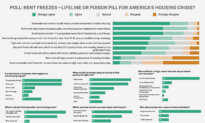
Survey respondents overwhelmingly believed that government intervention in the pricing of rental housing would have a negative impact on both tenants and landlords.
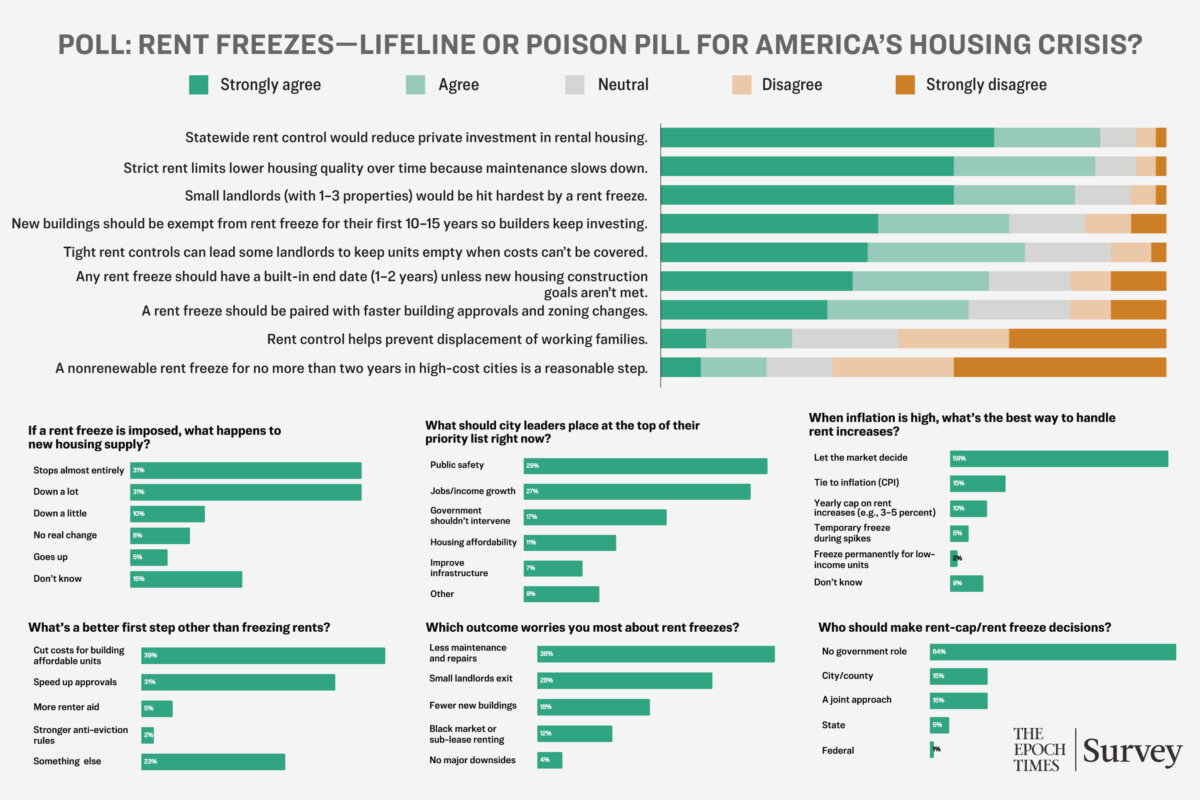
Eighty-seven percent of respondents agreed that statewide rent control would reduce private investment in rental housing. Nearly the same proportion (86 percent) agreed that rent limits eventually lower housing quality by slowing maintenance.
Seventy-two percent said a rent freeze would slow new construction either almost entirely (31 percent), a lot (31 percent), or a little (10 percent).
Landlords owning 1–3 properties would be hit hardest by a rent freeze, according to 82 percent of respondents, and 72 percent agreed that rent controls might lead some landlords to keep units empty if income did not cover costs.
Most readers (53 percent) did not agree that rent control helps prevent the displacement of working families, though 21 percent were unsure.
The greatest worry for respondents concerning a rent freeze was that it would result in less maintenance of rental units. A second concern was that it would cause small-time landlords to exit the market.
Alternatives
Survey respondents largely considered market solutions a better alternative to addressing a housing shortage than various forms of government price control.
Exactly two-thirds (66 percent) disagreed that a non-renewable rent freeze for up to two years would be a reasonable first step.
When inflation is high, the majority of respondents (59 percent) said the market should be allowed to decide on rent increases.
However, a sizable minority favored some moderate form of government intervention, such as tying rent increases to inflation (15 percent), or implementing a price control on rent increases of perhaps 3 percent to 5 percent (10 percent).
Rather than freezing rents, 39 percent said cutting costs for builders would be the best first step in solving a housing shortage. Thirty-one percent identified speeding up approvals for construction. Just 5 percent and 2 percent favored more aid for renters and stronger anti-eviction rules, respectively.
However, 23 percent of respondents identified other options. Among those, changes in the tax structure topped the list.
One reader wrote, “Cut city taxes and negotiate lower corporate taxes in exchange of demonstrable wage increases to allow workers to keep more of their earnings.”
“If rent is frozen, why not also freeze property tax and control insurance rates?” another wrote.
Others suggested attacking the factors they see interfering in the market.
“Break up large companies that buy up homes and sell to each other to drive market prices up,” one reader wrote.
Another wrote, “Change zoning to exclude investors from converting houses into rental properties, and allow home owners to add tiny rental homes to their property.”
Implementation
Assuming that a rent freeze were to be implemented, readers favored a limited approach.
Nearly two-thirds (64 percent) saw no government role in capping or freezing rent. Others were evenly split on whether the city or county government should make the decision (15 percent) or a joint approach between governments (15 percent).
More than two-thirds (69 percent) agreed that new buildings should be exempt from a rent freeze for up to 15 years to encourage continued investment.
Sixty-five percent agreed that any rent freeze should be effective for no more than two years unless housing construction goals aren’t met.
Sixty-one percent agreed that a freeze should be paired with speeding up building approvals and zoning changes.
If rents are capped or frozen, one reader wrote, “all taxes, utilities, and cost must be held to that index.”
A minority of respondents (11 percent) said housing affordability should currently be the top priority for city leaders. Public safety topped the list at 29 percent, with job and income growth close behind at 27 percent, while 7 percent favored improved infrastructure.
Nine percent of respondents offered other priorities, including reducing taxes, cutting regulations, and prioritizing immigration enforcement.
“Reduce red tape so builders can build,” one reader wrote.
Another said, “Enforce deportation laws to cut the population, increase jobs and wages, and decrease demand.”
This survey of readers of The Epoch Times was conducted on Oct. 29, 2025, via email and social media.
 Friends Read Free
Copy
Facebook
Tweet
Friends Read Free
Copy
Facebook
Tweet