BOSTON—While the European Union’s 27 member nations are still “sorting out the details” of the July 27 framework trade deal between EU Commission President Ursula von der Leyen and U.S. President Donald Trump, most European businesses are eager to expand the world’s biggest bilateral trade and investment relationship, according to a key union representative.
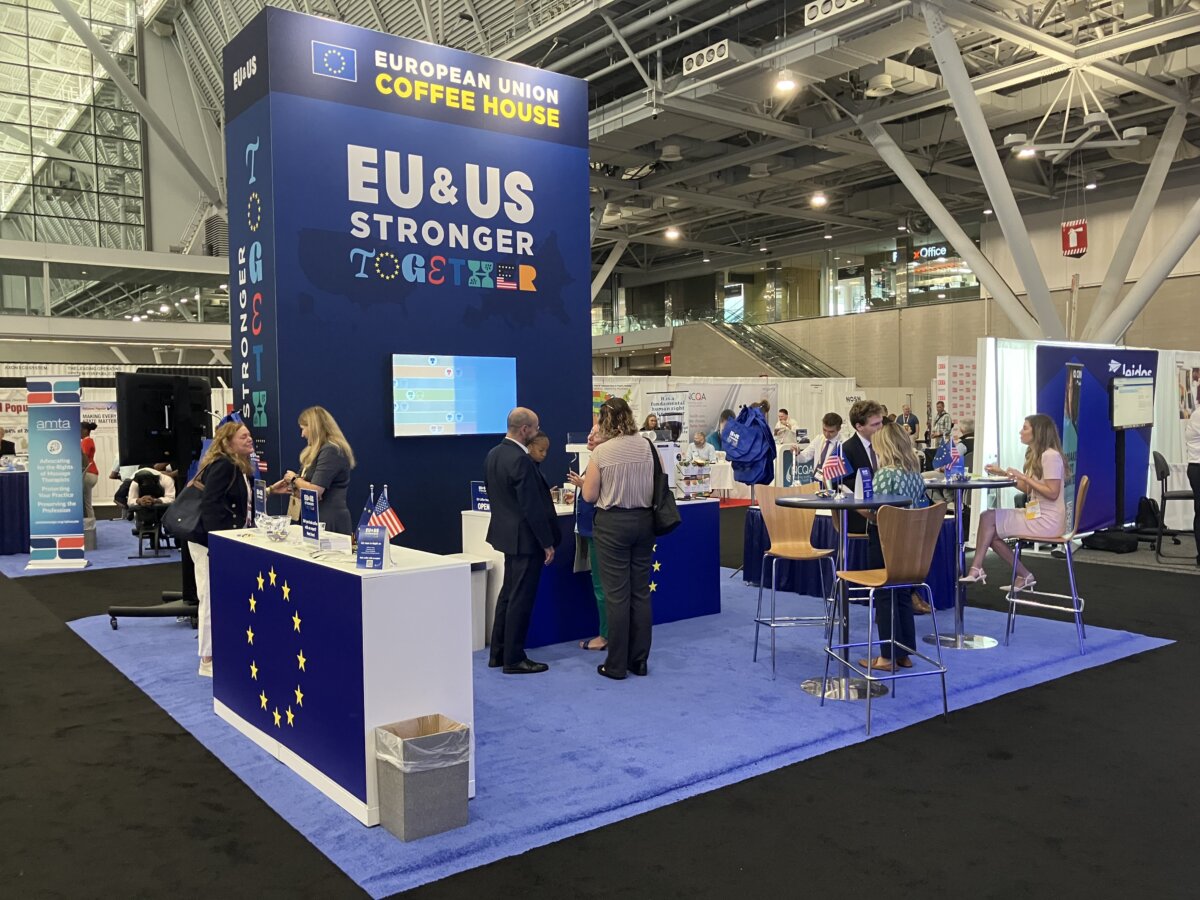
“We feel very good about the framework agreement,” Deputy EU Ambassador to the United States Ruth Bajada said during the final day of the Aug. 4–6 National Conference of State Legislatures’ 2025 Legislative Summit in Boston’s Thomas Michael Menino Convention & Exhibition Center.
“It’s a result of long negotiations,” she told The Epoch Times at the EU’s convention floor exhibit. “So we have an agreement that stabilizes trade now between the EU and the United States and should provide the sort of framework to continue to work from there.”
Bajada, a native of Malta, said that although officials in some member states reacted with agitation to the 15 percent tariff the United States will impose on most European imports, the prospective trade pact has much to offer businesses on both sides of the Atlantic.
She said the base tariffs outlined in Trump’s July 31 executive order are “very good for [the EU] because one of the areas that was negotiated is that there is no ‘stacking’ for tariffs, meaning that there should not be tariffs on tariffs.”
“We agree on the 15 percent, and it includes the MFN [Most Favored Nation] tariffs in it,” she said.
Under the MFN tariff agreement, import levies cannot be raised after the pending three-year pact goes into effect.
Bajada said the EU is now waiting for Trump’s next executive order that would explain how to proceed on products excluded from the framework agreement, such as cars, pharmaceuticals, and semiconductors.
She said the EU remains “worried” about “continuous” Section 232 investigations into those products, as well as the 50 percent tariffs on steel and aluminum imports by the U.S. Department of Commerce.
“We are also negotiating a joint statement that should highlight the rest of the discussions,” Bajada said.
She also said that it should clarify vagaries in the EU’s pledge to convince Europeans to purchase $750 billion in U.S. energy commodities, products, and technologies in the next three years.
In the immediate aftermath of the “handshake deal,” many analysts questioned the capacity of American producers to essentially triple oil, liquefied natural gas (LNG), and coal exports to EU nations within a year to meet a European demand for fossil fuels that has been declining and is projected to continue slackening in coming decades.
Bajada said that energy commitment isn’t limited to oil, LNG, and coal. It includes nuclear technologies, $40 billion in “high-end chips,” and energy to support artificial intelligence (AI), she said.
“We are already the biggest buyer of American LNG,” Bajada said.
“The EU is preparing to invest very much in itself in terms of AI. The European Union wants to make the EU the new ‘AI continent.’ And for that, we need energy. So it’s with that in mind that we see these big, big investments.”
EU nations, for years reliant on Russian oil and LNG, “have a plan to wean completely off” Russian oil by 2028, Bajada said.
She said that depending on when and how the pact is enacted, that goal could be moved up to 2027.

Urgencies
Bajada and her EU delegation were among nearly 150 exhibitors at National Conference of State Legislatures’ 50th annual summit, which included not only nearly 2,000 U.S. state lawmakers and staffers among its 9,000 attendees but also 375 state and provincial lawmakers from 44 countries.
Although the big deals are cut by national governments, the EU–U.S. trade agreement will be “actually ultimately implemented by the states, by the cities—that’s where the investments are,” she said.
The EU is among the top three trade partners and investors “in 47 of the 50 states,” Bajada said.
During the summit, EU representatives had discussions with states on energy, resilience, investments, and trade, she said.
“We want to know what state legislators are thinking, what legislation they [will be] proposing, how they [will be] doing it to prepare and get ready and to work with our member states for future investments,” she said.
That’s what Western Cape Provincial Parliament Speaker Daylin Mitchell and Deputy Speaker Reagan Allen were doing also, although they were lobbying state lawmakers and U.S.-based business partners to convince Congress and the Trump administration to claw back the 30-percent tariffs on South African imports set to go into effect the next day—Aug. 7.
Allen said he is “deeply concerned” because the tariff will affect 6,000 products South Africa exports to the United States that could cost 300,000 jobs.
Africa’s biggest economy offered to buy more U.S. LNG and invest $3.3 billion in U.S. industries but, thus far, no dice.
The tariffs will be “a devastating blow” for the province but also for consumers in the United States, Allen said, noting that importing West Cape citrus and automobiles—BMW, Mercedes Benz, Volkswagen have factories there—also offers Americans benefits.
Despite those concerns, Mitchell and Allen said the 20 provincial South African lawmakers at the summit feel encouraged that the relationships established with their U.S. counterparts will bear fruit in securing a better trade deal.
Despite Trump’s recent threats to double the 25 percent tariffs on goods from India because of its significantly increased imports of Russian oil and LNG, Uttar Pradesh Legislative Assembly Member Ramesh Chandra Mishra said such disruption is part of the negotiation process.
He said Trump’s hardball tactics are understandable and that despite the potential for economic pain for his nation and others, in the long run, everyone can win.
“As President Trump says, many countries took undue advantage of America. So sooner or later, America has to take a corrective step.” Mishra said. “Time is short. In two, three years, [Trump] will be a lame duck. So that is why he is taking big steps. Politicians have a very short window.”
The United States has been accruing annual $1.5 billion trade deficits and is now $36 trillion in debt. That is not good for global trade and not good for India, he said, adding, “We don’t like the status quo.”
There were 120 lawmakers and legislative staff from India’s 28 states at the summit, an event that Mishra said the Uttar Pradesh Legislative Assembly sends a delegation to every year.
He said that this year, it is “more urgent” because his manufacturing and services constituents still want to grow relationships with American partners and markets despite the trade discord.
Nigeria National Assembly Sen. David Jimkuta also had urgent matters to discuss with U.S. state lawmakers: immigration and visa policies.
In 2022, the U.S. Census Bureau estimated there were 448,400 Nigerian immigrants in the United States, more than double the number in 2000—a fallout from the Nigerian diaspora.
Nigerians are the most populous group of African immigrants to the United States. But after Nigeria refused to accept Venezuelan deportees in early July, the Trump administration tightened visa rules—now mostly allowing only single-entry visas valid for three months—for Nigerian citizens and re-imposed 15-percent tariffs on Nigerian exports.
“We’re trying to plead with the U.S. government about that,” Jimkuta said.
He said that he is among eight Nigerian federal lawmakers lobbying U.S. congressional and state legislators, as well as business leaders, to negotiate a deal that will “make life easy for both countries.”
He said Nigerian lawmakers regularly attend the National Conference of State Legislatures (NCSL) summit to learn about something they want to emulate from the world’s most expert practitioners.
“Why we are here? Our democracy is new, as are many in Africa,” Jimkuta said. “We come to NCSL to learn more about our democracy.”
 Friends Read Free
Copy
Facebook
Tweet
Friends Read Free
Copy
Facebook
Tweet