

The “framework trade deal” forged on July 27 by U.S. President Donald Trump and European Commission President Ursula von der Leyen was touted by both leaders as “the biggest deal ever made,” but it’s far from a done deal, with many details still to be ironed out, according to analysts.
To avoid Trump’s vow to increase tariffs to 30 percent on European imports on Aug. 1 from the 25 percent duty he imposed in April, von der Leyen accepted 15 percent tariffs and pledged that EU nations would purchase $750 million in oil, liquefied natural gas (LNG), and nuclear technologies over the next three years.
Under the tentative pact, EU nations will also increase investments in the United States by $600 billion and, as Trump told reporters at his golf resort near Turnberry in Scotland after his July 27 meeting with von der Leyen, European nations will spend “hundreds of billions” purchasing American-made weapons and armaments.
But there are many hurdles ahead for the pact. Among them: The EU has no authority to make policy for its members, meaning the deal must now be ratified by all 28 union nations. Nor can it dictate private industry decisions.
The European Union made that distinction on July 28 in an explainer, noting the $750 billion energy and $600 billion investment provisions are a “political agreement” and “not legally binding.”
The EU states that “as a public authority,” it cannot guarantee “the intention of private companies,” calling the broad consensus between Trump and von der Leyen “the first step in a process that will be further expanded over time to cover additional areas and continue to improve market access.”
Many European leaders are criticizing the tentative pact, including Hungarian Prime Minister Viktor Orbán, who called it worse than the deal the United Kingdom negotiated with the United States this spring. Trump “ate von der Leyen for breakfast,” he told reporters.
“Von der Leyen-Trump Agreement: it is a dark day when an alliance of free peoples, united to affirm their values and defend their interests, resolves to submission,” French Prime Minister François Bayrou said in a July 28 X post.
Politics aside, many global analysts question the capacity of American producers to essentially triple energy exports within a year to meet a European demand for fossil fuels that has been declining and is projected to continue slackening in the coming decades.

Replacing Russia
While the deal may rankle some Europeans, von der Leyen said it provides certainty and “stability” missing in Europe’s energy markets since Russia’s February 2022 invasion of Ukraine.
In 2022, nearly half of the EU nations’ gas imports came from Russia. In 2025, it’s 13 percent, according to a report from Eurostat, the EU’s statistical office.
In the first quarter of 2025, Russia’s share of EU petroleum oil imports fell to just 2 percent, from 29 percent during the same 2021 span, the report states.
The tentative July 27 deal calls for EU-based companies to completely shift away from Russia and purchase $250 billion a year in oil, LNG, and nuclear technologies such as small modular nuclear reactors from U.S. producers in 2026, 2027, and 2028.
“This is a delusional level of imports that the EU has virtually no chance of meeting, and one that U.S. producers would also struggle to supply,” Reuters Energy Columnist Clyde Russell wrote on July 28.
In 2024, U.S. energy exports worldwide in 2024 were $318 billion, according to the U.S. Energy Information Administration (EIA).
Of that, the EU’s 28 member nations imported a combined $76 billion, including $40 billion in crude oil, nearly $22 billion in LNG, and $6.7 billion in metallurgical coal, according to the EIA.
In the first half of 2025, EU countries imported about 1.53 million barrels a day of oil worth $19 billion from the United States, of which 86 percent was crude, according to London-based analytics firm Kpler.
That number represented about 14 percent of EU oil consumption, which averaged 10.66 million barrels a day in 2024, according to the Energy Institute Statistical Review of World Energy.
More than 55 percent of the EU’s LNG imports in the first half of 2025 were from the United States, according to EuroStat.
“To comply with this agreement, we would not only have to buy all our LNG from the U.S., but also 60 percent of the oil we import,” Valencian Association of Energy Sector Companies General Director Pedro Fresco said in comments forwarded to The Epoch Times by the Global Strategic Communications Council’s New York office.
“And that is impossible, if only because of the long-term contracts already in place.”
Infrastructure Already Stretched
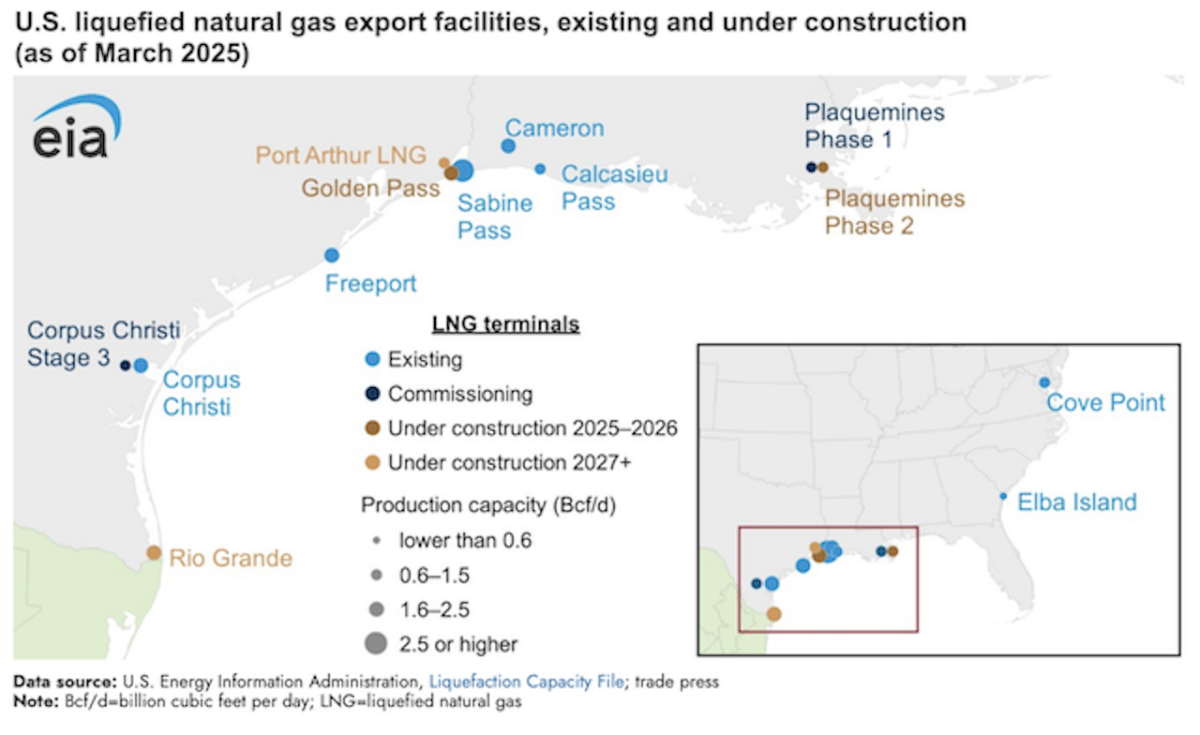
American natural gas producers, in particular, are constrained by maxed-out pipeline and LNG export terminal capacities; there’s only so much fluid the nation’s 300,000-mile interstate pipeline network can move from well to end user, and only so much its eight LNG terminals can ship overseas.
LNG exports from the United States have increased every year, starting from scratch in 2016 and becoming the world’s largest exporter by 2023, the EIA reports.
Venture Global Inc.’s Plaquemines LNG plant, 20 miles south of New Orleans, which went online in December 2024, was the eighth LNG export terminal in the United States. All are in Texas and Louisiana on the Gulf of America.
More liquefaction plants and export terminals are being proposed and built, with a new port operation set for Alaska at the end of an 800-mile pipeline and others being considered in several West Coast and mid-Atlantic ports, including Philadelphia.
Proposals to build an LNG export terminal in the Philadelphia area along the Delaware River have been circulating since at least 2017, with sites in Chester and Marcus Hook in Pennsylvania, and in Gibbstown, New Jersey, among prospective projects.
“It’s been hope and a dream for a long time,” Pennsylvania Independent Oil & Gas Association President and Executive Director Dan Weaver told The Epoch Times in April. “We’re working on it.”
“The U.S. natural gas industry has dramatically changed over the last 10 years, with prices halving as production grew by almost 50 percent,” a Deloitte Marketpoint analysis notes.
But even before the July 27 U.S.–EU deal outline surfaced, the London-based global accounting firm questioned if the industry could sustain that production-cost ratio without more capacity to move more oil and gas.
A July 28 analysis by Wood Mackenzie North America Gas Senior Research Analyst Daniel Myers and Natural Gas Research Analyst Devin Cao determined that “interstate natural gas pipeline development is regaining momentum.”
In 2025, they note, 27 proposed pipeline projects have launched “open seasons”—when a pipeline operator offers new or existing capacity to producers—while “securing commitments for new infrastructure expected to begin service within the next five years.”
The recent surge in “open seasons” offerings for pipelines that are not yet built “reflects industry confidence, yet the true test will be whether proposed projects can navigate both market conditions and state-level hurdles in the years ahead,” they wrote.

Will Exports Raise Costs?
Buyers and sellers will need to increase capacity because “producers will need to grow production at historically low prices—not just by investing additional capital to complete more wells, but also by leveraging operational efficiencies and pursuing new technologies,” Deloitte said in its analysis, titled “Building an industry: Can the United States sustainably export LNG at competitive prices?”
“How much gas needs to be produced for domestic consumption and how much will be exported via pipelines and LNG?” the study asks, noting that increasing supplies to overseas buyers could raise domestic prices.
The Biden administration imposed an LNG export “pause” in early 2024 to ask that same question, looking at the impacts of projects seeking approval for LNG exports to Europe and Asia. The administration concluded in December that increased LNG exports would raise domestic energy costs for consumers.
The study found that “unfettered exports of LNG would increase wholesale domestic natural gas prices by over 30 percent” while “unconstrained exports of LNG would increase costs for the average American household by well over $100 more per year by 2050,” according to a statement by then-Energy Secretary Jennifer Granholm.
In hearings this spring, the Trump administration accused Biden appointees of skewing the Department of Energy (DOE) study and cherry-picking comments and data to fit what it called its “green agenda.”
House Committee on Oversight and Government Reform chair James Comer (R-Ky.) said in March that the previous administration’s DOE “withheld key data from both the American people and Congress in order to push forward their radical environmental agenda.”
In May, the DOE updated the study and determined that the United States has enough natural gas “to meet growing levels of exports while minimizing impacts to domestic prices.”
The revised report said “growing LNG exports increases our gross domestic product and expands jobs while improving our trade balance … and increasing U.S. LNG exports enhances domestic and international global security with no discernable impact to global greenhouse gas emissions.”
While energy analysts questioned how quickly the infrastructure to extract and export oil and gas can be built to supply a dramatically increased demand, some said the political hurdles present a greater risk of derailing the deal.
“Even if the $250 billion a year in EU energy purchases from the U.S. pledge wasn’t absurd on its face—it is, for the record—there’s still the small issue that those energy flows are determined by private sector purchasing decisions, not Brussels,” Canadian analyst Rory Johnston said in a July 28 X post.
Others say the deal merely makes EU nations and businesses beholden to a new energy kingpin rather than Russia and a fossil fuel many have forsaken.
“Over-reliance on a single gas supplier is a ‘déjà vu,’” IEEFA Europe Lead Energy Analyst Ana Maria Jaller-Makarewicz said in comments sent by email to The Epoch Times by the Global Strategic Communications Council.
“Increasing imports of US LNG, as set out in the deal, is not only an energy security risk but also an unrealistic goal. Europe’s gas demand is declining, and the market is unlikely to absorb excess volumes.”
The Epoch Times has reached out to the White House for comment on whether the United States can expand production to meet the increased demand from the EU.
 Friends Read Free
Copy
Facebook
Tweet
Friends Read Free
Copy
Facebook
Tweet