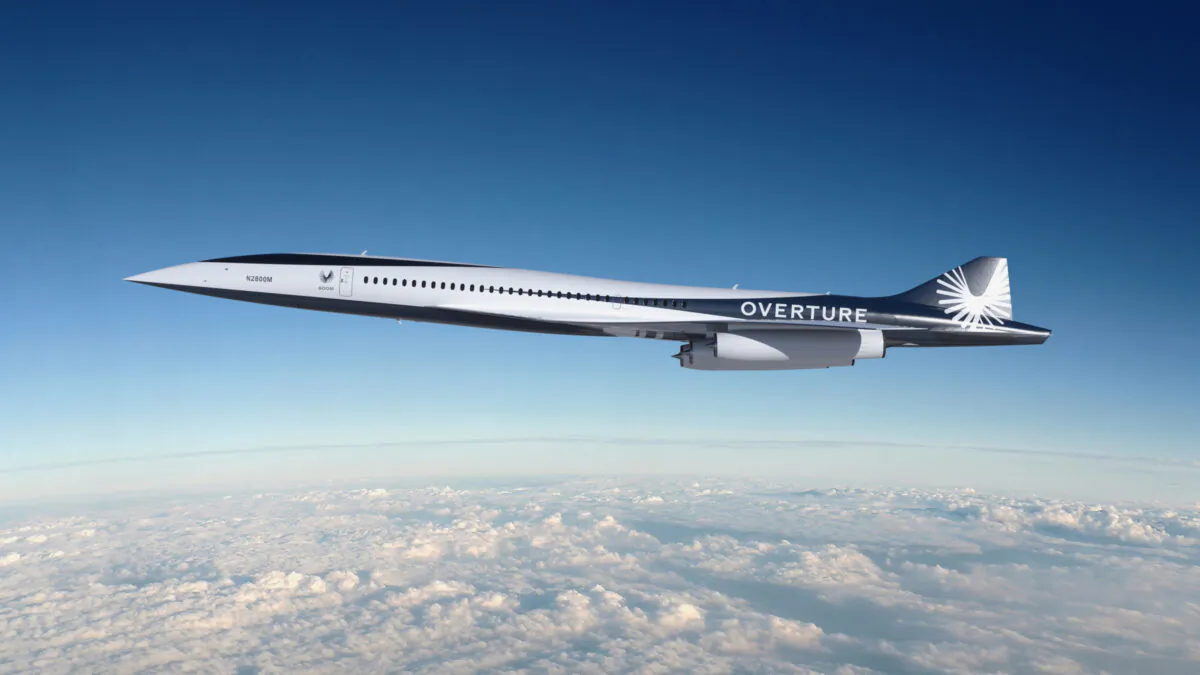

The Federal Aviation Administration (FAA) on Tuesday moved to end the more than 50-year ban on civilian supersonic flights over the continental United States, proposing rules that would allow aircraft to exceed the speed of sound provided they don’t produce a sonic boom.
The U.S. Department of Transportation (DOT) announced on June 30 that the FAA has issued a notice of proposed rulemaking that would replace the more than 50-year-old prohibition on overland civil supersonic flight with a regulatory framework focused on limiting noise rather than speed.
The proposal marks a key step in implementing President Donald Trump’s executive order signed last month directing the FAA to repeal regulations that the administration says have unnecessarily constrained U.S. aerospace innovation.
“For more than 50 years, outdated and overly restrictive regulations have grounded the promise of supersonic flight over land, stifling American ingenuity, weakening our global competitiveness, and ceding leadership to foreign adversaries,” Trump said in the order.
If finalized, the rule would clear the way for what the DOT described as a new generation of commercial supersonic aircraft capable of dramatically reducing travel times while minimizing the noise impacts that led regulators to ban such flights in the early 1970s.
“Restoring supersonic flight over land isn’t just about speed, it’s about unleashing American innovation and ushering in a Golden Age of Travel,” Transportation Secretary Sean Duffy said in a statement.
Current regulations prohibit civilian aircraft from flying faster than Mach 1 over U.S. land except under special flight authorizations for research and testing in isolated test areas.
The FAA aims to finalize the rule by mid-2027.
Shift From Speed Limits to Noise Limits
Under the proposed rule, that blanket speed restriction would be replaced with a noise-based operating standard.
Aircraft operators would instead have to prove through FAA-approved measurement, modeling, or other methods that their aircraft can prevent excess levels of sonic boom overpressure at the ground.
By adopting a performance-based regulatory framework, the proposal would usher in what the FAA described as a clear pathway for “safe, efficient, and commercially viable operation of civil supersonic aircraft in the United States.”
FAA Administrator Bryan Bedford said that innovative technologies have made it possible for the agency to rethink regulations adopted decades ago.
“Advances in aerospace engineering, materials science, noise reduction, and new operational concepts will eliminate the old sonic boom,” Bedford said in a statement. “This means we can ultimately repeal the ban from the 1970s on supersonic flight over U.S. territory while minimizing noise impacts to residents in communities along the route and near airports.”
Tuesday’s proposal follows Trump’s executive order directing the FAA to repeal the overland supersonic flight ban within 180 days and establish interim noise-based certification standards before developing permanent regulations.
The proposal will be open for public comment for 45 days after publication in the Federal Register.
The Transportation Department said that, in addition to this first proposed rule, the FAA plans to put forward another one later this year that would establish landing and takeoff noise standards for supersonic aircraft.
“We are working at lightning speed to safely enable the next quantum leap in aviation technology and deliver an exciting new way to fly to the American flying public,” Duffy said in a statement.
The FAA cited Boom Supersonic’s February 2025 XB-1 test flight and NASA’s Farfield Investigation of No-boom Thresholds (FaINT) research as evidence that advances in technology have made a blanket ban on overland civilian supersonic flight obsolete.
Boom Supersonic founder and CEO Blake Scholl welcomed Tuesday’s announcement, saying in a post on X that “legalizing supersonic flight is a great way to celebrate America’s 250!”
“Boomless supersonic flight is technically feasible,” he said.
 Friends Read Free
Copy
Facebook
Tweet
Friends Read Free
Copy
Facebook
Tweet