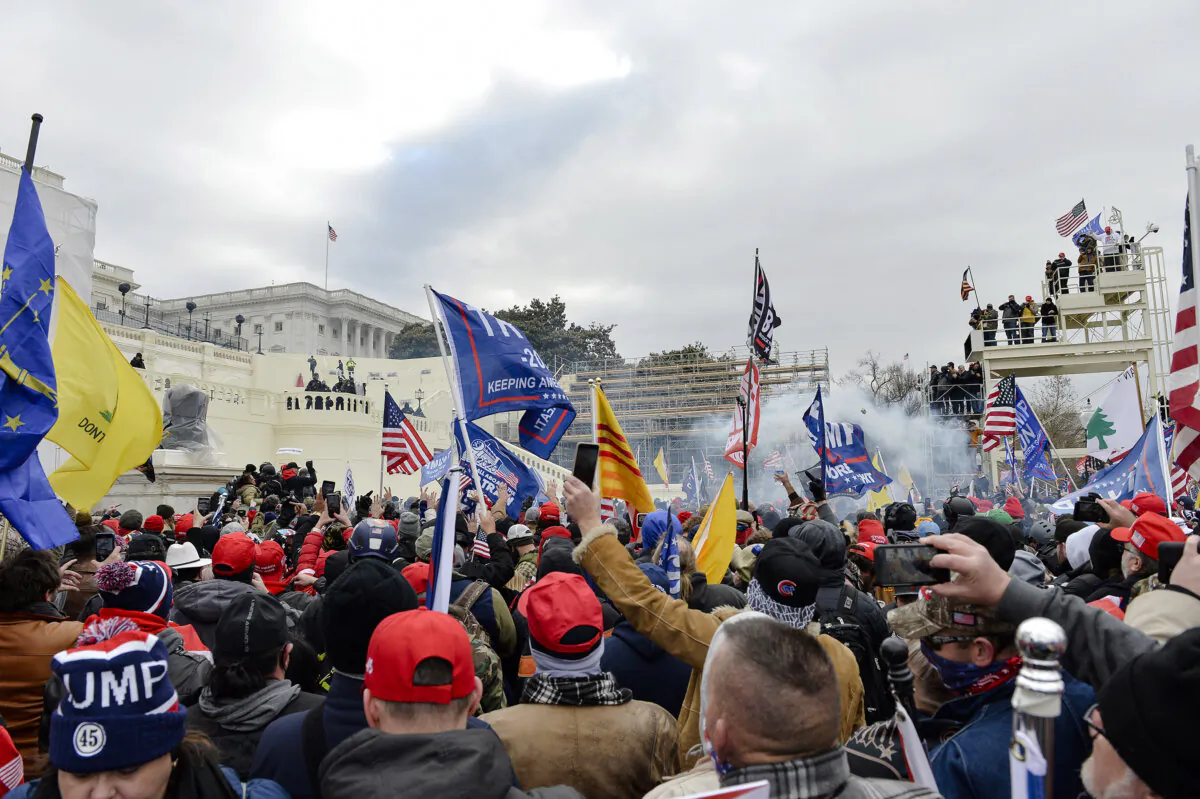

The FBI sent hundreds of agents to the U.S. Capitol and nearby locations on Jan. 6, 2021, according to an after-action report that includes numerous complaints of political bias at the bureau.
Just the News broke the story about the document on Sept. 26. Later that day, FBI Director Kash Patel threw his support behind the reporting.
“The only reason you have answers is because we are finding and producing materials exposing corruption at record levels,” Patel wrote on X in response to a post linking to an article from journalist John Solomon.
The after-action report states that 274 agents were sent to various locations in Washington on Jan. 6, including the U.S. Capitol and the Capitol grounds, when demonstrations turned into a breach of the Capitol building.
Some of those 274 agents responded to a red truck parked near the Capitol that contained components for Molotov cocktails, according to the document. Others investigated pipe bombs placed at the headquarters of the Republican National Committee and the Democratic National Committee. Both locations are also close to the Capitol complex.
In a December 2024 report, the Justice Department’s Office of the Inspector General stated that it had not found evidence “showing or suggesting that the FBI had undercover employees in the various protest crowds, or at the Capitol, on Jan. 6.”
It did document the presence of 26 confidential human sources in Washington on Jan. 6, including four who entered the Capitol. It also noted that the FBI “deployed several hundred Special Agents and employees to the U.S. Capitol and the surrounding area.”
The Office of the Inspector General’s conclusion could be consistent with the after-action report if the agents mentioned in the after-action report were not undercover. However, they could include plainclothes officers.
Political Bias a Concern
The report also records many agents’ concerns with what they perceived as political bias at the agency. Christopher Wray was its director at the time.
“The FBI should make clear to its personnel and the public that, despite its obvious political bias, it ultimately takes its mission and priorities seriously,” one anonymous comment reads. “It should equally and aggressively investigate criminal activity regardless of the offenders’ perceived race, political affiliations, or motivations; and it should equally and aggressively protect all Americans regardless of perceived race, political affiliations, or motivations.”
Another anonymous commenter took aim at the FBI’s Washington field office, describing it as “a hopelessly broken office that’s more concerned about wearing masks and recruiting preferred racial/sexual groups than catching actual bad guys.”
A third anonymous commenter called for the agency to “be politically impartial,” writing that the agency “needs to treat all crimes with an equal hand whether from left or right, and it needs to have its final goal come, ultimately, from the integrity of our Republic.”
“The very source of that is a transparent electoral system,” the comment reads. “It is not so now.”
Multiple comments contrasted the agency’s response on Jan. 6 with its response to protests and riots during summer 2020.
“Agents stood by on the ground in Washington, D.C., and observed stores being looted, burned, and ripped of anything of value,” one comment reads.
Another commenter warned that the FBI’s “response to the Capitol riot reeks of political bias.”
Some comments complained of poor communication, inadequate equipment, and insufficient training.
Rep. Barry Loudermilk (R-Ga.), who chairs the House of Representatives’ new select subcommittee on Jan. 6, wrote on X that the after-action report “is more damning than anyone could have imagined, and opens up even more questions.”
Another member of that subcommittee, Rep. Morgan Griffith (R-Va.), wrote on X, “We will continue fighting for the whole truth and full transparency.”
 Friends Read Free
Copy
Facebook
Tweet
Friends Read Free
Copy
Facebook
Tweet