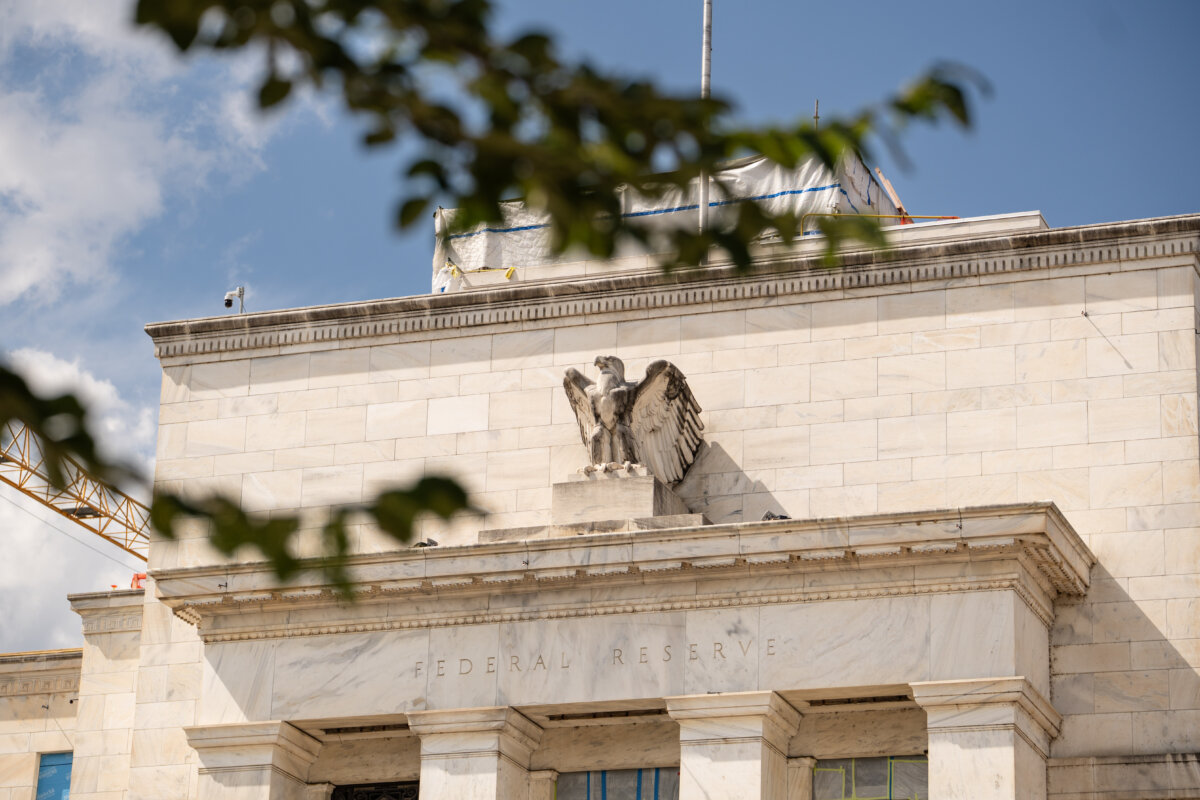

Lisa Cook, a governor on the Federal Reserve Board, is expected to sue President Donald Trump over her recent firing, refocusing attention on questions about the extent of presidential power and the protections Congress has instituted for particular federal entities.
As it has with other federal agencies, Congress passed a law limiting the reasons for which presidents could remove members of the Federal Reserve. The Federal Reserve Act allows presidents to remove governors “for cause.”
What constitutes adequate cause will likely be the subject of considerable debate in Trump’s second term, which has been marked by agency heads filing multiple legal challenges to their removals.
Central to these lawsuits is the question of whether Congress can restrict the president’s ability to fire agency heads and how much that intrudes on his constitutional authority.
A future Supreme Court case could touch on this issue while clarifying major precedents from the last 100 years. It could also address Trump’s stated reasoning for firing Cook, which centers on alleged false statements she made on mortgage documents.
The alleged conduct, the president said, “exhibits the sort of gross negligence in financial transactions that calls into question your competence and trustworthiness as a financial regulator.”
While the legal battles continue to unfold, the Supreme Court has offered limited clues into how they might end and how Cook’s case in particular might differ from those of other officials.
Executive Power
In May, a majority of the justices allowed Trump to remove the heads of two labor boards—National Labor Relations Board (NLRB) Chair Gwynne Wilcox and Merit Systems Protection Board (MSPB) Chair Cathy Harris—reversing lower court orders in the bureaucrats’ favor.
In that case, Harris and Wilcox pointed to federal laws specifying that presidents could remove them for reasons such as neglect of duty and malfeasance. They were able to secure lower court orders in their favor based on a landmark case from 1935 known as Humphrey’s Executor v. United States.
That case centered on President Franklin D. Roosevelt’s decision to fire Federal Trade Commissioner William Humphrey, who, like Wilcox and Harris, was protected by a law specifying reasons for removal. After Humphrey’s death, the executor of his estate sued, teeing up a landmark decision on presidential power.
When it decided the case, the Supreme Court held that the Constitution didn’t prevent Congress’s restrictions on the ability to fire commissioners such as Humphrey. The court’s language, however, would later be dissected by future judges and attorneys to determine whether the decision applied to other agencies and officials.
A critical portion of the Supreme Court’s decision described the Federal Trade Commission (FTC) as “quasi-legislative” or dedicated to carrying out legislative policies. “Such a body cannot in any proper sense be characterized as an arm or an eye of the executive,” the court said.
That language was cited by Chief Justice John Roberts in 2020 when he issued a decision in a case known as Seila Law v. Consumer Financial Protection Bureau. In that case, the court’s majority said that Congress had intruded on executive authority by attempting to prevent the president from removing the financial agency’s director “without cause.”
Their reasoning was based on the idea that the Consumer Financial Protection Bureau was not the type of multimember entity that the Federal Trade Commission (FTC) was, and that the financial agency’s director wielded more executive power than did members of the FTC in Humphrey’s Executor.
The administration used this case in court to argue that the president should be able to fire Wilcox and other officials. Both Seila Law and Humphrey’s Executor will likely form a critical part of the litigation surrounding Cook as well.
Her case, however, is different in certain ways, including that Trump has cited evidence of purported fraud.
Georgetown University Law Professor David Super told The Epoch Times that Trump’s allegations “could force the Supreme Court to decide what level of justification is required for a ‘for cause’ firing of a Federal Reserve board member.”
“In the past, this term has been limited to serious proven wrongdoing in office,” he added.
The Federal Reserve
Another way her case is different is that the Supreme Court has already indicated that it views the Federal Reserve as enjoying legal protections separate from agencies such as Wilcox’s and Harris’s.
Wilcox and Harris argued that their agencies and functions were similar to the FTC and its functions. They also said that if the Supreme Court ruled in Trump’s favor, it would effectively call into question the independence of the Federal Reserve.
When the Supreme Court intervened in May, it allowed Trump to remove Wilcox and Harris. Its decision was tentative, however, with a majority granting Trump’s application for a stay of a lower court decision in the agency heads’ favor.
Nonetheless, its unsigned opinion stated that the majority thought the Trump administration was likely to succeed in arguing that the two labor boards “exercise considerable executive power.”
Alex MacDonald, an attorney with the firm Littler Mendelson, told The Epoch Times that “from a constitutional standpoint, it’s hard to see why Cook’s case would be different [from Wilcox’s and Harris’s].”
“If an agency exercises significant executive power, its leaders have to be removable by the president at will,” he said.
However, that’s “probably not the view” of the Supreme Court, he added, pointing to its decision in May.
In its opinion, the majority disagreed with Wilcox’s and Harris’s attempts to compare their agencies to the Federal Reserve. It added that the “Federal Reserve is a uniquely structured, quasi-private entity that follows in the distinct historical tradition of the First and Second Banks of the United States.”
Justices Elena Kagan, Sonia Sotomayor, and Ketanji Brown Jackson dissented from that decision.
Writing for her dissenting colleagues, Kagan said that the majority’s decision was “extraordinary” and that it “poses a puzzle.” She added that “the Federal Reserve’s independence rests on the same constitutional and analytic foundations as that of the NLRB, MSPB, FTC, and so on—which is to say it rests largely on Humphrey’s [Executor].”
 Friends Read Free
Copy
Facebook
Tweet
Friends Read Free
Copy
Facebook
Tweet