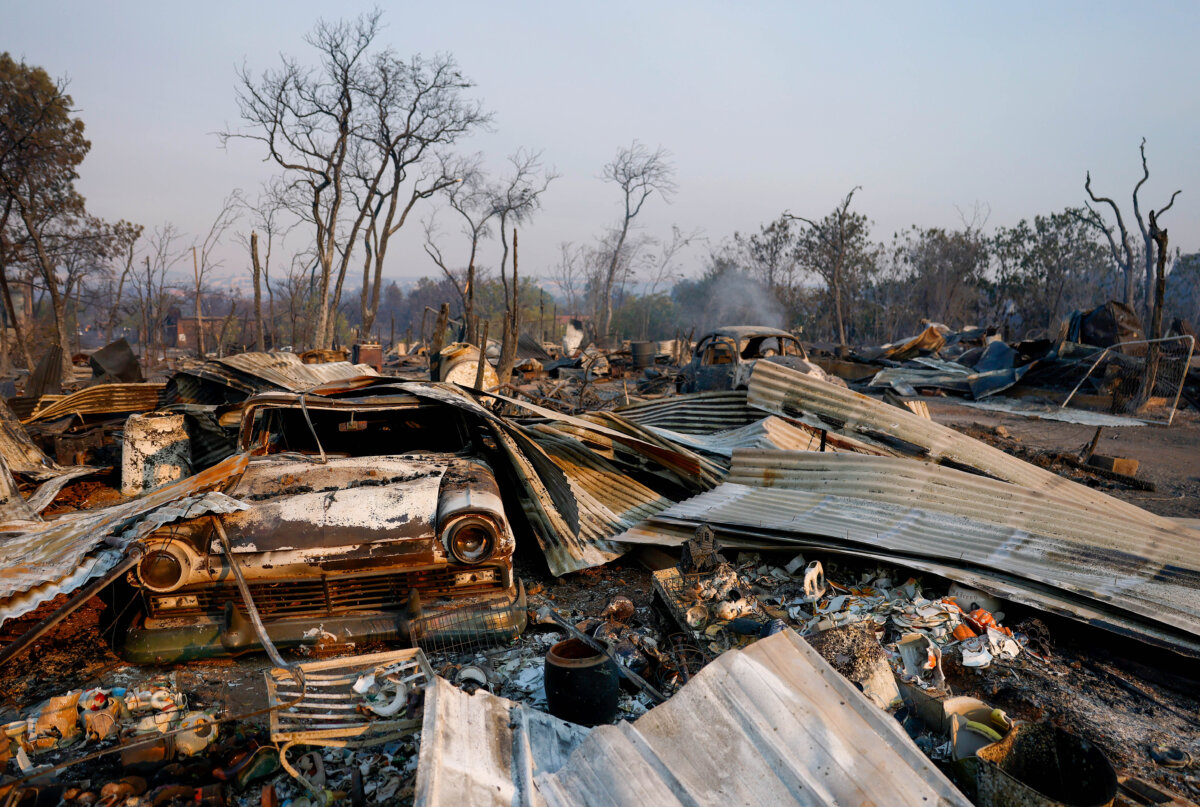

An administrative consolidation of federal wildland firefighting resources will be tested in the coming months, as the National Interagency Fire Center has warned that more than 60 percent of the United States is now in drought and AccuWeather has projected that up to 8 million acres, primarily across the parched intermountain West, will burn by fall.
Interior Secretary Doug Burgum said the U.S. Wildland Fire Service, created in January, will merge what is now a mosaic of federal responders from multiple agencies into a single command-and-control operation to enhance coordination with state, local, and tribal firefighters in battling blazes on 500 million acres of federal public lands.
The new service is led by Brian Fennessy, former chief of the Orange County Fire Authority in California and a 50-year wildfire-fighting veteran, who will function as “essentially a joint chiefs of staff,” he told the House Natural Resources Committee in a May 13 hearing on the Interior Department’s proposed $16.1 billion fiscal year 2027 budget.
The operation Fennessy leads, based at the National Interagency Fire Center in Boise, Idaho, right now is only an administrative footprint. Congress must approve the transfer of more than 5,780 federal and 900 tribal firefighters into the service, a proposed consolidation incorporated into the Trump administration’s Fiscal Year 2027 spending requests for the Department of the Interior (DOI) and Department of Agriculture, for the service to be fully manned and functioning next year.
Burgum said the proposed consolidation of wildland firefighters from the Department of Agriculture’s Forest Service with those from the DOI’s Bureau of Land Management, Fish & Wildlife Service, Bureau of Indian Affairs, and National Park Service into one “unified force” is a long-overdue reorganization of federal public lands management agencies.
Also proposed in the DOI’s Fiscal Year 2027 spending request is the merger of the DOI’s Bureau of Ocean Energy Management and the Bureau of Safety and Environmental Enforcement into the newly established Marine Minerals Administration, as is the partial incorporation of the Commerce Department’s National Oceanic and Atmospheric Administration’s fishery offices’ responsibilities under the Endangered Species Act into the DOI’s Fish and Wildlife Service.
The proposed mergers are among initiatives Burgum, Agriculture Secretary Brooke Rollins, and Energy Secretary Chris Wright have been touting in budget hearings that kicked off in April and will continue through the summer on three of the 12 appropriations bills that constitute the annual federal budget for the approaching fiscal year, which will begin on Oct. 1.
Although there are questions from both sides of the aisle about the proposed agency mergers, especially those under the Marine Minerals Administration, Burgum’s “strategic unification” of federal firefighting forces appears to have bipartisan support.
There’s also urgency across party lines to act because the nation, even outside the West, faces growing water quantity and quality crises and because the prospect of a calamitous summer wildfire season is a real possibility.
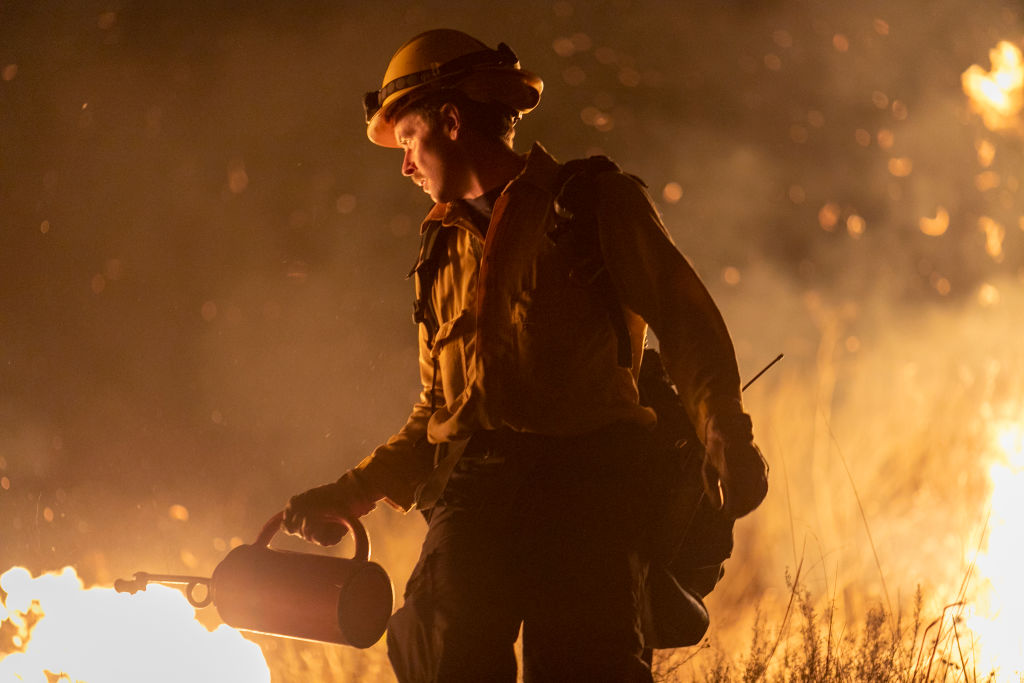
Dire Fire Projections
The May 1 seasonal outlook posted by the National Interagency Fire Center classifies 62 percent of the nation as in drought, and the West, the High Plains, and the Southeast now display “the greatest degradation.”
As of April 30, the center reported, more than 24,000 wildfires have burned nearly 1.85 million acres nationwide already in 2026, a 194 percent increase in acreage and a 150 percent hike in frequency over the previous 10-year average.
“Snowpack across the West is well below normal, indicative of a snow drought, with many river basins from Oregon and California to the Great Basin, Colorado, and Southwest less than 20 percent of normal, if not already barren of snow,” the center documented, and snowpack in the Northwest is between 40 percent and 80 percent of normal.
Using those statistics, Accuweather forecasters project that between June and October, there will be 65,000 to 80,000 wildfires that will burn between 5.5 million and “above 8 million acres,” compared with 5.1 million acres in 2025.
California’s Sierra Madre, “where grasses dry out quickly” and there’s “little snowpack,” present a risk that fires “could expand later in the summer and peak in the fall, when wind events become more common.” Accuweather warns that West Texas, Oklahoma, Kansas, eastern Colorado, and “some areas along, and west of, the Blue Ridge Mountains” from west Pennsylvania to Georgia are facing immediate peril that could linger through the summer.
House National Resources Committee Chair Rep. Bruce Westerman (R-Ark.) said that “more than 44 million homes are at risk” near public lands “in the wildland-urban interface” and that comprehensive federal oversight in responding to wildland conflagrations is a concept certain to get its baptism by fire this summer.
“The need to act quickly has never been greater,” he said. “Across the West, snowpack is at its lowest level in more than four decades, an ominous sign as we enter the height of the wildfire year.”
But Westerman—a forester—also said that unless forestry management practices that increase timber harvesting on public lands are adopted, the nation’s public lands will remain thickets of deadwood tinder waiting for a lightning strike or fallen power line to combust.
He urged the Senate to adopt his proposed Fix Our Forests Act, passed by the House 279–141 in January 2025, which amends federal timber harvesting practices, and he praised the proposed DOI budget for “tripling the size” of allowable cut areas on federal public lands and “codifying emergency authorities” under one consolidated firefighting office.
 Friends Read Free
Copy
Facebook
Tweet
Friends Read Free
Copy
Facebook
Tweet