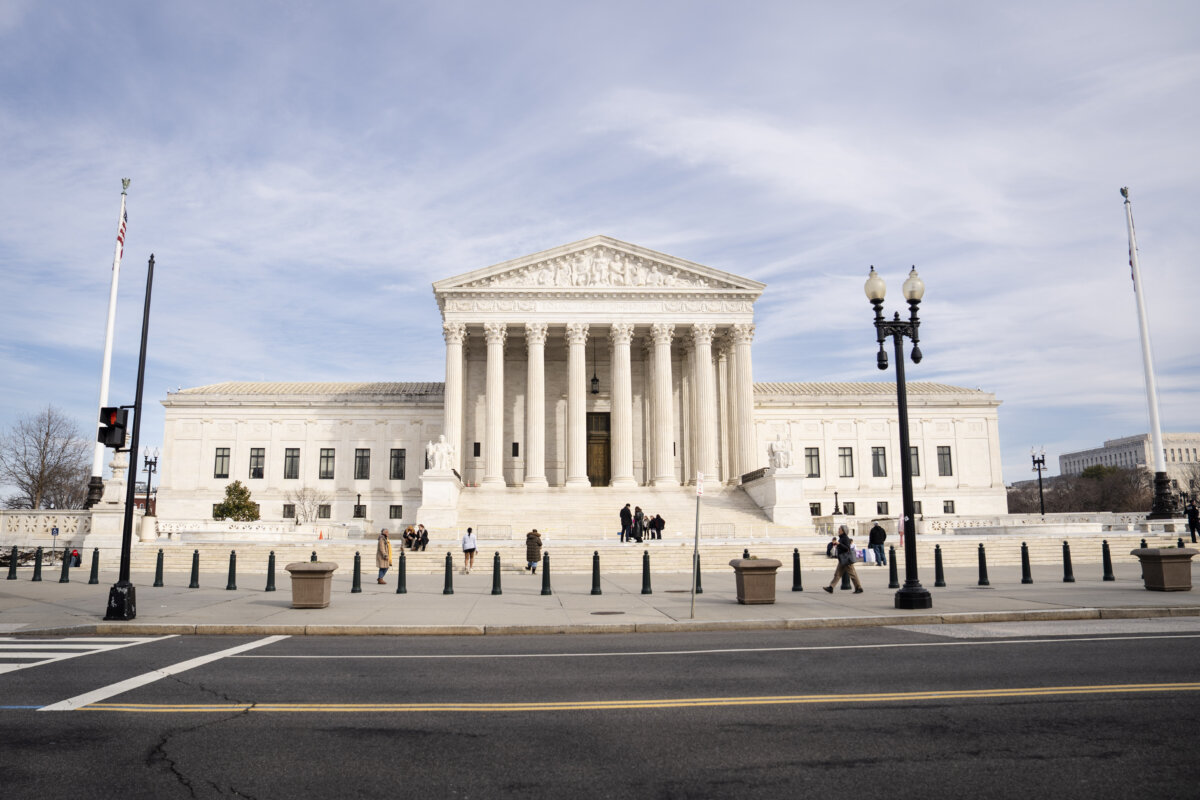

The federal judiciary has asked Congress to pass legislation giving it the power to manage its own courthouses.
If the request is granted, the change would shift that authority from the General Services Administration (GSA), which is part of the executive branch. The Judicial Conference, which is the rule-making body for the federal courts, sent a draft bill on Feb. 24 to administration and congressional leaders, proposing a gradual shift in property-management authority.
The group cited a decade’s worth of deferred maintenance, noting that even emergency repairs, including repairs of storm damage, can take years to complete.
“Federal courthouses are in crisis. Without immediate action, the problems will continue to worsen,” Judge Robert J. Conrad Jr., the director of the Administrative Office of the U.S. Courts, said in a statement in support of the request.
“Action is needed now to reverse a downward spiral of critical-system failures, long-term underfunding of repairs, security risks, and climbing costs.”
Called the Space and Facilities Management Effectiveness Act of 2026, the bill would allow the judicial branch the same property authority held by the other two branches of government.
Currently, GSA is the judiciary’s landlord, and the Architect of the Capitol manages property needs for the legislative branch.
“The transfer would support the Judiciary’s function as a co-equal branch of the federal government, by enabling it to manage properties critical to the Judiciary’s constitutional mission,” the U.S. Courts said in a statement.
GSA-owned buildings account for more than 80 percent of the federal court system’s space. Currently, the Judicial Conference is paying $1.3 billion to GSA in rent annually, and the group is responsible for the upkeep of the federal buildings and support offices.
In the legislative package, the Judiciary Conference cited GSA staff cuts and reorganization as a cause for delay.
Late in 2025, hundreds of GSA employees were asked to return to work after initially losing their jobs because of changes made by the Department of Government Efficiency.
Marianne Copenhaver, GSA associate administrator for strategic communications, told The Epoch Times in an emailed statement that GSA officials “disagree with the characterization that the federal courthouse portfolio is in ‘crisis’ due to mismanagement.”
“While aging federal buildings present well-known challenges, their narrative omits critical context regarding our lack of access to GSA’s Federal Building Fund to address delinquent maintenance,” she said.
She said it was the GSA’s position that “the American taxpayer is best served by the Judiciary focusing on the rule of law while GSA continues to focus on the federal real estate portfolio.”
According to the Judiciary Conference, it was slow to seek the new authority, formally known as real property authority.
The conference first pursued the authority in 1989, and again in 2006. In both cases, the group voiced concerns about courthouse management and maintenance.
In 1989, Congress did not pass the necessary legislation to transfer such authority to the Judicial Conference.
In 2006, the plea was made to Congress again, this time amid growing concerns about courthouse security after 9/11. Complaints about delays and underfunding still did not prompt Congress to transfer real property authority to the courts, and the GSA maintained operational management.
The judicial branch has said that if real property authority is granted to the Judicial Conference, it will be able to complete repairs faster and more effectively than under the current system, reducing the backlog.
The Judicial Conference is seeking action from Congress to transition property management to properties “critical to the constitutional mission of the Judiciary.”
“We see this as an opportunity for constructive realignment, not separation,” Conrad said. “GSA would ultimately shed $8.3 billion in delinquent maintenance it lacks the funding and resources necessary to remediate.
“Real property authority will empower the Judiciary to coordinate directly with Congress on critical courthouse needs. It will ensure that the Judiciary can control and maintain the buildings it occupies to safely fulfill its constitutional mission more effectively.”
 Friends Read Free
Copy
Facebook
Tweet
Friends Read Free
Copy
Facebook
Tweet