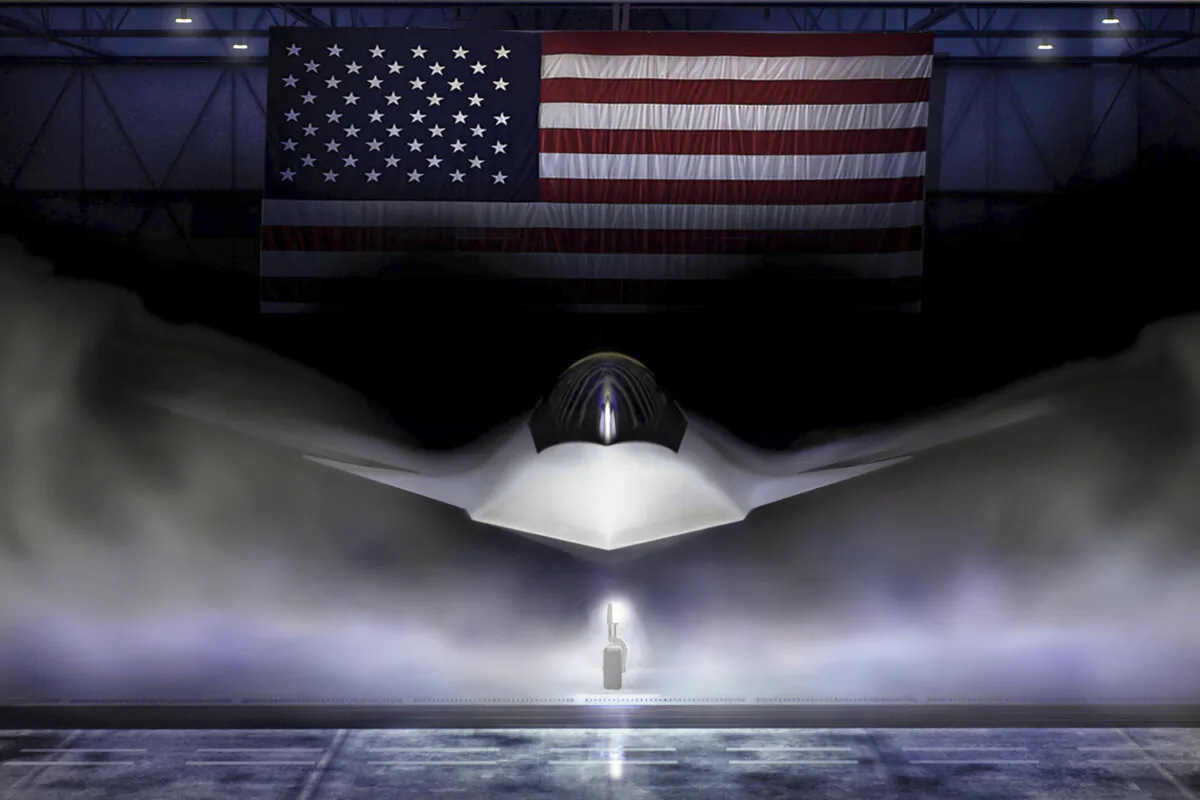

Boeing has begun building the U.S. Air Force’s most advanced stealth fighter, the F-47, Air Force Chief of Staff Gen. David Allvin revealed on Sept. 22.
“The team is committed to getting the first one flying in 2028,” Allvin said, according to Air & Space Forces Magazine, the Association’s official publication.
“In the few short months since we made the announcement, they are already beginning to manufacture the first article,” Allvin said, referring to the first test aircraft. “We’re ready to go fast. We have to go fast.”
Speaking at this year’s Air, Space & Cyber Conference, hosted by the Air & Space Forces Association in Maryland, Allvin said Boeing began work after being awarded a $20 billion contract in March.
The F-47—previously known as the Next Generation Air Dominance (NGAD) platform—is envisioned to replace the F-22 Raptor as the centerpiece of America’s future air superiority fleet. The program was briefly paused under the Biden administration but was revived under President Donald Trump, who announced the aircraft at a White House briefing and revealed it would carry the designation F-47, a nod to the 47th president.
“Nothing in the world comes even close to it, and it’ll be known as the F-47,” Trump said at the time.
While much about the aircraft remains highly classified, it is expected to incorporate cutting-edge stealth technologies, integrate artificial intelligence and quantum computing, and operate alongside semi-autonomous drone wingmen known as collaborative combat aircraft. Concept graphics released by the Air Force in May suggested a combat radius of more than 1,000 nautical miles, or about 1,150 miles, and speeds exceeding Mach 2—twice the speed of sound, more than 1,500 miles per hour.
That same post suggested that the Air Force plans to buy at least 185 F-47s, which would match or exceed the size of the F-22 fleet.
“It’s the platform that, along with the rest of the system, is going to ensure [air] dominance into the future,” said Allvin, who is set to retire but will remain chief of staff until a successor is confirmed.
Boeing did not respond to a request for comment.
The defense contract giant is also competing in the U.S. Navy’s F/A-XX program to develop a next-generation carrier-based fighter. A rendering the company recently released of its F/A-XX concept bears notable similarities to the images released so far of the F-47.
The Sept. 22 announcement was made amid an intensifying race between the United States and China to field the world’s first operational sixth-generation combat aircraft, a weapon seen as critical in the contest for air superiority.
On Sept. 3, during a massive parade marking the 80th anniversary of Japan’s defeat in World War II, China unveiled new carrier-based fighter variants, including the J-15T, adapted for electromagnetic catapult launches, and the upgraded J-15DH and J-15DT electronic warfare aircraft.
The event also showcased the J-35, China’s second fifth-generation fighter. State broadcaster CCTV reported this week that both the J-35 and the carrier-based KJ-600 early warning and control aircraft had completed catapult launch and recovery trials aboard the Chinese navy’s newest aircraft carrier, Fujian.
China is also believed to be working on sixth-generation fighters. Photos and videos circulating online suggest two prototypes—unofficially dubbed the J-36 and J-50—featuring a three-engine, tailless design reminiscent of the U.S. NGAD.
At the same Maryland conference, U.S. Air Force Secretary Troy Meink appeared to mock Beijing’s efforts to reverse-engineer U.S. designs after showing a rendering of the F-47.
“I expect some of the Chinese intel analysts are spending a lot of time looking at this picture,” Meink said. “Good luck.”
 Friends Read Free
Copy
Facebook
Tweet
Friends Read Free
Copy
Facebook
Tweet