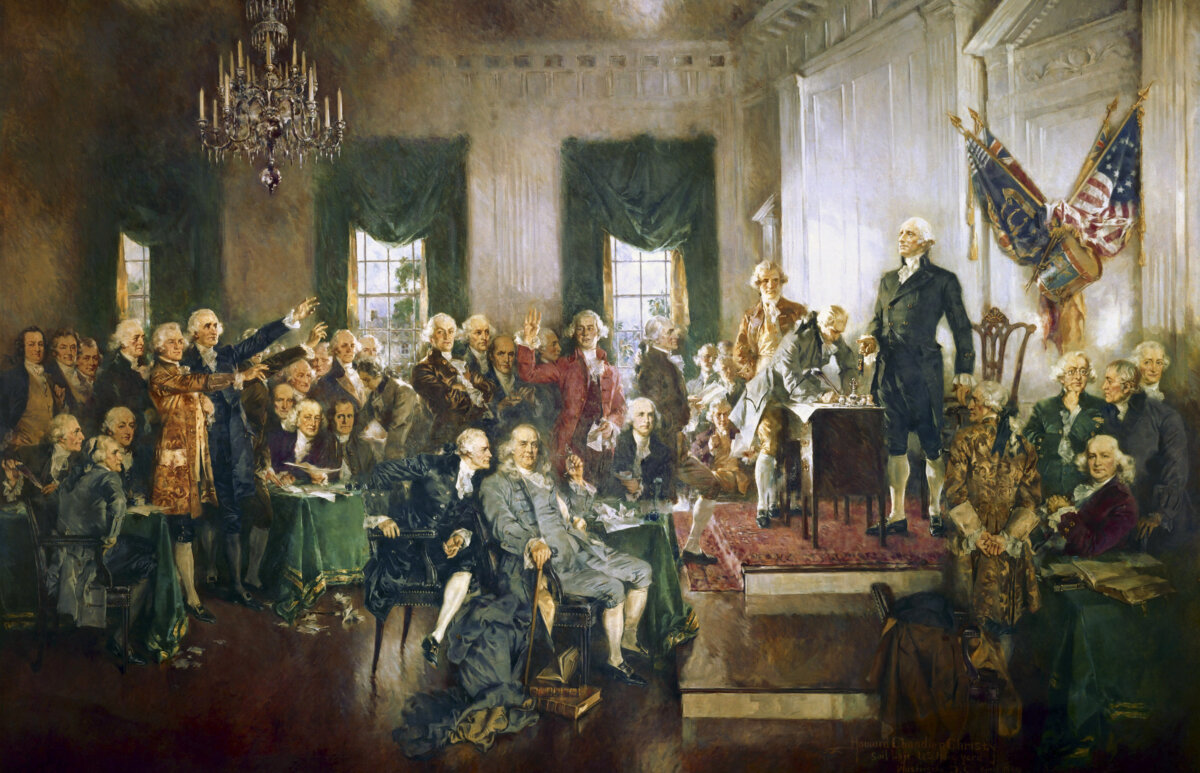

Sept. 17 is Constitution Day and Citizenship Day in the United States, and it commemorates the signing of the U.S. Constitution, which took place on that date in 1787.
The signing marked the start of a stand for the American way of life that took a harrowing journey through the American Revolution.
But it officially began when 42 delegates to the Constitutional Convention met for the last time in Philadelphia, and 39 signed onto what became one of the founding documents of this country.
Here’s what to know about Constitution Day and Citizenship Day—often simply called Constitution Day—and why it’s worth celebrating.
The Road to Ratification
While most of us know the results of America’s rebellion from England, it’s easy to forget that the founding of the nation was done with intention and procedure.
Delegates from each colony came together with instructions to revise the original framework of government, called the Articles of Confederation.
Instead, they did what many early Americans did and threw out the rulebook, creating a new governmental system.
The debate took months, but eventually a division of power was decided upon, and the resulting Constitution took shape, splitting power between three branches of federal government and reserving other powers to the states.
Only three delegates declined to sign, with one of their primary objections being the absence of a Bill of Rights, which was ratified in 1791.
However, as the new system of government required, the signing by the delegates did not immediately make it the law of the land; ratification by the states was required.
The new form of government needed at least nine of the 13 states to sign off. Delaware was the first to take that step, and New Hampshire was the ninth, on June 21, 1788.
The federal government began operation under the newly ratified Constitution in 1789.
Constitution Week
While Sept. 17 is the official Constitution Day, it is just one part of Constitution Week, which will be observed from Sept. 17 to Sept. 23 of this year.
Observance of Constitution Week began in 1956 and features a presidential proclamation and a spotlight from many in government.
This year, President Donald Trump issued a proclamation commemorating the 239th anniversary of the signing of the Constitution and the founding of the Republic.
“Over two centuries later, we remain more committed than ever to protecting and cherishing the fundamental values of America and the vision of our forefathers for a just, prosperous, and free Nation,” Trump said.
The presidential proclamation reminded Americans that the Founding Fathers took their own lives into their hands when they assembled at Independence Hall to sign the document and “form a more perfect Union.”
Trump called on school teachers, as well as state and local leaders, to “educate America’s pupils on the rights and responsibilities of citizenship under our constitutional order.”
Federal Requirements
Constitution Day is more than just a holiday to remember a significant event in American history.
In fact, every federal educational institution that receives federal funds must provide materials about the Constitution on Sept. 17.
This was reiterated this year by the United States Department of Education, which issued a reminder on Sept. 16 to educational institutions about their responsibility.
While the law doesn’t state what instruction must be offered, or how the information needs to be presented, some suggested activities include providing students with the opportunity to recite the Pledge of Allegiance, hosting a mock Constitutional Convention, and conducting a public reading of the Constitution.
Interestingly enough, however, Constitution Day is not a federal employee holiday.
Frequently, Constitution Day is marked by naturalization ceremonies at federal courts.
The U.S. Courts describe the observance of those ceremonies as one way to participate in the day.
While U.S. Citizenship and Immigration Services is typically responsible for the naturalization ceremonies, federal judges often hold events when they fall on Citizenship Day.
History of Citizenship Day
While the Constitution was signed in the late 1700s, the “citizenship” part of the holiday was added much later.
The modern Citizenship Day was established in 1940 and was initially on the third Sunday in May. It was called “I Am an American Day.”
During a time when the nation was still dealing with the aftermath of WWI and the immediate impacts of WWII, the day was meant to recognize those who attained their American citizenship.
An act by Congress moved the observance to Sept. 17 in 1952, and also renamed it “Citizenship Day,” coinciding with the anniversary of the signing of the Constitution.
Congress officially named the day Constitution Day and Citizenship Day with the stated purpose of commemorating the Constitution and recognizing those who, “by coming of age or by naturalization, have become citizens.”
In his proclamation for the year 2026, the president asserted that “Guided by the most righteous political document ever conceived, America remains the greatest force for good in the history of the world.”
 Friends Read Free
Copy
Facebook
Tweet
Friends Read Free
Copy
Facebook
Tweet