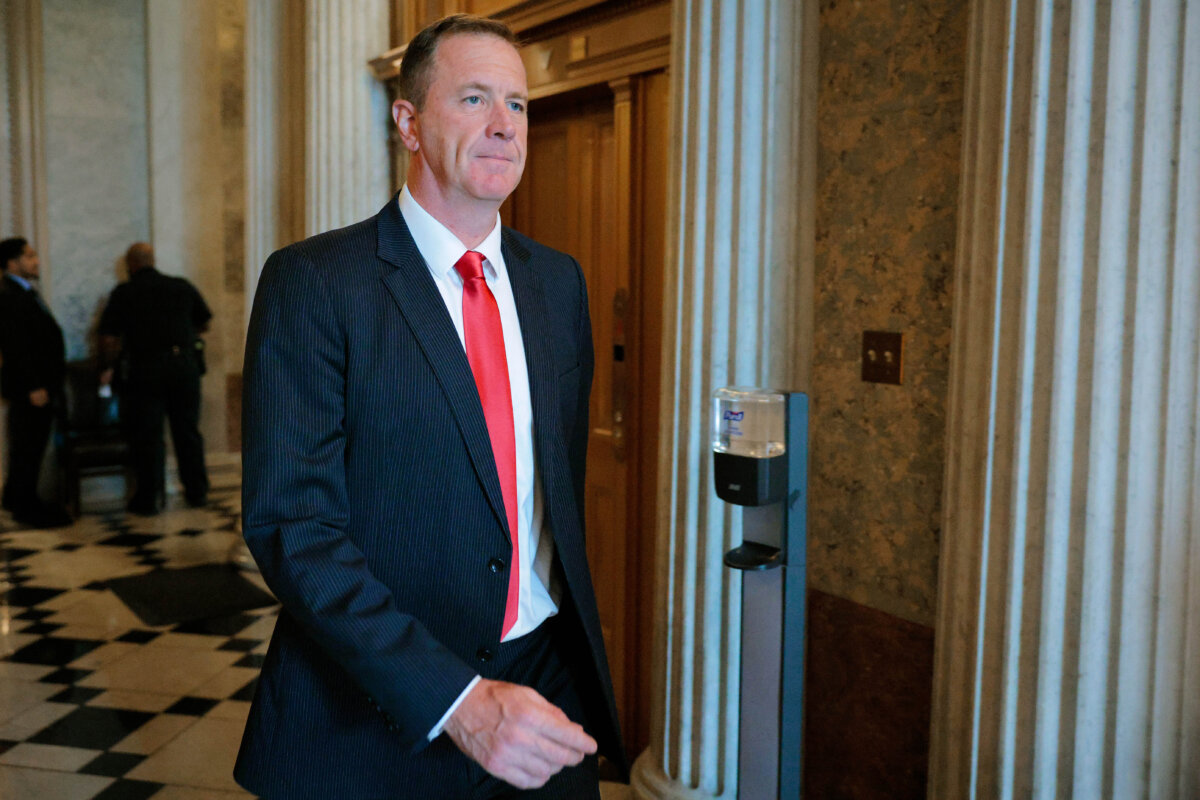

Republican Missouri Senator Eric Schmitt introduced legislation on Jan. 19 aiming to broaden the federal government’s power to revoke citizenship from naturalized people who commit serious crimes.
The Stop Citizenship Abuse and Misrepresentation (SCAM) Act comes after massive fraud allegations against Minnesota and weeks of unrest in the state.
The senator, referring directly to the Somali community in Minnesota in his announcement on X, said his White House-endorsed bill would target naturalized citizens accused of fraud and other serious felonies. The Department of Justice has previously said the majority of suspected or convicted fraudsters in Minnesota are of Somali descent.
President Donald Trump vowed in a Jan. 13 speech in Detroit to revoke the citizenship of naturalized Somali immigrants convicted of fraud.
“We’re going to get them the hell out of here fast,” Trump said in his speech. “If you come to America to rob Americans, we’re throwing you in jail, and we’re sending you back to the place from where you came.”
Schmitt wrote that his bill is simple: If, within 10 years of being naturalized, a citizen commits a serious crime, it’s evidence the individual never qualified for citizenship to begin with, and it should be revoked.
The legislation outlines several serious crimes that could be used as legal grounds for denaturalization of a person, including espionage, felony fraud against government programs, aggravated felonies, and joining or affiliating with drug cartels or terrorist organizations.
Citizenship applicants must be of good moral character, attached to the principles of the U.S. Constitution, and well disposed to the order and happiness of the country.
These are non-negotiables for naturalization, Schmitt said.
Schmitt said denaturalization is a punishment the United States has used throughout American history, with Congress authorizing its use more than a century ago.
In both world wars, foreign-born naturalized citizens had their citizenship revoked if they aligned or worked with enemy powers, he stated, continuing that this practice was used in the Cold War for those who concealed their allegiance to the communist party.
“The SCAM Act doesn’t invent a new idea out of whole cloth,” Schmitt said. “It builds on an existing principle by applying it to modern conditions—which unfortunately includes massive Somali fraud rings.”
Schmitt said a number of suspects involved in the alleged Minnesota fraud are naturalized citizens and lied when they took an oath to be loyal to American laws.
“They were entrusted with the gift of American citizenship, and they betrayed that trust by enriching themselves at our expense,” the senator’s X post reads.
If the 10-year window outlined in Schmitt’s bill is deemed unconstitutional by the courts, he said the period can be knocked down to five years.
Representative Ilhan Omar (D-Minn.) has criticized the Trump administration and the Republicans for backing the immigration enforcement operations in Minneapolis.
“It is appalling for them to be okay for there to be checkpoints in American cities,” she said at a hearing co-hosted with Representative Pramila Jayapal (D-Wash.) in St. Paul, Minnesota, on Jan. 16.
Minnesota Gov. Tim Walz has called for citizens to continue peacefully protesting against ICE operations.
He recently called the ICE raids “political retribution,” accusing the president of punishing Minnesota because the state voted against him in recent presidential elections.
“Minnesotans believe in the rule of law,” Walz said in a follow-up post. “We’re a place where there’s room for everybody, no matter who you are, or who you love, or where you came from.”
 Friends Read Free
Copy
Facebook
Tweet
Friends Read Free
Copy
Facebook
Tweet