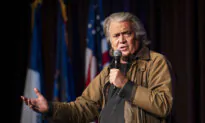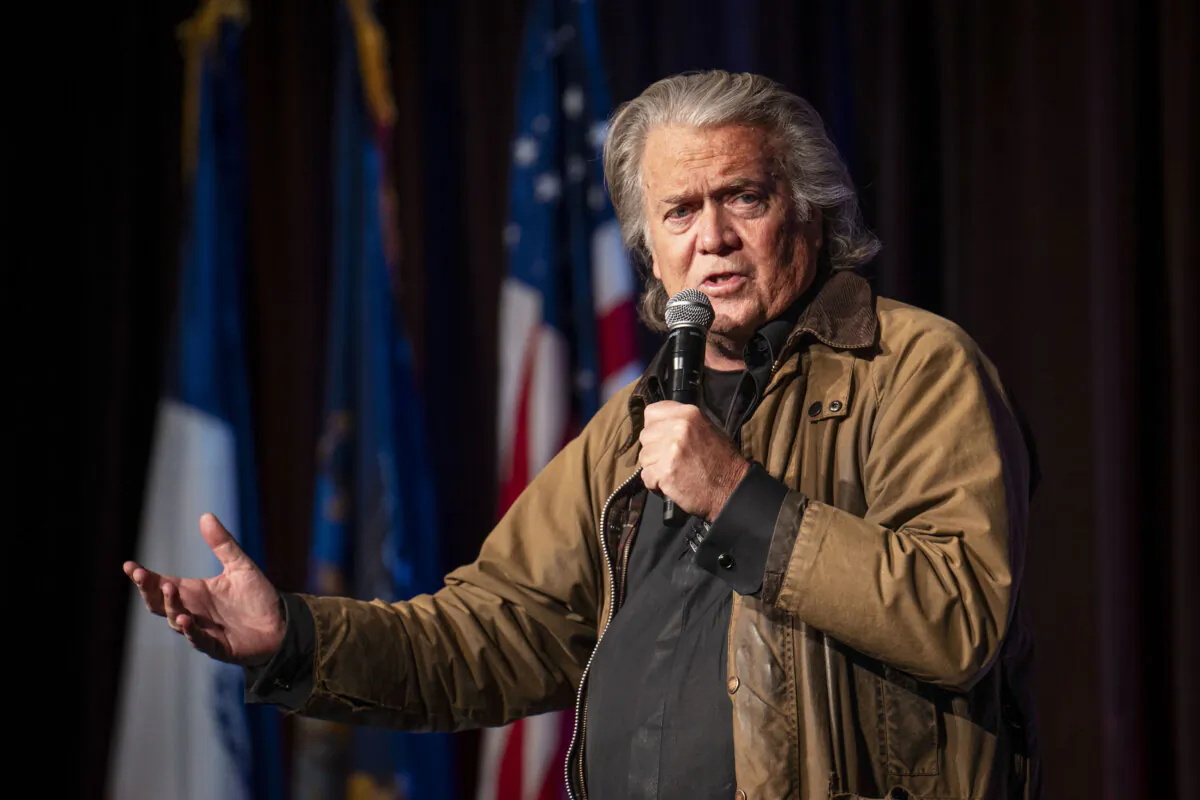

A federal judge on Aug. 26 rejected the Department of Justice’s (DOJ’s) request to dismiss the indictment against former White House strategist Steve Bannon, for which he was convicted and sentenced in 2022.
Bannon, a one-time adviser to President Donald Trump, served in the first Trump term and was imprisoned for four months in 2024 in the contempt case.
U.S. District Judge Carl Nichols wrote that prosecutors failed to adequately explain the rationale.
“The Government’s motion does not explain its motivations for seeking dismissal of the indictment,” said Nichols.
Nichols left the door open for the DOJ to try again. He said that the government is “free to submit a renewed motion.”
Both Bannon and the Trump administration want the case to be thrown out.
Bannon had been convicted by a federal jury in the nation’s capital on two counts of contempt of Congress for not providing documents or testimony to a Democratic-led House committee that was investigating the Jan. 6, 2021, security breach at the U.S. Capitol.
“Mr. Bannon believed his actions were in compliance with the law,” his lawyers said in a filing to the Supreme Court, highlighting how Bannon’s representatives had instructed him not to comply with the subpoenas until issues surrounding executive privilege, or privilege exerted by the president, were resolved.
In 2022, Bannon became the first person since the 1980s to be convicted of contempt of Congress.
At the time of the breach, Congress was in the process of certifying the results of the 2020 presidential election. Joe Biden was inaugurated as president on Jan. 20, 2021.
Bannon had claimed the committee’s investigation and the charges later brought against him by the Biden administration were politically motivated.
Nichols oversaw Bannon’s trial.
Nichols sentenced Bannon to four months in prison and levied a fine of $6,500.
Bannon, who hosts the popular “WarRoom” podcast, said at a media event when he left prison in October 2024 that he believed prominent Democrats had hoped to break him.
“I think you can see today I’m far from broken. I’ve been empowered by my four months in Danbury federal prison,” he said.
Federal lawyers asked Nichols to dismiss the criminal case against Bannon on Feb. 9.
“The government has determined in its prosecutorial discretion that dismissal of this criminal case is in the interests of justice,” prosecutors wrote in filings to the Supreme Court and Nichols.
Bannon’s lawyers, in a 2025 filing to Supreme Court justices, said the contempt of Congress statute requires proving that a person knew his or her conduct was illegal and that it should not have been redefined to intentional conduct.
Keeping the conviction in place “conflicts with 150 years of case law from this Court, is contrary to basic canons of construction, and will cause serious harm to the separation of powers,” they wrote.
The court previously rejected Bannon’s attempt to delay reporting to prison but has not weighed in on the appeal itself.
In a 7-page filing on Feb. 9, Solicitor General D. John Sauer told justices that the court should grant the petition for review, vacate the judgment of the appeals court, and remand the case to Nichols.
Then on April 6, the Supreme Court cleared the way for the Trump administration to dismiss the criminal contempt case.
The high court granted Bannon’s petition in an unsigned order. The court did not explain its order. No justices dissented.
The Supreme Court sent the case back to the U.S. Court of Appeals for the District of Columbia Circuit for further consideration, as that court considers a pending motion to dismiss the indictment.
The Epoch Times has contacted Steve Bannon and the Department of Justice for comment.
The Associated Press, Matthew Vadum, and Zachary Stieber contributed to this report.
 Friends Read Free
Copy
Facebook
Tweet
Friends Read Free
Copy
Facebook
Tweet