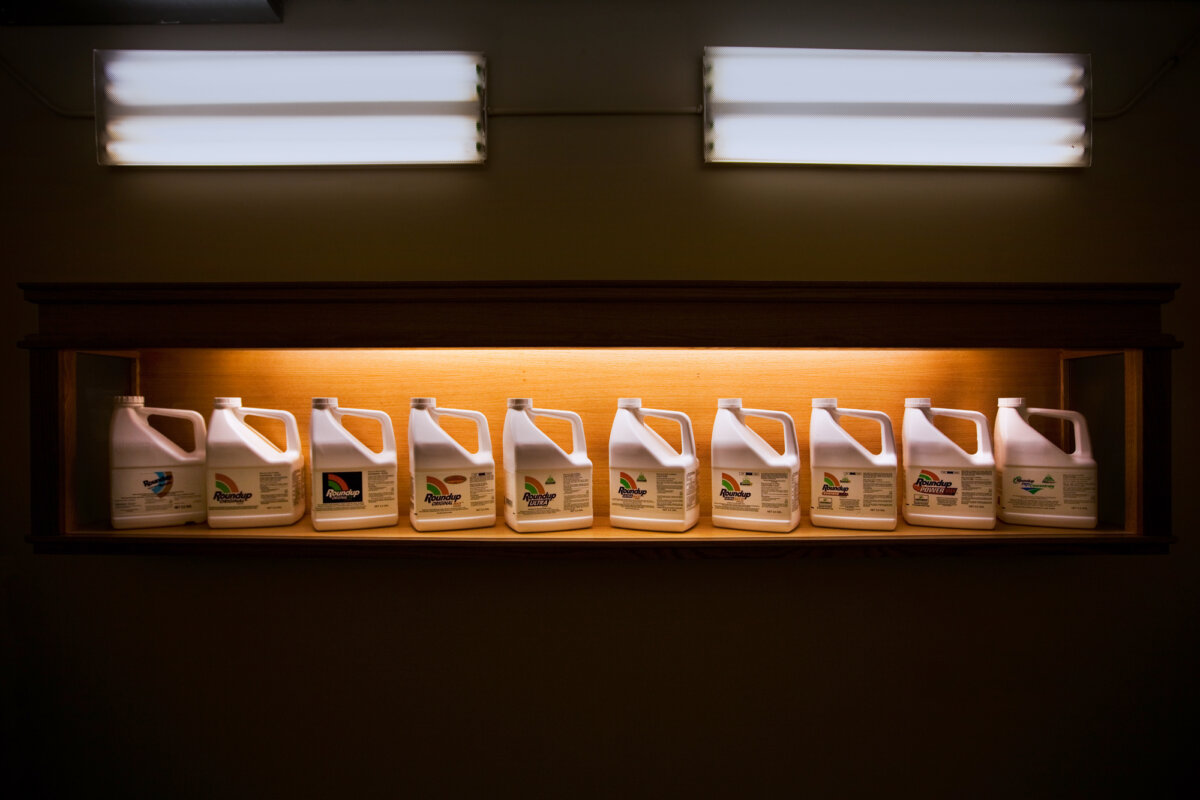

A circuit judge in Missouri is set to begin weighing on Sept. 14 agrochemical giant Monsanto’s proposal of a $7.25 billion settlement for tens of thousands of lawsuits alleging that the company’s popular Roundup weedkiller causes cancer.
Judge Timothy Boyer of St. Louis is not expected to issue an immediate ruling at the hearing, but he will examine Monsanto’s lawyers’ justification of the settlement as they seek Boyer’s final approval, while some plaintiffs’ attorneys argue that their clients should not be strong-armed into accepting the company’s proposal.
The settlement, which was announced in February, is meant as a way to contain litigation.
It aims to resolve nearly all of the roughly 65,000 claims still pending in federal and state courts, and it’s meant to cover future Roundup claims as well. The settlement received preliminary approval from Boyer on March 4.
As part of the settlement, the company would offer payouts for individuals who were exposed to Roundup and developed non-Hodgkin lymphoma. The exact award amount for each person would depend on different factors, including the severity of their cancer, their age when they were diagnosed, and whether they were exposed to the chemical at work or at home.
For occupation claimants—meaning farmers, gardeners, maintenance workers, landscapers, and more—their payouts could range from $60,000 to $165,000.
The agreement would also award residential claimants, referring to homeowners who use Roundup for their gardens, yards, and driveways. Payouts for this group could range from $20,000 to $40,000.
“Monsanto remains confident that the class settlement, which is supported by plaintiffs’ counsel representing tens of thousands of potential class members, is fair to all parties, the objections have no merit, and warrants final approval following the September 14th hearing,” the company said in an Aug. 28 statement.
Supreme Court’s Involvement
Litigation against Monsanto, acquired by Germany-based Bayer in 2018, has plagued it for years, leading to one case reaching the highest court in the United States.
Individuals across the country have claimed that exposure to Monsanto’s Roundup weedkiller, which contains a key and controversial ingredient called glyphosate, causes cancer.
Although the company has repeatedly denied any link between its products and cancer, there have been multiple instances of juries throughout the country awarding plaintiffs millions of dollars.
One of those cases involved Missouri man John Durnell, who was diagnosed with non-Hodgkin lymphoma after exposure to Roundup.
He had previously won $1.25 million in his lawsuit against Monsanto, with a Missouri jury agreeing that the agrocompany failed to follow a Missouri state law requiring a warning for risks such as cancer.
But Monsanto appealed the decision, and eventually it came before the Supreme Court. The company called that prior verdict flawed because of a legal doctrine known as preemption, which holds that federal law overrides state law when the two are in conflict.
Monsanto said the federal government, through the Federal Insecticide, Fungicide, and Rodenticide Act, had already regulated its Roundup product and glyphosate. The Environmental Protection Agency (EPA), under that law, approved glyphosate’s use and has never required additional labeling related to cancer risks.
The justices, in one of the most consequential decisions from its last term, ruled 7–2 on June 25 in favor of Monsanto, holding that federal law does indeed preempt Missouri’s state law, thus throwing out the basis of the lower court’s verdict for Durnell.
Following the ruling, Bayer CEO Bill Anderson said the company would continue to pursue the $7.25 billion settlement.
Bayer already paid a $10 billion settlement in 2020 that resolved many Roundup cases but had left the company open to future claims.
Glyphosate Controversy
For years, health advocates have accused the key ingredient of Roundup—glyphosate—of being a cancer-causing chemical.
The EPA registered glyphosate as a pesticide in 1974, and it has since become one of the most widely used chemicals in the world for agriculture production.
As its use over time increased, so too did claims that exposure to glyphosate caused cancer.
The World Health Organization’s International Agency for Research on Cancer published a March 2015 review that found the chemical as “probably carcinogenic to humans.”
The Trump administration backed Monsanto in the Supreme Court case, filing a brief that urged the justices to rule favorably for the company.
In a Feb. 18 executive order, President Donald Trump said glyphosate was critical to national defense and instructed his administration to ensure that there was an adequate supply.
“Lack of access to glyphosate-based herbicides would critically jeopardize agricultural productivity,” the order read. “Glyphosate-based herbicides are a cornerstone of this Nation’s agricultural productivity and rural economy.”
This caused a rift among the Republican base, as proponents of the Make America Healthy Again, or MAHA, movement became increasingly frustrated with the federal government’s support of glyphosate.
Health Secretary Robert F. Kennedy Jr., one of the movement’s champions, had previously helped secure a $289 million award from Monsanto in 2018 for a client who alleged that Roundup caused him to develop non-Hodgkin lymphoma.
But following Trump’s executive order, Kennedy released a statement that appeared to balance support for glyphosate in securing the country’s food supply in the short term and the need to shift away from the chemical over time.
“Pesticides and herbicides are toxic by design,” Kennedy wrote in a Feb. 22 post on X. “Unfortunately, our agricultural system depends heavily on these chemicals. … I support President Trump’s Executive Order to bring agricultural chemical production back to the United States and end our near-total reliance on adversarial nations.”
He stressed that Trump did not build the current system—he inherited it—and that there are ongoing efforts to shift away from harmful agricultural methods.
Two months before the Supreme Court ruling in favor of Monsanto, Kennedy testified in Congress.
Sen. Brian Schatz (D-Hawaii) asked the health secretary whether glyphosate caused cancer, and without hesitation, Kennedy responded, “Yes.”
“I would say it’s important to minimize consumption of glyphosate as much as possible,” Kennedy said.
 Friends Read Free
Copy
Facebook
Tweet
Friends Read Free
Copy
Facebook
Tweet