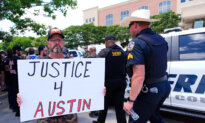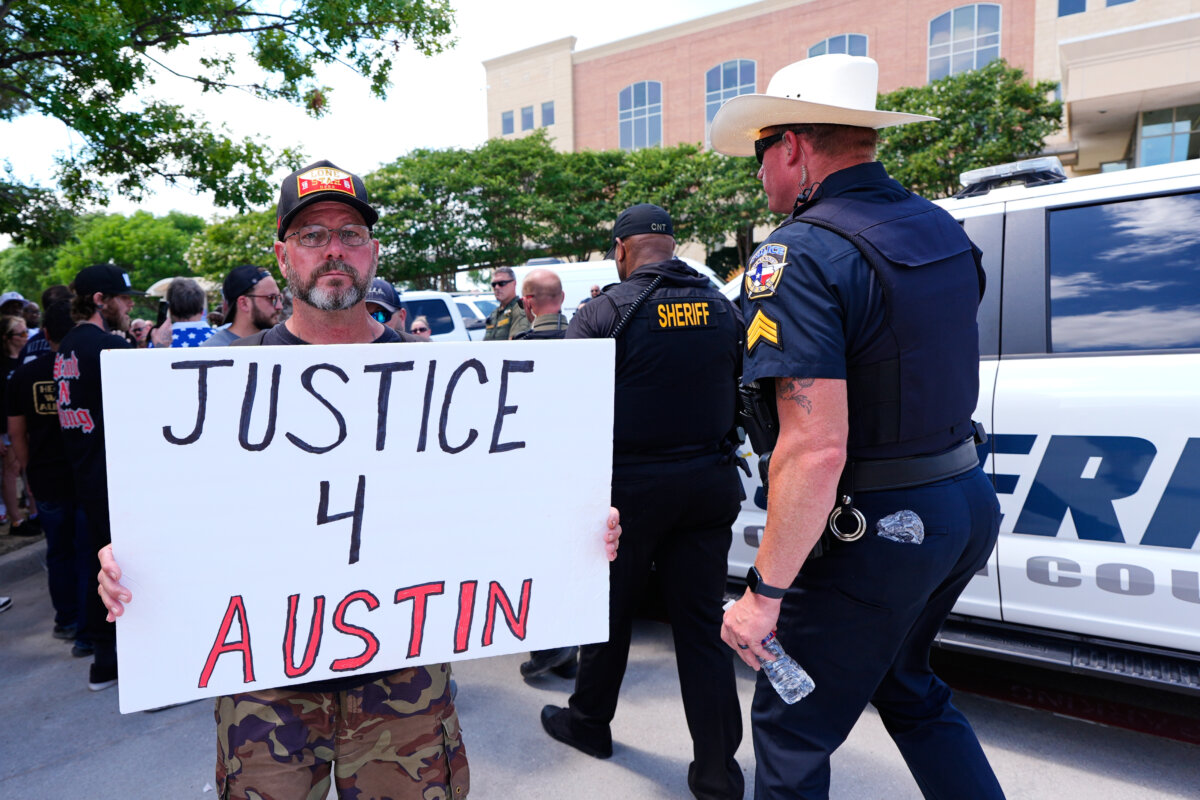
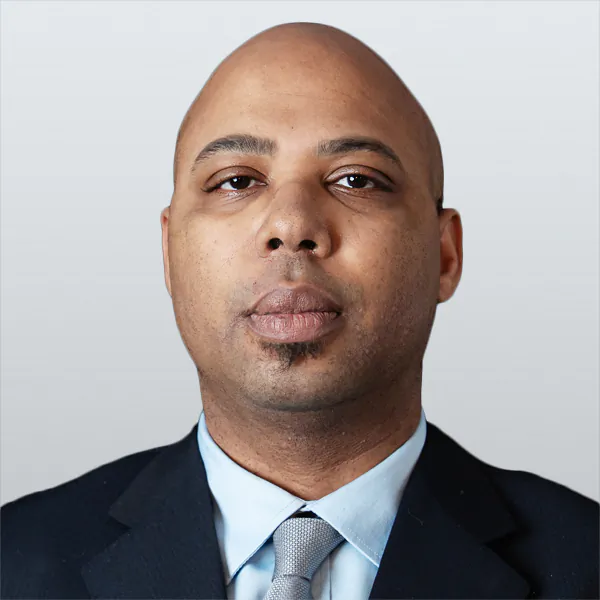
One day after a jury convicted Karmelo Anthony for the murder of a fellow high school athlete, Austin Metcalf, his attorneys said they will appeal his case. Anthony was sentenced on June 9 to 35 years in prison for the crime; the jury rejected the lesser charge of manslaughter.
“We believe there are several important issues for the appellate courts to consider,” Mike Howard, Anthony’s attorney, told TMZ. “An appeal is the next part of the legal process and a right afforded every American.”
The Epoch Times has reached out to Howard for comment.
Here are a few facts about the case.
The Circumstances of the Crime
On April 2, 2025, Memorial High School students at a track and field event in Frisco, Texas, returned to the bleachers and found Anthony sitting under a tent designated for their team.
One student, 17-year-old Metcalf, asked Anthony to leave, since he was a student of rival Centennial High School.
After Anthony refused, other students joined in and the altercation became heated.
“Touch me and see what happens,” Anthony allegedly said, according to an arrest report.
Later witness testimony was unclear about whether Metcalf shoved Anthony with one hand or two, as well as exactly how hard he pushed him.
What happened next is not in dispute: Anthony quickly produced a folding knife from his bag, stabbed Metcalf in the heart, and fled. Metcalf died shortly after, in the arms of his twin brother.
Police arrested Anthony the same day, but he was released from prison after his bond was reduced. He was indicted for murder in June 2025.
A GiveSendGo fundraiser for Anthony drew public criticism, but also raised more than $600,000. A disclaimer on the donation page clarified that the money would be used for “the safe relocation of the Anthony family due to escalating threats to their safety,” counseling, and other costs.
The Trial
Ahead of the trial, Howard spoke to reporters and urged the public not to rush to judgment.
He pointed out that Anthony was captain of his school’s track and football teams, describing him as an “excellent student … who’s never been in any sort of trouble before” and as someone going through a “scary, bewildering process.”
He later told jurors that Anthony had acted out of self-defense and fear, The Associated Press reported.
“Texas law does not require that you wait until you get hit,” Howard said. “In that split second of chaos, you must put yourself in his shoes.”
But multiple witnesses testified that Anthony, not Metcalf, was the aggressor.
“Dude, I’m not gonna fight you at a track meet,” one witness quoted Metcalf as saying, according to local media reports.
Prosecutor Bill Wirskye said during closing arguments: “This is not self-defense, folks. It’s murder plain and simple. You don’t get to meet a shove with a stab, especially if you provoke the shove.”
Jurors had the option of convicting Anthony on the lesser charge of manslaughter, but instead found him guilty of first-degree murder after only three hours of deliberation.
The Role of Race
The case has been framed as a racial incident following social media and news commentary, but both prosecution and defense had argued that race was not a factor in the stabbing.
Metcalf’s father agreed.
“This was not a race thing,” he said during an interview with Fox News. “This is not a political thing. Please do not comment if you do not know what happened.
“This is a human being thing. This person made a bad choice and it affected both his family and my family forever.”
Four of the six students who gave testimony were black. The jury selection for the trial came under scrutiny, since the final jury pool contained no African Americans.
“The absence of Black jurors in this high-profile, racially divisive case involving a Black defendant” and the brevity of the trial were concerning, the Collin County NAACP posted on its Facebook page following the verdict.
“Diverse perspectives do not guarantee a particular outcome, but they strengthen public confidence that all viewpoints and life experiences have been considered during deliberations,” it said.
The defense objected, but Judge John Roach Jr. ruled that the prosecution had used nonracial means to strike those jurors. Prosecutors argued that they struck three potential black jurors from the pool because they were all educators, and the case involved young students, according to local media reports.
Rumors that the jury was all white are also false. Jurors included Asian and Hispanic members, and one Muslim woman wearing a hijab.
 Friends Read Free
Copy
Facebook
Tweet
Friends Read Free
Copy
Facebook
Tweet