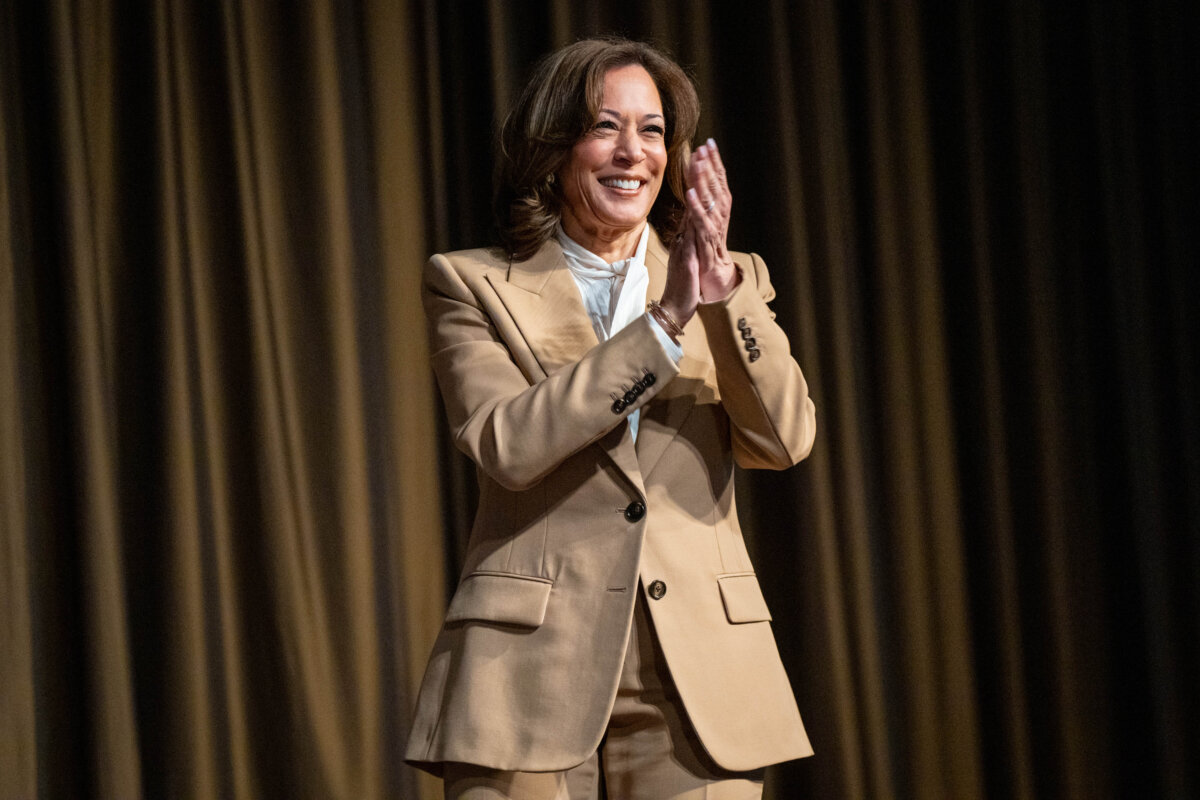

LinkedIn co-founder Reid Hoffman said on Sept. 16 that former Vice President Kamala Harris would face a difficult road if she runs for president again in 2028.
Hoffman was asked whether Harris, a Democrat, should run during an onstage interview at Politico’s Decoded Summit in Washington.
“I think it would be a very challenging path for her, and it’s going to be a very noisy field,” Hoffman said.
Hoffman, a partner at the venture capital firm Greylock, is one of the Democratic Party’s largest individual donors, according to Federal Election Commission (FEC) records. He backed President Joe Biden’s reelection bid and then Harris’s 2024 campaign after she replaced Biden at the top of the ticket.
FEC records show that he gave at least $10.25 million to Future Forward PAC, the main super PAC supporting the Democratic ticket in 2024. That total includes $10 million before Biden withdrew in July and $250,000 in October, after Harris became the Democratic nominee.
Hoffman’s largest single contribution on record came on June 30, when he gave $10 million to Lone Star Rising PAC, a super PAC backing James Talarico, the Democratic nominee for U.S. Senate in Texas. FEC records show Hoffman has given the group $11.5 million since January.
He has also given $310,000 to the Democratic Senatorial Campaign Committee and $310,100 to the Democratic Congressional Campaign Committee, FEC records show.
Harris said in April that she is considering another run. Asked by the Rev. Al Sharpton at the National Action Network’s convention in New York City whether she would seek the presidency again, she said: “I might. I’m thinking about it. I’ll keep you posted.”
Her decision could shape the 2028 Democratic field. California Gov. Gavin Newsom told CNN on Sept. 14 that he would not run in 2028 if Harris does.
“I don’t know if she runs, but we’ll see,” Newsom said. “I wouldn’t run if she ran.”
Newsom said a primary between the two Californians would help their opponents and split the same base of voters.
“First of all, electorally, it’s a gift from God for everybody else. They’d enjoy the hell out of it. Mutual assured destruction. It services no greater good,” he said. “I know her base of supporters, I know her friends, the Venn diagram on that is just pure crossover. I wouldn’t do that to people.”
Newsom, who is term-limited and leaves office in January 2027, said in October 2025 that he was considering a 2028 presidential run.
At the same Politico event on Wednesday, Hoffman was asked whether he would support Rep. Alexandria Ocasio-Cortez (D-N.Y.) if she became the Democratic nominee. He did not rule it out.
“Well, it depends a little bit on, I mean, I think she’s much more pragmatic than people give her credit for,” Hoffman said. “It depends on who she’s running against.”
Hoffman said his support generally comes down to two questions.
“I tend to be, if you’re basically kind of pro-society, which she is, and pro-business, which is a question, that tends to be where I think the right focal points are,” he said.
In an Aug. 9 interview on ABC’s “This Week,” Ocasio-Cortez said she has not ruled out a presidential run. She said the party has a responsibility to stay focused on the midterms rather than on any one person’s ambitions.
Asked whether she might instead challenge Senate Minority Leader Chuck Schumer (D-N.Y.), she said, “Anything is possible at this juncture.”
When queried about Harris, Hoffman first joked that it was “the thing you want to ask the tech guy on AI.”
The interviewer responded that “all of the tech policy is going to be downstream from whoever gets [the presidential nomination].”
The Epoch Times has reached out to Harris’s office and Ocasio-Cortez’s office for comment.
Algdra Fredly contributed to this report.
 Friends Read Free
Copy
Facebook
Tweet
Friends Read Free
Copy
Facebook
Tweet