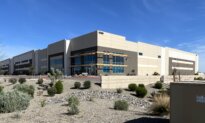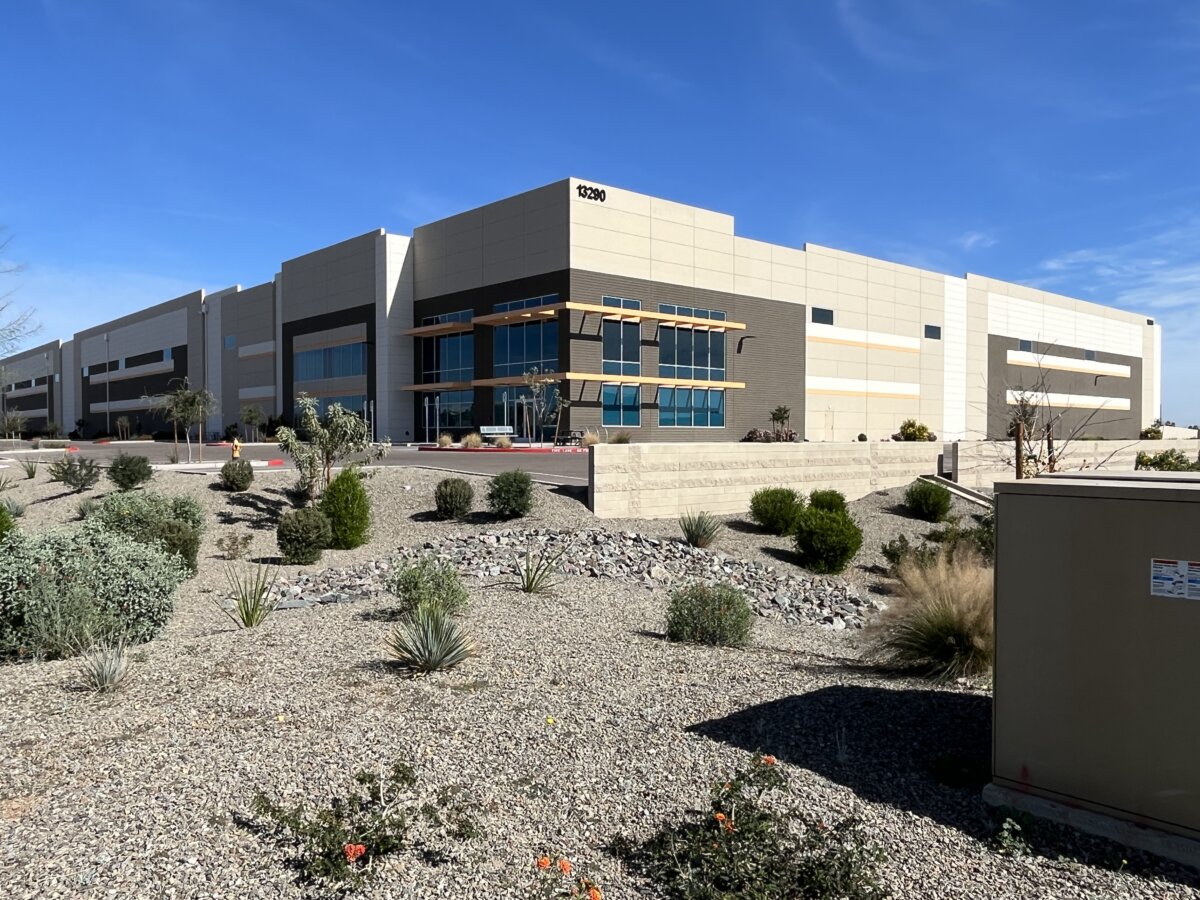

SURPRISE, Ariz.—The Department of Homeland Security (DHS) purchased a large warehouse in Surprise, Arizona, in January to house as many as 1,500 illegal immigrants.
DHS spent $70 million in cash to purchase the building, as part of the Trump administration’s push to transform sites nationwide into federal detention centers.
“My wife and I aren’t happy about it,” said John Weston, who owns property in Surprise about three miles from the empty warehouse. “It was just sprung on us.”
On Feb. 12, Weston was visiting with his friend, Herb, who owns a home across the street from the DHS property, near an industrial-commercial district that includes a bustling Walmart.
Herb, who did not want to share his last name, said he only learned about the project from his neighbors and the news.
He said that like many of his friends and neighbors, he opposes the facility. “They might as well send everybody back, because we’re all immigrants,” Herb told The Epoch Times.
Other locals who spoke with The Epoch Times said they are upset that DHS acquired the property without public notice or input.
The purchase caught many residents and city officials off guard, said Darren and Sally, who have owned their home across the street for 28 years. The couple preferred not to give their last name.
“I don’t think it’s going to be positive,” Sally said. “I hear [about] it everywhere I go.”
Darren said the acquisition has made residents anxious. They are concerned that being so close could disturb the community’s peace, lower property values, and even push people to sell their homes and leave.
“It’s going to hurt property value because it’s [Immigration and Customs Enforcement],” Darren said. “I think it’s going to bring a lot of trouble. We’ve got other troubles.
“It’s a waste of taxpayer money. So people are saying, ‘What are they gearing up for?’”
County records obtained by The Epoch Times show that DHS bought the 418,800-square-foot warehouse from RG Surprise for $70,035,000 in cash on Jan. 23. However, the total value of the property, located at 13290 West Sweetwater Avenue, was $46,581,111, according to county assessor records.
DHS did not respond to a request for comment.
“People are starting to realize it’s not about black, white, or brown—it’s about green,” Weston told The Epoch Times.
“I can understand going after the criminals, [but] we’re supposed to be America. We’re supposed to be a shining beacon.”
Lawmakers Support the Move
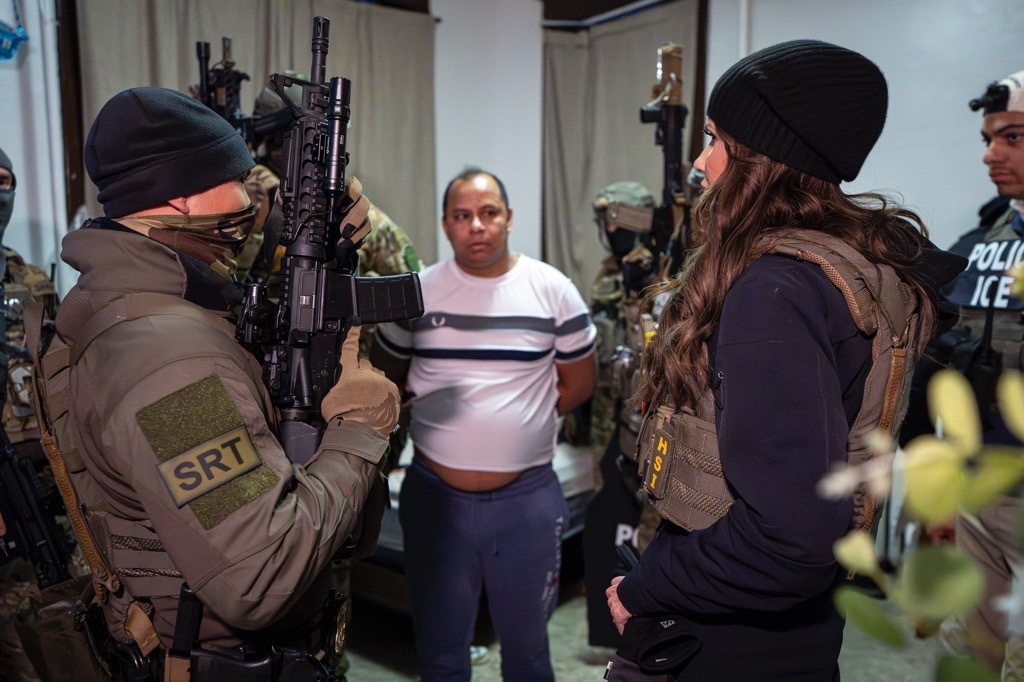
Several Arizona Republican lawmakers said the new facility dovetails with DHS efforts to enforce immigration law.
“If the Department of Homeland Security determines that expanded facilities in Arizona are necessary to efficiently process and remove individuals who are unlawfully present, then I fully support them,” Arizona state Rep. Leo Biasiucci told The Epoch Times.
“Every sovereign nation enforces its borders. A nation without secure borders is a nation that cannot fully exercise its sovereignty.”
Arizona state Rep. Nickolas Kupper told The Epoch Times: “I can’t say that it’s necessarily the best or the worst spot for it to be [from a logistical standpoint].
“My gut tells me that this particular warehouse may not be in the best location as far as the city is concerned. However, I don’t know what the exact needs of DHS are.”
Kupper said that if DHS can make it work logistically without it being a net negative on the city, “then [it should] go for it.”
“They have a job to do,” he said.
State Sen. John Kavanagh said concerns about how the DHS detention center in Surprise might affect the community may not be justified.
“I don’t think it would be that intrusive because these people will not be coming and going like it’s a hotel,” Kavanagh told The Epoch Times. “I think the opposition may be a little bit more political than real, or if not political, perhaps misunderstood.”
Kavanagh is sponsoring Arizona Senate Bill 1635, which seeks to make it illegal to warn others about police or immigration actions if those people are about to be arrested.
“And they need to be apprehended, held, given due process, and then, if they’re deportable, deported,” Kavanagh said regarding the DHS warehouse facility.
“This is part of the overall criminal justice, or if it’s a civil offense, civil justice immigration process.”
Lawmakers Oppose the Deal
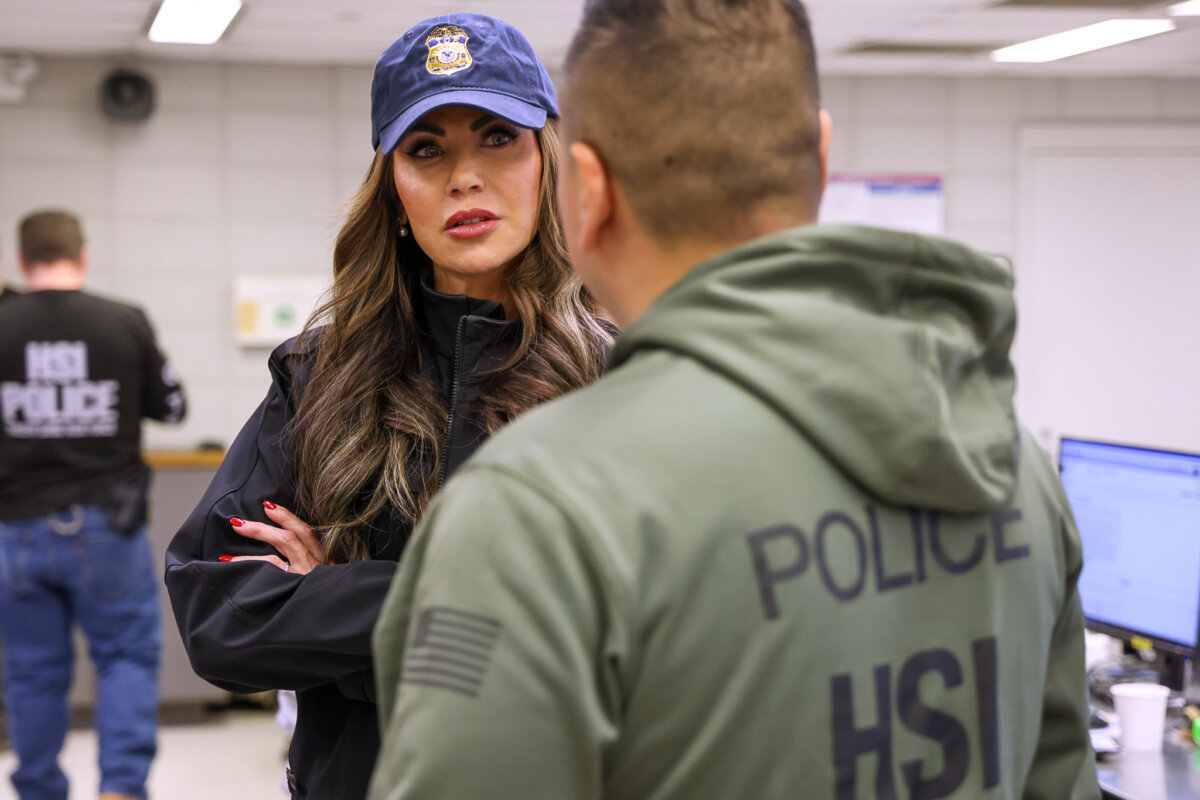
Several Arizona state and federal officials have written to DHS about the proposed detention center, calling for transparency and accountability.
“DHS has an obligation to work cooperatively with state and local officials—especially when making decisions that directly affect the day-to-day life of a growing city like Surprise,” Rep. Paul Gosar (R-Ariz.) wrote in a Feb. 4 letter to DHS Secretary Kristi Noem.
“Even when detention capacity is necessary, it must be implemented responsibly, with appropriate review and open communication.”
Gosar emphasized that congressional oversight plays a vital role in earning public trust and empowering immigration enforcement to fulfill its legal responsibilities.
Although he supports the enforcement of immigration laws, he said it must be “carried out effectively while respecting the legitimate interests of the communities that bear its local impacts.”
“I am confident that DHS will provide clear answers and will work collaboratively with local stakeholders moving forward,” Gosar said.
On Feb. 9, Arizona Attorney General Kris Mayes, a Democrat, sent a letter to Noem, raising concerns about the building’s location near residential neighborhoods and a high school with many Hispanic students.
“Prior to starting any construction or operational activities, DHS must answer basic questions about the use of the facility and its impacts upon the local community,” Mayes wrote.
She noted that local officials were not informed of the purchase in advance and that more than 80 residents voiced concerns at a Surprise City Council meeting on Feb. 3.
The state’s top lawmaker joined a bipartisan group of federal lawmakers to seek information from DHS about the facility, which could hold up to 1,500 illegal immigrants.
Her letter asks 10 questions about how the project could affect local schools, traffic, noise, water supply, trash removal, health care for detainees, and the need for fire, police, and emergency services.
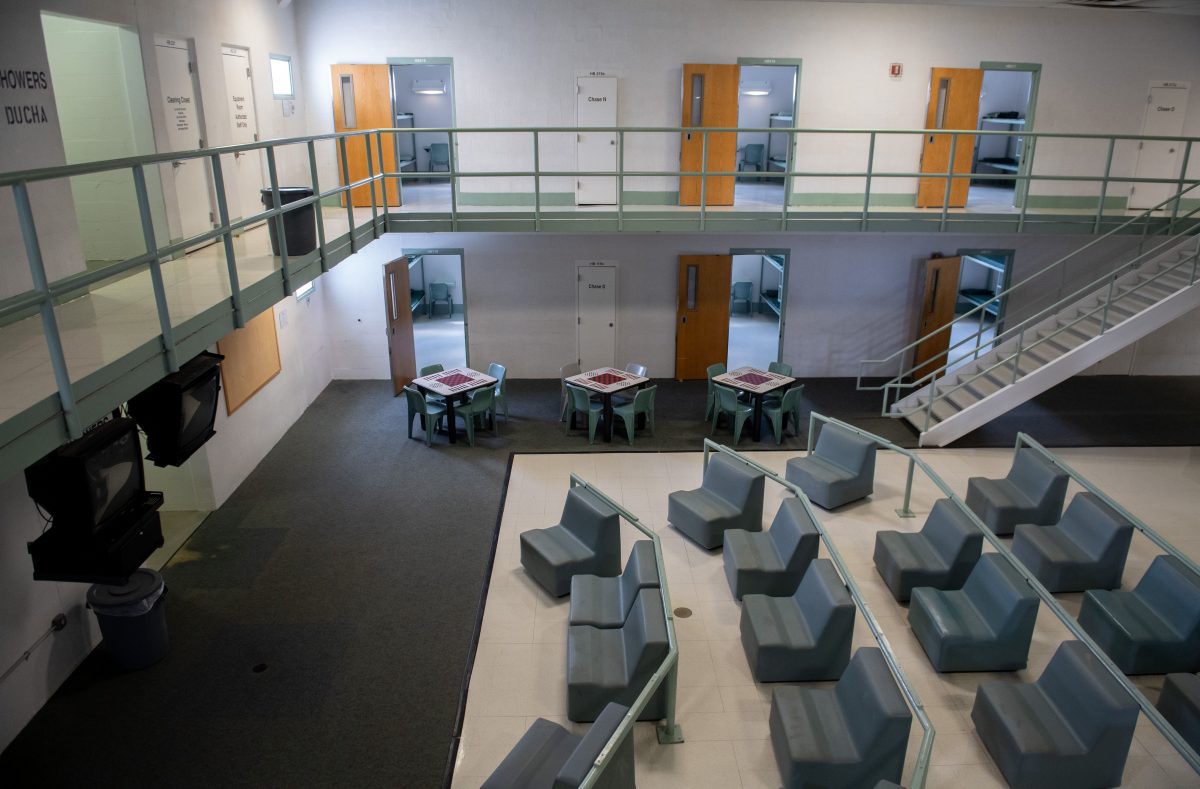
According to Maricopa County property records, the warehouse property covers more than 1 million square feet in the Dysart Unified School District. Built in 2024, it can hold up to 584 people.
Gosar’s letter asks 15 questions, including how many people would be held at the facility, how long they would be held, who would run it, and whether city officials were consulted.
The letter also asks about the facility’s operating costs, the timeline from conversion to use, and the security plans for nearby residents, schools, and businesses.
On Feb. 10, Sens. Mark Kelly (D-Ariz.) and Rubén Gallego (D-Ariz.) wrote to Noem and Todd Lyons, acting director of Immigration and Customs Enforcement (ICE), to express “serious concerns” about the proposed detention facility.
“This acquisition appears to be part of a broader, nationwide effort by the department to rapidly expand detention capacity through the purchase and conversion of mega commercial warehouses at unprecedented scale and speed,” the lawmakers wrote.
“At some facilities, the department plans to hold as many as 10,000 individuals—over twice the capacity of ICE’s largest existing detention facility—starting in just a couple of months with little to no public input.”
ICE plans to open all facilities by Nov. 30, 2026.
The senators said the large size of the planned facilities, the short timeline for opening them, and the alleged lack of transparency raise red flags about whether the projects have been properly planned and reviewed for environmental impact.
As a result, they said, cities such as Surprise and people across the country do not know how these facilities will affect their communities.
Surprise Mayor Kevin Sartor and three city council members did not respond to requests for comment.
On Feb. 11, Sartor wrote to Noem and Lyons to request more information about DHS’s purchase and its plans for the warehouse property as a federal detention facility.
“The city is aware we cannot interfere with federal operations; however, the city must be able to plan responsibly, protect public safety, and provide accurate information to residents,” Sartor said.
“Proceeding without meaningful coordination places undue strain on local resources and undermines public trust.”
On Feb. 6, Reps. Greg Stanton (D-Ariz.), Yassamin Ansari (D-Ariz.), and Adelita Grijalva (D-Ariz.) sent DHS two letters demanding greater transparency about the warehouse purchase in Surprise.
“Arizonans don’t want a detention facility across the street from their house or the neighborhood high school,” Stanton wrote.
“DHS hasn’t done the bare minimum to communicate with local and county officials about how they’ll mitigate the impacts on the West Valley community, and they haven’t communicated to Congress how they’ll make an industrial warehouse fit to hold human beings.”
Ansari wrote: “The purchase of a warehouse in Surprise for proposed use by ICE is extremely alarming. I’ve heard from countless conservatives, libertarians, and independents across our state who don’t want ICE in our communities.”
Grijalva wrote, “Communities are waking up to massive detention centers being dropped into their neighborhoods with no warning, no transparency, and no accountability.”
There are currently four ICE detention centers in Arizona. Two are located in Florence and the others are in San Luis and Eloy.
In June 2025, Ansari sent a letter to Noem and Lyons detailing her “deep concerns” about alleged inhumane conditions reported by detainees at the Eloy facility.
Ansari said she spoke with more than 20 detainees on May 29, 2025, who described guards allegedly making them walk laps until they felt “dizzy and sick.”
In another incident, guards allegedly turned off the air conditioning or set it to “alarmingly low temperatures.”
Other Detention Sites
The DHS website lists 142 active detention facilities across the United States. Seven are in California and 23 are in Texas.
According to USAFacts, at least 59 new facilities were added in the first few months of 2025 under the Trump administration.
By December 2025, USAFacts reported that 212 detention centers were in use, 108 more than in January 2025.
A new DHS detention facility with 400 to 600 beds and 324,395 square feet is planned in Merrimack, New Hampshire, as part of a $38.3 billion federal initiative, as documented on the official website of New Hampshire Gov. Kelly Ayotte, a Republican.
ICE plans to introduce a new detention model by the end of fiscal year 2026 through the Detention Reengineering Initiative, according to the site.
The project aims to expand capacity to 92,600 beds and improve detention and removal efficiency using facilities designed for the new model.
An ICE fact sheet from the same website states that illegal immigrants stay at each facility for about 60 days on average. These facilities will also serve as a long-term solution.
The new model involves acquiring and updating eight large detention centers and 16 processing sites. ICE will also take over 10 existing turnkey facilities where it already operates.
On Feb. 4, Sen. Roger Wicker (R-Miss.) sent a letter to Noem to oppose a DHS plan to buy a warehouse in Byhalia, Mississippi, and turn it into an 8,500-bed detention center for illegal immigrants.
He said the warehouse was built to bring new businesses and jobs to Mississippi. Turning it into an ICE detention center would put too much pressure on local services and stop better job opportunities from coming to the area, he said.
“The proposed conversion also raises serious feasibility concerns,” Wicker wrote. “Detention facilities impose substantial and specialized infrastructure demands—including transportation access, water, sewer and energy costs, staffing, medical care, and emergency services.”
Meanwhile, an increase in hiring efforts has added 12,000 new ICE officers to keep up with the expected rise in enforcement actions and arrests in 2026.
Tracreports, a clearinghouse of government data, reported that as of Feb. 7, ICE held 68,289 illegal immigrants in custody, of whom 73.6 percent had no criminal convictions.
Correction: A previous version of this article misspelled the name of Arizona state Rep. Nickolas Kupper. The Epoch Times regrets the error.
 Friends Read Free
Copy
Facebook
Tweet
Friends Read Free
Copy
Facebook
Tweet