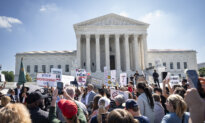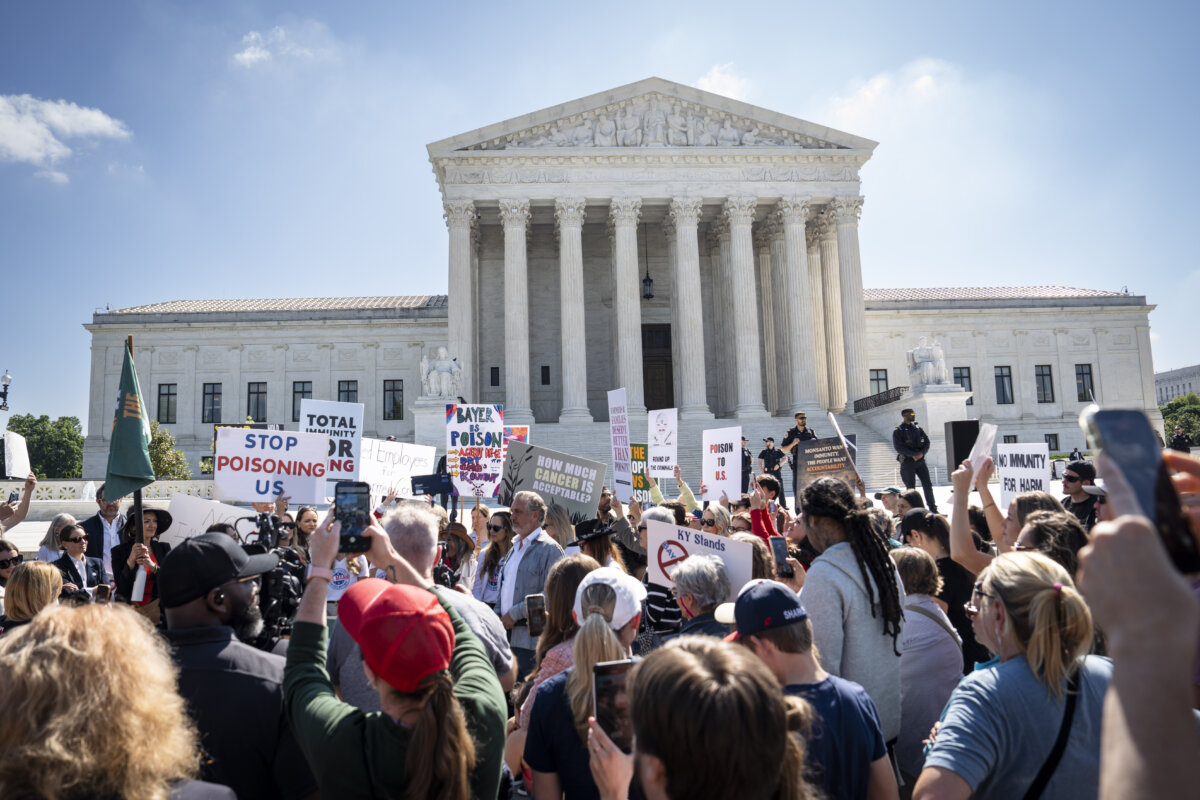
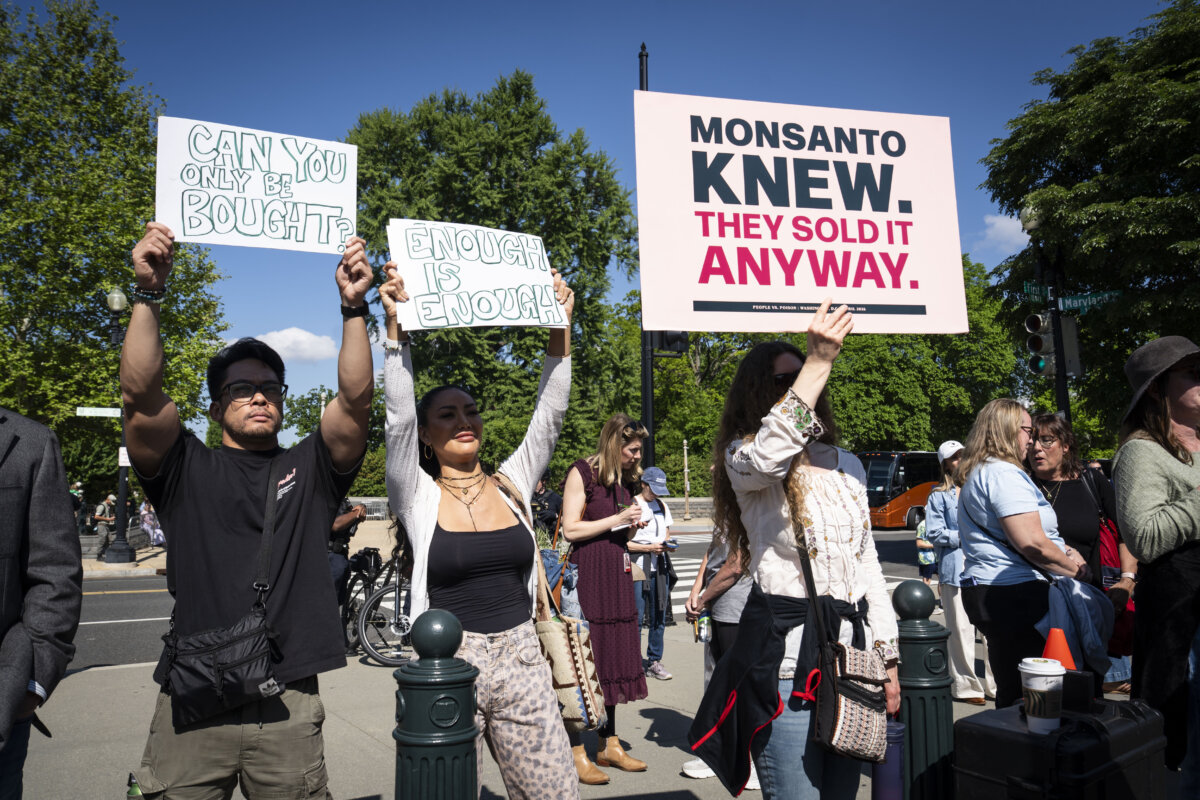
WASHINGTON—As the Supreme Court heard opening arguments on Monsanto v. Darnell, a case which could prevent people harmed by pesticides from suing manufacturers, hundreds of Make America Healthy Again (MAHA) proponents, farmers, and environmental activists gathered near the steps of the building outside for the People Vs. Poison rally on April 27.
The event cut across traditional political party lines and highlighted tensions surrounding federal agriculture policies. Speakers expressed frustration with what they deem inconsistencies in federal approaches to “real food” and chemical company protections.
Kelly Ryerson, known as the Glyphosate Girl, is cofounder of American Regeneration and an outspoken critic of Monsanto, which is now a subsidiary of Bayer. Her comments reflected the sentiments of many attendees.
“If your product is safe, then you don’t need immunity. And if your business depends on immunity, the problem is not the lawsuits. The problem is the product,” Ryerson said.
Glyphosate, the world’s most widely used herbicide, is manufactured by Bayer. It is the main ingredient in RoundUp, which is produced by the company.
In February, President Donald Trump surprised some MAHA movement leaders when he issued an executive order invoking the Defense Production Act.
A day before the president signed an executive order relating to glyphosate, Bayer announced that Monsanto submitted a proposal for a $7.25 billion class‑action settlement.
In 2018, Bayer completed its acquisition of Monsanto for $63 billion, including debt.
Bayer agreed to a separate $10 billion settlement regarding non-Hodgkin lymphoma claims in 2020.
Glyphosate is used to kill weeds and dry crops before harvest.
Glyphosate-tolerant crops account for a significant majority of the corn, soy, and cotton acreage on American farms.
The rally was held at a time of heightened frustration within MAHA circles over what they consider a three-front campaign by Bayer that is seeking immunity through the Supreme Court, pushing liability shields in state legislatures and Congress, and gaining an executive order from Trump to classify glyphosate as essential to national defense.
Vani Hari is a New York Times bestselling author, founder of Food Babe and Truvani, and one of the most visible “clean food” advocates online. She organized the rally and described it as a line in the sand against pesticide corporations and politicians who shield them from accountability.
“We wouldn’t be here right now if President Trump didn’t sign that executive order. We wouldn’t be here right now if they weren’t inside this building arguing on Monsanto’s behalf. We wouldn’t be here right now if Monsanto Bayer wasn’t pushing legal shields through every branch of government, including the farm bill today at Congress. They made this their moment. Now we make it ours,” Hari said at the rally.
Hari warned that if industry succeeds, more than 57,000 pesticide products could be shielded from meaningful accountability.
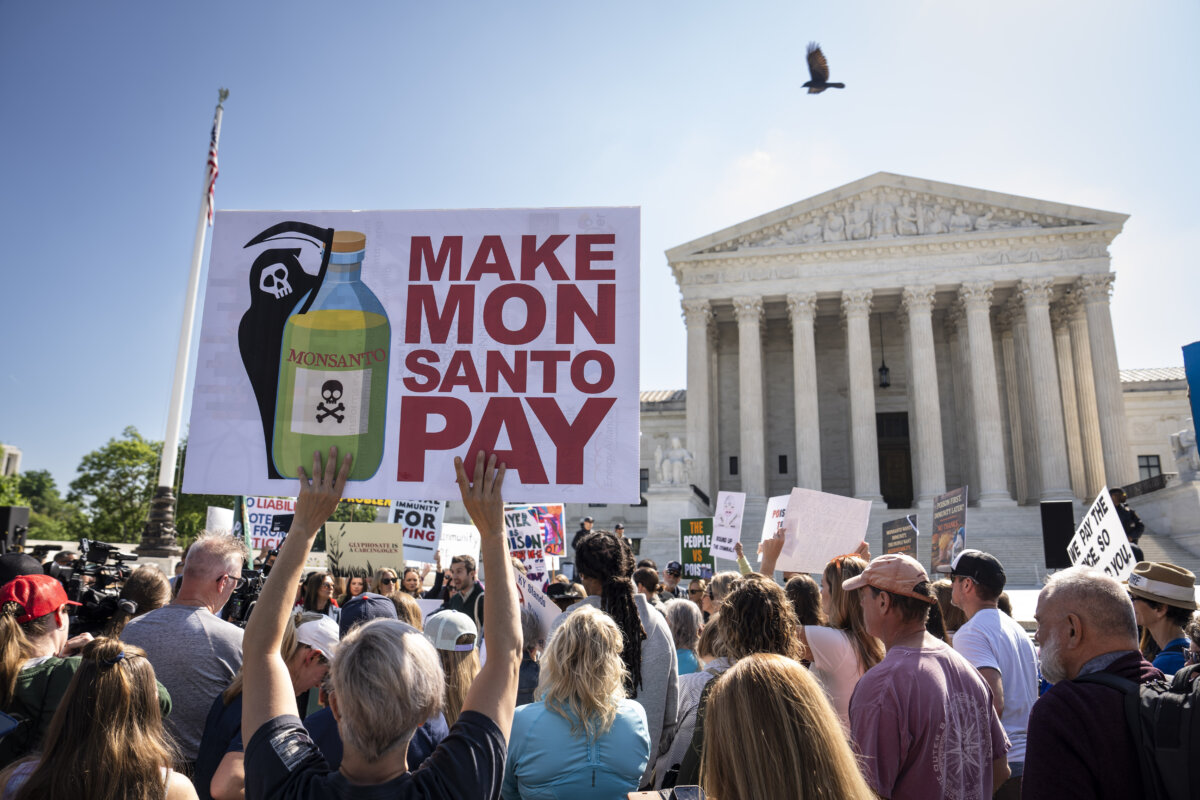
MAHA supporters have applauded what they deem as wins since Robert F. Kennedy Jr. became health secretary. Under Kennedy, the federal government began to phase out artificial dyes in some foods, removed junk food from several state SNAP programs, replaced members of a national vaccine panel, and worked to eliminate the “generally recognized as safe” policy that allows food companies to certify new additives as safe without gaining FDA approval.
While she applauded the Trump administration for these measures, she said: “You cannot claim to care about health while protecting poison. You cannot tell Americans to eat real food while protecting the cancer‑causing chemicals sprayed on it.”
“We want to know why farmers are allowed to spray crops with Roundup right before harvest, but this practice is banned in Europe. We want to know why Europe has a safer, less-toxic formula of Roundup. Why don’t Americans get the same?”
Inside the Supreme Court building, Paul Clement, the lawyer representing Bayer, argued that a ruling against the company “would open the door for crippling liability and undermine the interests of farmers who depend on federally registered pesticides for their livelihood.”
The Environmental Protection Agency (EPA) and other regulatory bodies have maintained that the chemical is not carcinogenic when used properly. The International Agency for Research on Cancer (IARC) classified it as “probably carcinogenic to humans” in 2015.
Glyphosate has been implicated in roughly 180,000 cancer lawsuits since 2018, Hari said.
A state-level jury previously ruled in favor of John Durnell, a Missouri man who developed non-Hodgkin lymphoma after exposure to Roundup, which was developed by Monsanto. It awarded him $1.25 million after concluding that Monsanto failed to comply with state law requiring a warning about cancer risks.
Monsanto argues that because the EPA has not, under the Federal Insecticide, Fungicide, and Rodenticide Act (FIFRA), deemed glyphosate to be carcinogenic and has not issued a cancer warning, failure-to-warn lawsuits allowed under state law are preempted by federal law.
If Monsanto wins the case, thousands of pending lawsuits could be dismissed. The company could face significant liability if it loses.
The Supreme Court is expected to issue a ruling on the case by the end of June.
The Trump administration supports Monsanto’s position in the case.
U.S. Solicitor General D. John Sauer urged the Supreme Court to hear Monsanto’s case last year.
He wrote in a brief that leaving the Missouri court’s ruling in place means “a jury may second-guess the agency’s science-based judgments.”
The high court needs to protect the labeling authority in the Federal Insecticide, Fungicide, and Rodenticide Act, he said.
Angela Huffman, a regenerative farmer in northwest Ohio and president of advocacy group Farm Action, noted that Trump previously said his goal was to “get toxins out of our environment and poisons out of our food supply.”
Early in office, he established the MAHA Commission to investigate and address the chronic disease crisis. The panel’s assessment report in May 2025 reflected Trump’s stated health priorities, Huffman said. It identified environmental chemical exposures, including pesticides like glyphosate, as contributors to chronic health risks, she added.
Huffman lamented that the subsequent MAHA strategy report mostly omitted those concerns and showed confidence in the EPA’s existing review processes.
“When we talk about exposure and risk, we’re talking about what farmers, farm workers, and rural families are living with every day,” Huffman said on April 27. “Across the biggest corn-producing states, younger adults are seeing higher cancer rates than the rest of the country, and that should get our attention.”
Huffman attributed the problem to “a handful of corporations that control the seeds and the chemicals, and shape how farmers are expected to operate.”
“Farmers don’t have a lot of choices. A handful of companies control the seeds. The chemicals are designed to work with those seeds. They really control how farmers operate, and now they want to take away farmers,” Huffman told The Epoch Times.
Agriculture does not need to be dependent on glyphosate, Huffman said at the rally.
“Bayer has made major threats to take away glyphosate, and says that our food system will collapse without them. That’s not true. Farmers have other options,” Huffman said.
“I’d really love to see the [Trump] administration doing more to help farmers get out of this system in the first place and use more healthy and more profitable practices that don’t rely on these chemical inputs.”
Kennedy, who did not attend the April 27 rally, publicly defended Trump’s glyphosate executive order when it was issued.
“Donald Trump’s Executive Order puts America first where it matters most—our defense readiness and our food supply. We must safeguard America’s national security first. … When hostile actors control critical inputs, they weaken our security. By expanding domestic production, we close that gap and protect American families,” he said.
Last month, Kennedy said in an interview on “The Joe Rogan Experience” that he was “not particularly happy, to put it mildly,” with Trump’s executive order on glyphosate.
Kennedy added that he has “spent 40 years fighting pesticides” and considers them poison, but he understands Trump’s position of not disrupting the agricultural sector.
He reiterated that “we all know we’ve got to transition off of glyphosate” and highlighted work on alternatives like laser weed control and regenerative farming.
Ryerson advocates for less pesticide use and a wholesale shift toward regenerative agriculture, which includes cover crops, livestock integration, minimal tillage, and the rebuilding of soil organic matter. She believes that policies should redirect capital and federal subsidies away from GMO corn and soy and toward farmers willing to rebuild soil health.
“USDA dollars now prop up chemical-intensive monocultures when they should finance the transition infrastructure regenerative farmers need,” Ryerson said.
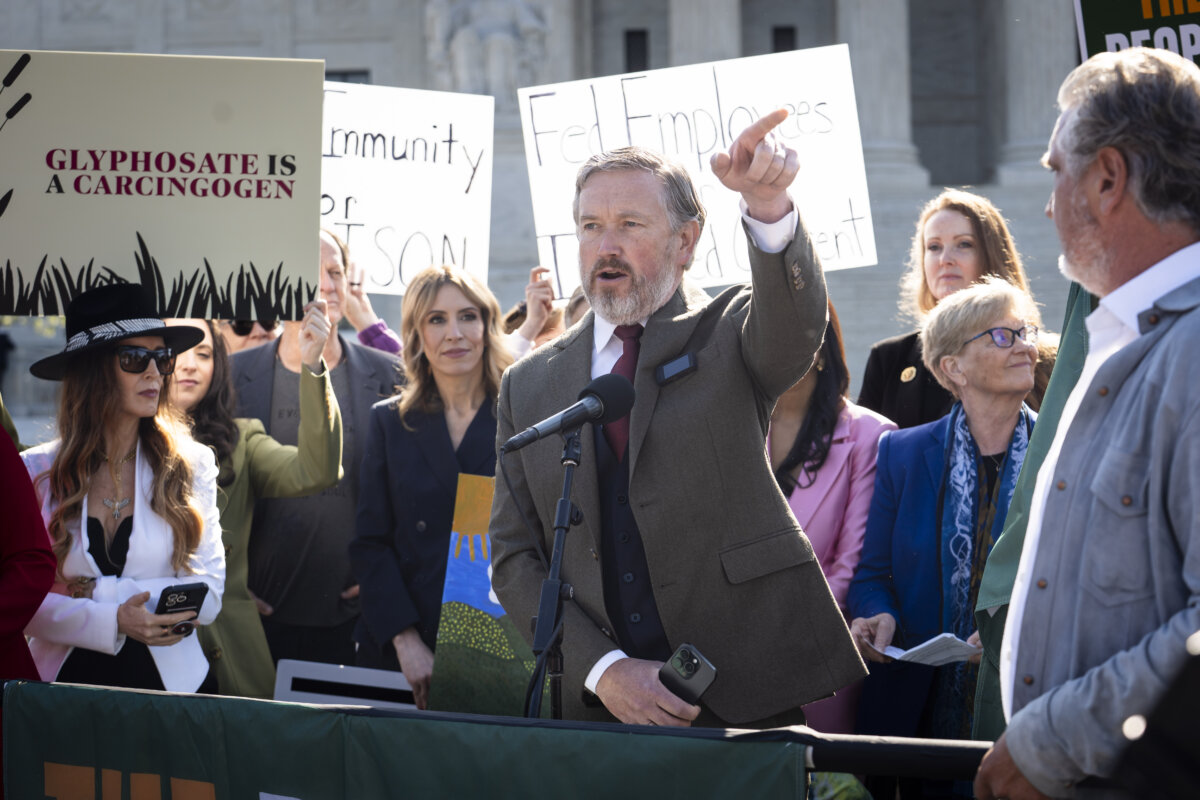
Reps. Thomas Massie (R-Ky.) and Chellie Pingree (D-Maine) spoke at the rally. Both lawmakers are farmers. They teamed up to introduce an amendment to this year’s federal farm bill, which strips legal immunity from chemical companies.
Provisions in the farm bill would shield chemical manufacturers from lawsuits and “would preempt state and local warning label laws or usage regulations for potentially harmful products,” Pingree said.
The Pingree-Massie Protect Our Health Amendment would remove the language from the farm bill.
In January, Pingree helped remove a similar provision from the FY2026 Interior and Environment Appropriations bill.
Pingree and Massie also introduced the No Immunity for Glyphosate Act, which would undo Trump’s executive order.
“Any Farm Bill that protects chemical companies over American farming families is not pro‑farmer, it’s not pro‑health, it’s not pro‑America. It’s a giveaway to big chemical,” she said at the rally, pledging to grill EPA leadership on its handling of glyphosate. “They have the money, but we have the people, and we can win.”
She told the crowd that Bayer is implementing a “coordinated offensive” to escape responsibility.
“Let’s just say it. We are all here today because we believe no corporation should be able to poison people and then run for protection to the Supreme Court and Congress,” she said. “They have 53 well‑paid lobbyists … and that is not to make their products safer. No, it’s to protect themselves,” she said.
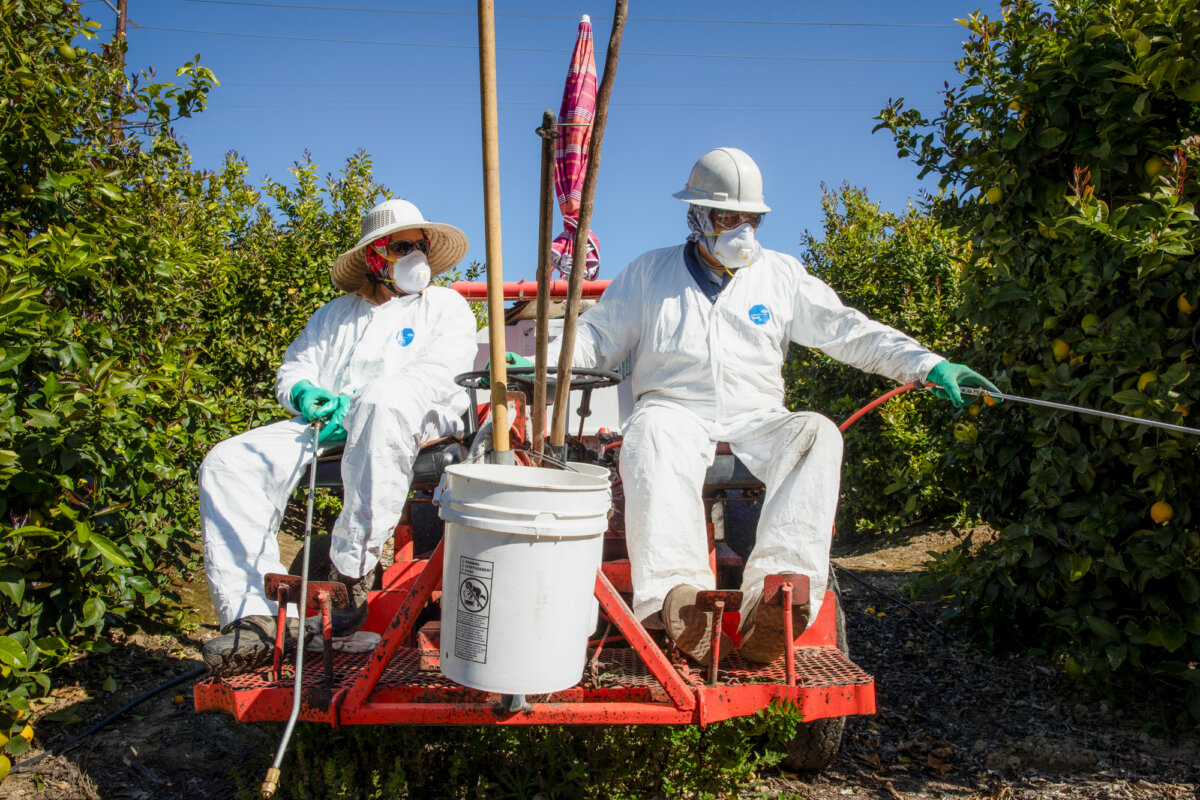
Pesticides in the United States are regulated under a combination of federal, state, and local laws. Many states, cities, and counties have adopted measures to restrict pesticide spraying near schools, homes, and public spaces.
Seven states—Maine, Alaska, Hawaii, Maryland, Utah, Nevada, and Vermont—do not prevent local governments from regulating pesticide use within their jurisdictions. In Maine, “there are more than 30 state and local regulations related to pesticide use and warning requirements that would be undermined or preempted” under the current version of the Farm Bill, Pingree said.
“I have been an organic farmer since the 1970s, and no one can tell me … that we can’t grow food without all of these toxic chemicals,” she said.
Pingree called for policies that give farmers “the resources they need to farm organically and regeneratively.”
Massie told rally attendees that “our government is under siege by lobbyists” on behalf of Bayer.
“Bayer has spent over $9 million lobbying for exemption from liability for harm its chemicals, like glyphosate, might cause. To Make America Healthy Again, Congress should remove the language containing the pesticide liability shield from the Farm Bill,” he said.
Massie pointed out that then-Attorney General Pam Bondi and Trump’s chief of staff, Susie Wiles, worked for Ballard Partners, a firm that registered to lobby for Bayer in December 2024.
Trump’s executive order calling glyphosate production “a national defense priority” was issued to protect Bayer from liability, Massie added.
White House press secretary Karoline Leavitt has dismissed claims that the administration bowed to lobbying efforts regarding the executive order.
“The president made this decision based on national security priorities,” she said at a Feb. 18 press briefing, adding that the administration is funding research into alternatives to the herbicide glyphosate.
Zen Honeycutt, founder of Moms Across America, has emerged as one of the most outspoken critics of glyphosate and a leading voice against the move for a pesticide immunity shield for chemical companies. At the rally, Honeycutt said that at least 57,000 chemicals would be covered under the current push for a liability shield.
Many, she noted, have already been linked to cancer, reproductive damage, and developmental harm.
Honeycutt said that 86 chemicals now being used in the United States have already been banned in countries across Europe, as well as in China and Brazil.
If chemical companies gain the immunity they are seeking, there would be no meaningful recourse for people who believe they’ve been harmed, no dedicated compensation fund, and no clear system for tracking injuries, she said.
“We would simply be giving chemical companies carte blanche to poison Americans with no repercussions,” she said. “This is undemocratic, anti‑science, anti‑health, and anti the future of this country.”
Honeycutt insisted that there are viable alternatives. She pointed to regenerative, organic, and biodynamic farming as proven, scalable ways to produce food without the chemicals at issue.
Chemical companies should redirect that money to reformulate their products or transition away from toxic models altogether instead of pouring “millions of dollars on lobbyists and lawyers,” Honeycutt said.
Alex Clark, host of the Culture Apothecary podcast, told rally attendees that their involvement can have a long-term impact on the direction of America’s food supply.
“They tell us to eat healthy, while the fruit and vegetables that we can afford are sprayed with glyphosate that we cannot wash off,” Hari said. “If you’re harmless, you don’t spend billions settling cancer lawsuits. A government that shields chemical companies instead of children has forgotten who it works for.”
Hari encouraged the continued bipartisan support of the objective to keep Bayer from gaining legal immunity.
“Every time we let politics get in the way, Bayer wins. Every time we make it a left or right issue, Bayer wins. Every time you come to the table, we can make Bayer lose.”
Matthew Vadum contributed to this report.
 Friends Read Free
Copy
Facebook
Tweet
Friends Read Free
Copy
Facebook
Tweet