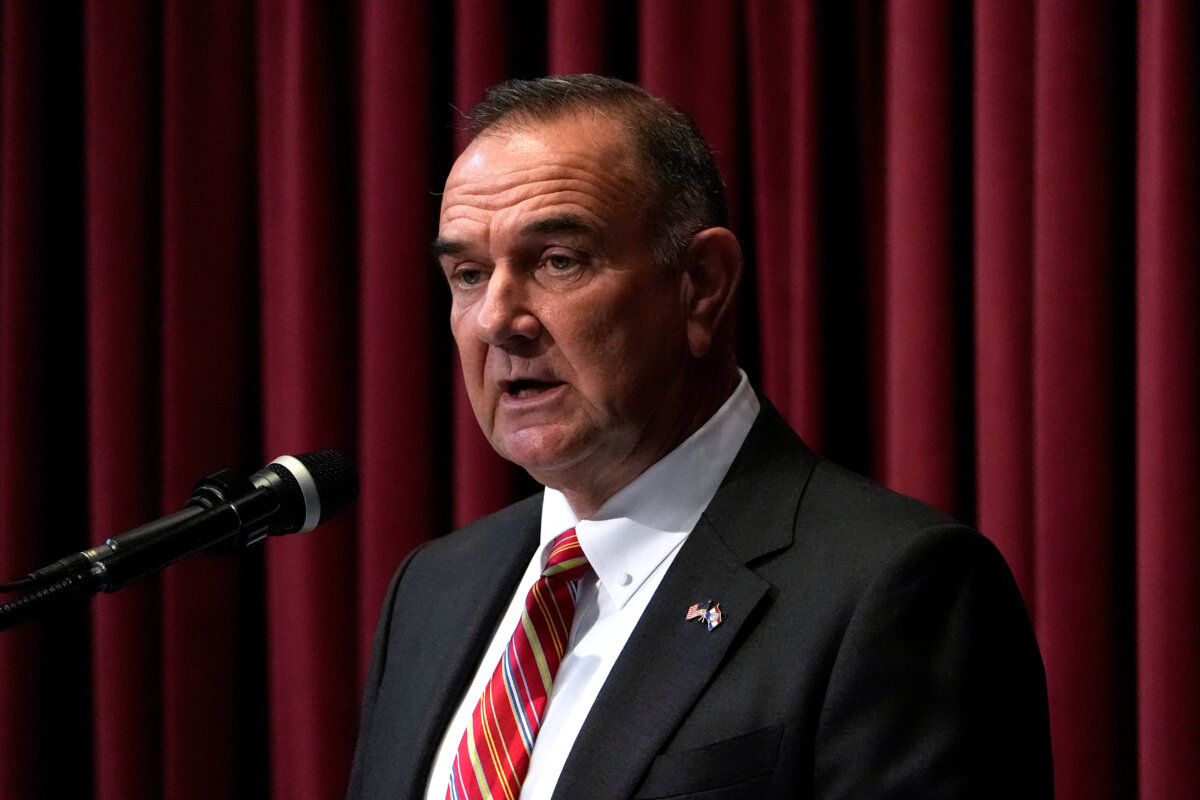

Missouri Gov. Mike Kehoe announced on Aug. 29 that he was calling state lawmakers back to the state Capitol for a special session tasked with redrawing the congressional district lines ahead of the 2026 election.
His announcement came just hours after fellow Republican Texas Gov. Greg Abbott signed into law Texas’s new congressional voting map, setting the stage for the GOP to gain five more seats in the House of Representatives.
Scheduled to begin Sept. 3, Missouri’s redistricting also appears to offer Republicans help in the coming midterms, as Kehoe’s proposed map looks to stretch a Kansas City-area district—currently held by Democratic Rep. Emanuel Cleaver—into Republican-leaning rural areas.
“Missouri’s conservative, common-sense values should be truly represented at all levels of government,” Kehoe said in a statement.
Cleaver represents one of two current Democratic-controlled districts in the state. The other is in St. Louis, held by Rep. Wesley Bell. There are six total congressional districts in Missouri.
Cleaver decried the decision to alter his district in a statement.
“This attempt to gerrymander Missouri will not simply change district lines; it will silence voices. It will deny representation,” he said.
House Minority Leader Ashley Aune, a Democrat, also spoke out against the change, accusing Kehoe of looking to “steal a congressional seat for Republicans.”
However, Missouri Democrats are unlikely to stop their Republican colleagues from passing the new map. Although they could filibuster in the Senate, Republicans have procedural means to shut that down, and there are too few Democrats for their absence to prevent a quorum.
Meanwhile, California’s Democratic Gov. Gavin Newsom is asking voters to approve a new congressional map that seeks to help his party win five seats as a response to Texas’s new map favoring Republicans.
The new map passed the state Assembly by a vote of 57–20, and then the state Senate in a 30–8 vote, on Aug. 21. It was signed into law by Newsom about 30 minutes after the legislature approved it. California voters will get their say on Nov. 4.
There are redistricting movements being considered in other states as well, including Florida and Indiana, where Republicans look to gain an advantage, as well as Illinois, Maryland, and New York, where Democrats seek to further expand their foothold.
Republicans won a 220–215 majority over Democrats in the U.S. House of Representatives in 2024. Democrats will need to net three seats in November 2026 in order to reclaim the lower chamber.
Missouri’s special session will also consider an amendment to the state constitution that would increase the difficulty with which citizen-initiated ballot measures are approved. Such measures resulted in the adoption of abortion- and marijuana-related amendments by the state in recent years.
The Associated Press contributed to this report.
 Friends Read Free
Copy
Facebook
Tweet
Friends Read Free
Copy
Facebook
Tweet