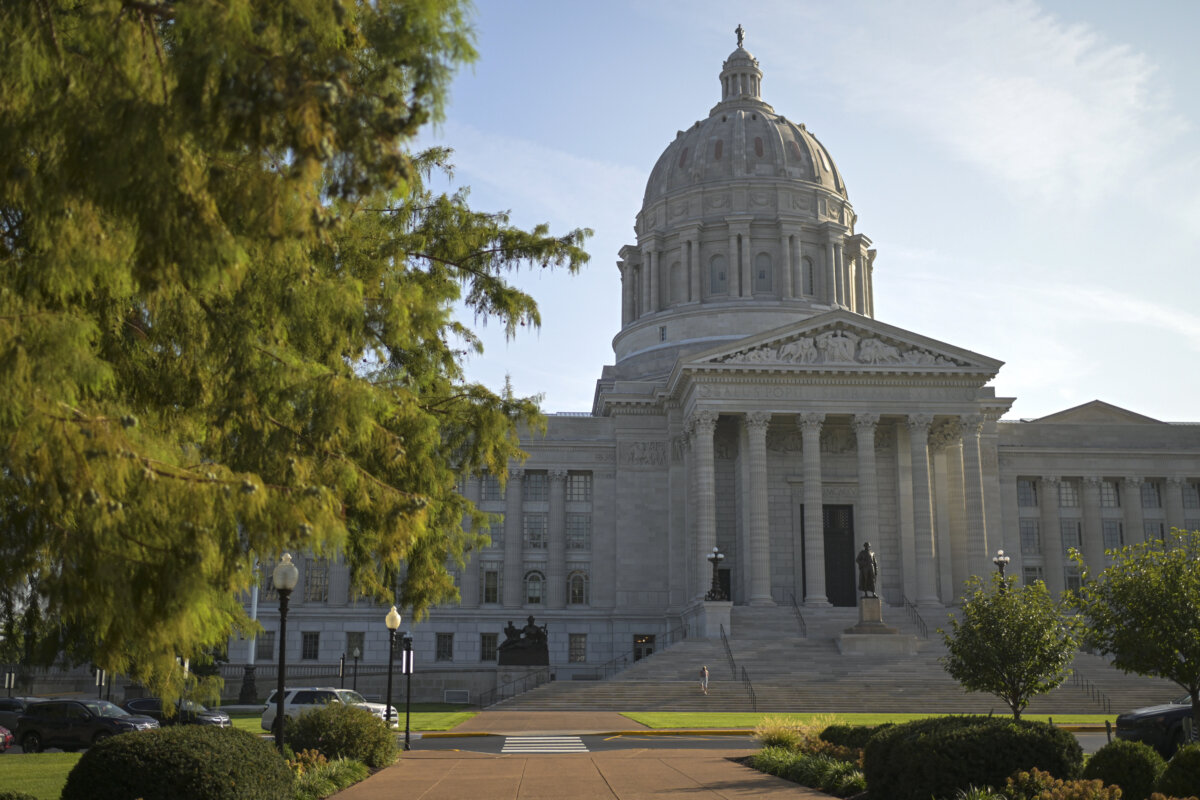

Missouri’s Republican-led House has approved a redistricting plan that would give the GOP a stronger hold on the state’s congressional delegation, positioning Republicans to win seven of Missouri’s eight U.S. House seats.
“Our Missouri FIRST Map and initiative petition reform now head to the Missouri Senate,” Missouri Gov. Mike Kehoe, a Republican, said in a Sept. 9 statement after the House voted 90–65 to advance the plan. The Senate is expected to sign off later this month, sending the measure to Kehoe for final approval.
The proposal reshapes Kansas City’s Fifth Congressional District by extending it eastward into Republican-leaning rural areas, shifting the balance of Missouri’s delegation in the GOP’s favor. Republican lawmakers argued that, overall, the new boundaries would make the state’s districts more compact and competitive.
It’s a “congressional map that will better represent Missouri in Washington, DC,” said state Rep. Dirk Deaton, the Republican sponsor of the measure. Kehoe, in his statement, thanked Deaton for his leadership and described the passage of the plan as a “commitment to ensuring that the values of Missourians are represented clearly and effectively.”
Democrats strongly opposed the plan, accusing Republicans of gaming the process to lock in an overwhelming advantage.
“Democracy in Missouri is taking a devastating blow,” state Rep. Mark Sharp, the top Democrat on a House committee, said during a hearing last week. “Every Missourian deserves fair representation and not these political tricks. … This type of policy is morally corrupt and inexcusable.”
Some Democratic lawmakers held a sit-in on the Missouri House floor for 100 hours, a protest that drew praise from former Vice President Kamala Harris.
Thirteen Republicans, including House Speaker Jon Patterson of suburban Kansas City, joined Democrats in voting against the Missouri plan.
“Using our raw political power to tilt the playing field to our side, regardless of the party, is wrong,” said Republican state Rep. Bryant Wolfin, one of the few who spoke against the measure during two days of floor debate.
In late August, Kehoe announced that he was convening lawmakers for a special session to redraw Missouri’s U.S. House districts, part of a push by President Donald Trump to revisit maps outside the once-a-decade redistricting cycle tied to the census. The effort is part of a broader national fight between Republicans and Democrats seeking an edge ahead of next year’s congressional elections.
It follows similar moves in Texas, where a GOP-drawn map is projected to add as many as five seats to the party’s column. In response, California lawmakers passed their own map designed to give Democrats an additional five seats.
Besides being met with opposition from Democrats, Missouri’s redistricting effort also faced a legal challenge.
The NAACP sued to block the special legislative session, arguing that Kehoe’s action violated the state constitution, which allows governors to summon lawmakers only on “extraordinary occasions.” The group also said new maps cannot be drawn without a fresh census or apportionment act of Congress.
The group said that no Missouri governor has ever called a special session on such grounds and noted that courts have never defined what qualifies as an “extraordinary occasion” under the state constitution. The NAACP requested both a temporary restraining order and a declaration that Kehoe’s proclamation is unconstitutional.
In response, Kehoe’s attorneys argued that the plaintiffs were asking judges to “shatter” Missouri’s separation of powers doctrine by inviting the court to “thwart Missouri’s democratic process” and carry out an “astonishing and unprecedented intrusion upon Missouri’s constitutional structure and the long-established prerogatives of the Governor and the General Assembly.”
Newly sworn-in Missouri Attorney General Catherine Hanaway said on Sept. 8 that she sees no constitutional barrier to redrawing districts mid-decade.
 Friends Read Free
Copy
Facebook
Tweet
Friends Read Free
Copy
Facebook
Tweet