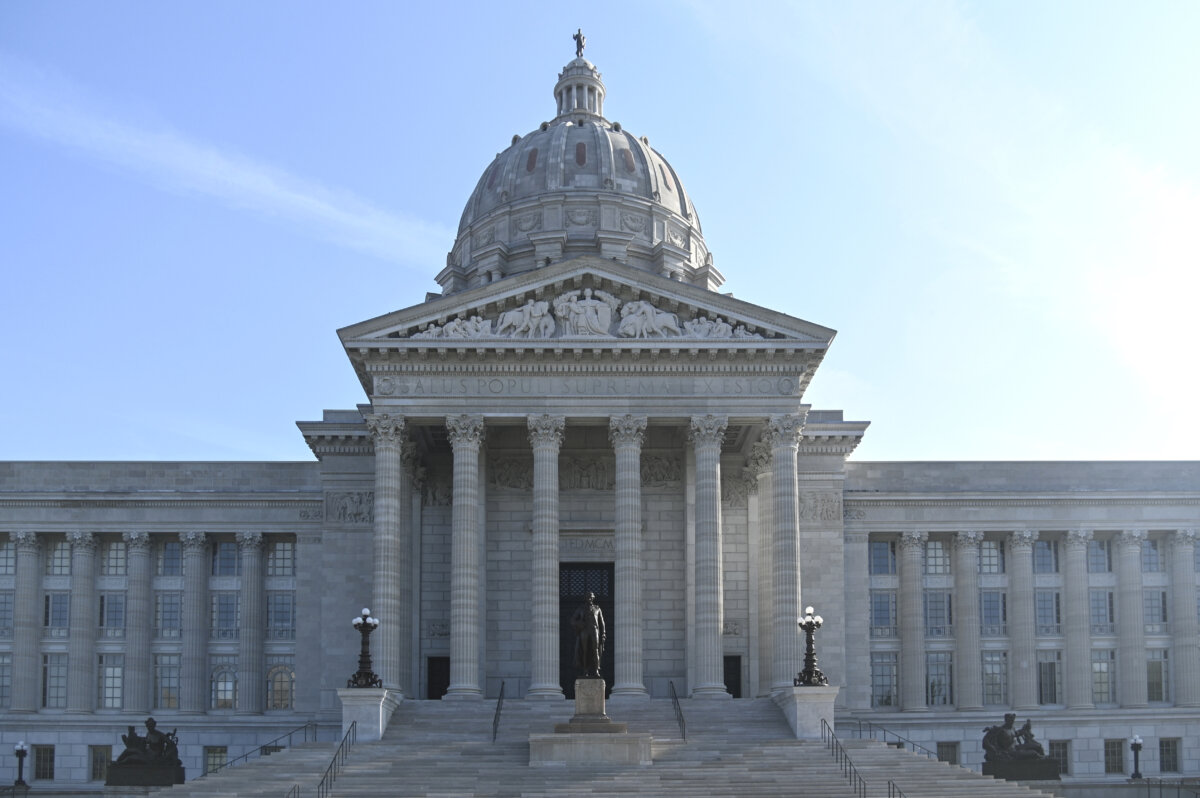

On Sept. 12, Missouri’s Senate approved a measure that will split up the state’s urban Fifth Congressional District into three existing but newly redrawn districts.
In a statement issued on Friday, Missouri Gov. Mike Kehoe, a Republican, said he will sign the legislation. The Missouri General Assembly’s House of Representatives approved the plan on Sept. 9.
On Sept. 12, Missouri’s state senate approved a measure that will split up the state’s urban Fifth Congressional District into three existing but newly redrawn districts. Missouri Gov. Mike Kehoe, a Republican, is expected to sign the legislation. The Missouri General Assembly’s House of Representatives approved the plan on Sept. 9.
In a statement published on social media, Kehoe extended his thanks to “the bill sponsors and handlers in the House and Senate, Republican leadership, and every member of the legislature for their work this week.”
The redistricting effort comes as states are trying to redraw voting districts mid-decade to preserve or expand Democratic or Republican representation in the U.S. House of Representatives. Missouri currently holds eight congressional seats. Six are represented by Republicans and two by Democrats.
On Sept. 9, President Donald Trump said on his Truth Social account that the redrawn map will “give the wonderful people of Missouri the opportunity to elect an additional MAGA Republican in the 2026 Midterm Elections.”
Missouri is the third state to pursue mid-decade redistricting for partisan purposes, following Texas and California. Other Republican-led states—including Indiana, Florida, and Ohio—are considering similar efforts.
Previously, Missouri’s Fifth Congressional District encompassed most of the Kansas City, Missouri, metropolitan area. Going forward, the district will be absorbed into a new, mostly rural Fifth District in western-central Missouri south of the Missouri River; a redrawn, mostly rural Fourth District in western Missouri; and a redrawn, mostly rural Sixth District covering most of Missouri north of the Missouri River.
As Trump said, the new district boundaries will likely dilute the voting power of Kansas City-area Jackson County, Missouri, and make it more difficult for a member of the Democratic Party to carry the Fifth District in 2026. That would help the Republican Party, which currently holds a narrow 219 to 213 majority in the House.
On Sept. 11, Rep. Emanuel Cleaver (D-Mo.), who represents the Fifth District in Washington, took the extraordinary step of appearing before a Missouri Senate committee considering the bill. At the appearance, he said Kansas City voters won’t soon forget how Republicans manipulated the map in Jefferson City to gain a small edge in Washington.
At a news conference after the Thursday hearing, Cleaver told reporters he intends to run for reelection in 2026. The former Mayor of Kansas City, Missouri, has served in Washington for 20 years.
In a statement published on Friday, Cleaver called the General Assembly’s actions a “power grab” and said he is “deeply disappointed that Missouri’s Legislature put the wishes of Washington above the voices of their own constituents.”
“I want to be very clear to those who are frustrated by today’s outcome: this fight is far from over,” Cleaver said in a statement. “Together, in the courts and in the streets, we will continue pushing to ensure the law is upheld, justice prevails, and this unconstitutional gerrymander is defeated.”
Additionally, the state Senate passed legislation amending Missouri’s initiative petition process. Kehoe is expected to sign it as well.
Among the changes are requiring a statewide majority and a majority of votes in each congressional district for a ballot measure to pass, banning foreign contributions to committees for or against statewide ballot initiatives, criminalizing fraudulent signature gathering, and expanding public access and transparency requirements.
The move could dilute the voting power of St. Louis and Kansas City, the state’s largest and second-largest population centers. Both were instrumental in passing an initiative petition that overturned the state’s abortion restrictions in 2024. The petition process also yielded legalized recreational marijuana in 2022 and sports betting in 2024.
The changes to the initiative petition process will go on the 2026 ballot in Missouri. A simple majority vote will approve or deny the changes.
Legal and Electoral Challenges
Opponents to the redistricting plan are expected to release a referendum petition that could force a statewide vote on the Congressional map approved on Friday.
Along with other groups, like the Missouri Voter Protection Coalition and People Not Politicians, the Missouri State Conference of the NAACP has vowed to fight the redistricting in court.
In a Sept. 2 statement, the Missouri chapter of the NAACP called the special session “a direct attack on Black voters, Kansas City, St. Louis, and the very idea of democracy.”
On Sept. 3, the NAACP Missouri State Conference and other allied parties filed suit against the state, Kehoe, and other government officials challenging the validity of the session itself.
“The state constitution only allows these sessions under actual emergencies,” the NAACP statement said. “There is no court order. No census trigger. Just a political stunt dressed up as law.”
In a statement issued on Friday, People Not Politicians spokeswoman Elsa Rainey said that the group will immediately file a referendum to place the question of modifying the congressional district map in front of Missouri voters.
“We now have 90 days to gather 116,000 signatures … we are confident the people will rise to meet this moment,” Rainey said in a Sept. 12 statement. “This fight is not over. Missouri voters — not politicians — will have the final say.”
Representatives of the Missouri chapter of the NAACP and People Not Politicians did not immediately respond to a request for comment from The Epoch Times.
The Associated Press contributed to this story.
 Friends Read Free
Copy
Facebook
Tweet
Friends Read Free
Copy
Facebook
Tweet