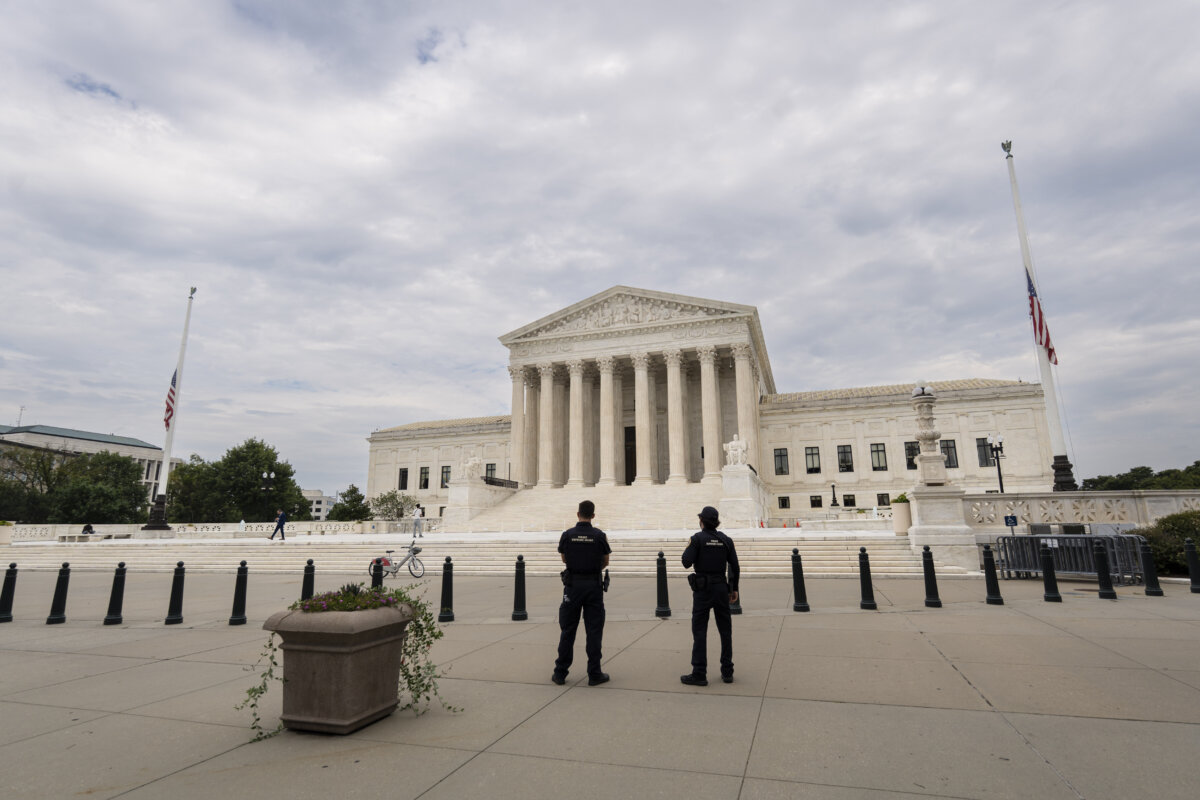

New Jersey asked the U.S. Supreme Court on Sept. 2 to decide whether states have the authority to regulate sports betting that takes place on prediction markets operated by Kalshi and its competitors.
Kalshi, which was recently valued at $22 billion, has been the focus of an intensifying legal battle over the ability of state gaming regulators to police businesses in the rapidly expanding prediction markets sector.
States argue that firms like Kalshi are operating platforms that allow bets without required state licenses and in the process violating state gaming laws, including prohibitions on wagers by individuals under the age of 21.
The specific issue, according to the Garden State, is whether prediction markets may offer sports wagers without having to follow state sports-gambling laws—that is, whether Congress removed state authority over gambling on these platforms.
New Jersey officials said this is the first petition for certiorari, or review, filed with the justices regarding the lawfulness of this business model—offering sports wagers that Kalshi has self-certified with the Commodity Futures Trading Commission (CFTC) without adhering to state laws.
Kalshi self-certified its sports betting contracts by advising the CFTC that they comply with federal law, without first seeking the agency’s approval.
“Companies like Kalshi claim to offer legal sports betting in all 50 States, but they refuse to follow the gambling laws of any State,” New Jersey Attorney General Jennifer Davenport, one of the petitioners, said.
“These companies have no right to offer their sports bets without following state law, which is why dozens of States across the ideological spectrum have opposed them,” Davenport said.
“States have long adopted careful laws to regulate gambling, including to prevent compulsive gambling, gambling by minors, and insider trading on sports games.”
The case goes back to 2025 when Kalshi sued New Jersey, challenging a state cease-and-desist order issued under the state’s Sports Wagering Act, which allows limited sports gambling, according to New Jersey’s petition.
The state law was enacted after the Supreme Court invalidated the ban on state-authorized sports betting in the federal Professional and Amateur Sports Protection Act in its ruling in Murphy v. NCAA (2018). That ruling held that states may legalize, ban, or regulate sports betting within their borders. New Jersey and other states followed by passing their own sports gambling statutes.
Instead of following the state laws, Kalshi “insisted that it could ignore state gambling laws—in New Jersey and across the country—because the company offers its bets via an exchange the company registered with the CFTC.”
A panel of the U.S. Court of Appeals for the Third Circuit affirmed by 2–1 a federal district court injunction from April 2025 against enforcement of the New Jersey law.
A recent ruling in the opposite direction by the Ninth Circuit created a split with the Third Circuit on the legal issue that the Supreme Court should step in to resolve, the petition said.
New Jersey rejects Kalshi’s argument that its sports contracts are swaps under the federal Commodity Exchange Act, as amended by the Dodd-Frank Wall Street Reform and Consumer Protection Act, and therefore not subject to state regulation.
If Kalshi is correct in saying Dodd-Frank federalized the regulation of sports betting, “then state-licensed sportsbooks that everyone has understood to be legal since Murphy—including at brick-and-mortar casinos—have apparently been violating Dodd-Frank all along,” the petition said.
“And it strains credulity to hold that Congress in resolving the 2008 financial crisis took steps to federalize regulation of sports gambling that was otherwise explicitly addressed across other federal statutes spanning decades.”
The Epoch Times reached out to Kalshi for comment. No reply was received by publication time.
Reuters contributed to this report.
 Friends Read Free
Copy
Facebook
Tweet
Friends Read Free
Copy
Facebook
Tweet