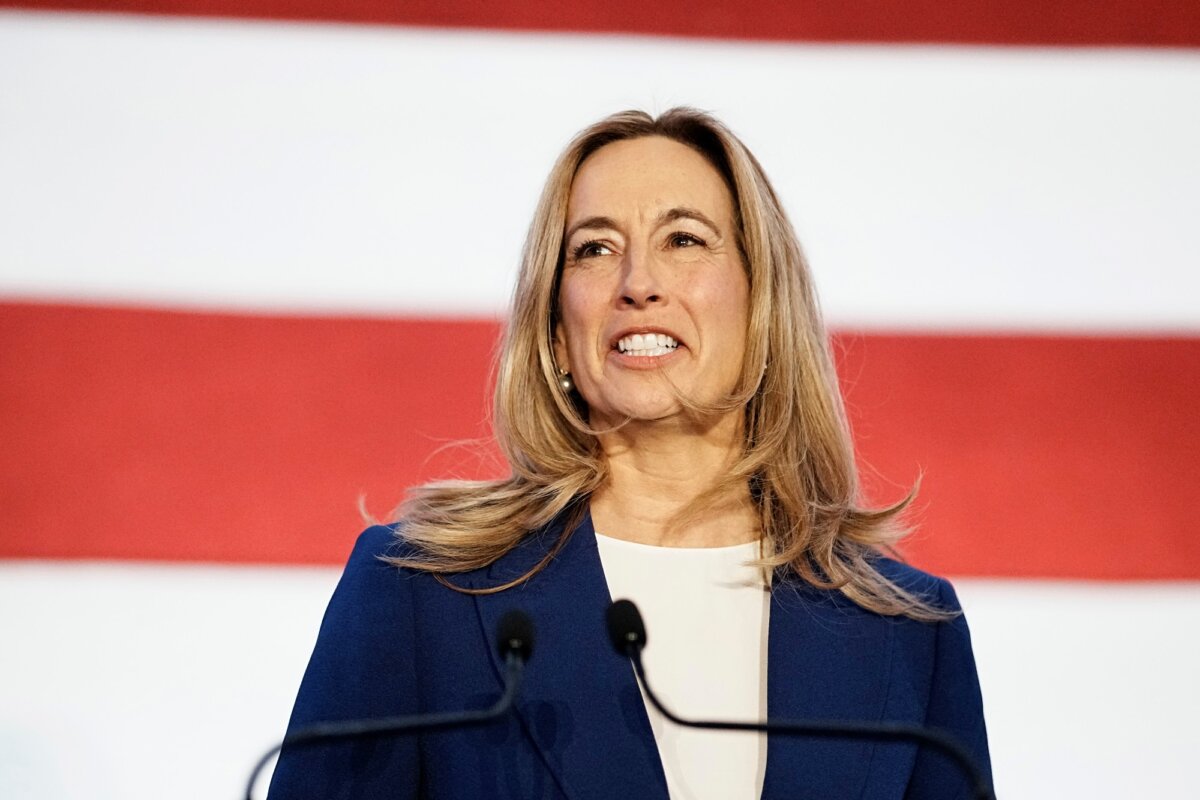

New Jersey Governor Mikie Sherrill this week presented her first state budget, a $60.7 billion spending plan that proposes record property-tax relief, a reduction in the structural deficit, and no new taxes on individual residents.
“Government hasn’t been working the way it can, the way it should,” the Democratic governor said as she addressed lawmakers at the state capitol on Mar. 10.
“And here in New Jersey, a broken budget is at the heart of so much of that. So for too long, too many in Trenton have taken the easy way out, opting for a quick fix instead of laying the foundation for a solid future. Last November, voters were clear. They sent me here to be a different kind of leader, to make their lives more affordable, to protect our kids, to make our government more accountable, and change how business is done. I take that trust seriously.”
The budget includes $4.2 billion in direct property-tax relief. That covers $2.3 billion for the ANCHOR property tax relief program, $350 million for the Senior Freeze program, and nearly $700 million for Stay NJ, a 2023 program that sends annual rebate checks to senior homeowners to offset property tax costs.
Sherrill proposed scaling back Stay NJ eligibility, capping qualifying income at $250,000—down from $500,000—and limiting the maximum benefit to $4,000. Her office said the changes are necessary to keep the program financially sustainable. The budget projects Stay NJ will still benefit more than 440,000 seniors, while ANCHOR is expected to reach nearly 1.4 million homeowners and more than 673,000 renters.
The proposal increases total appropriations 1.6 percent above the adjusted fiscal year 2026 figure, compared to an average annual increase of nearly 7 percent across the previous eight budgets, her office said. To raise new revenue without taxing individuals, her office said the budget closes corporate tax loopholes and improves compliance, steps the governor’s office projects will generate more than $700 million.
More than 74 percent of the total budget flows out to communities as grants, school aid, and municipal payments, according to the governor’s office. The pension payment accounts for $7.3 billion of the total—the sixth consecutive full payment and the first time a governor has fully funded the pension in the first year of an administration in decades, the governor’s office said.
State Treasurer Aaron Binder said the proposal “finds solutions to cut costs without compromising services for everyday New Jerseyans.”
The budget’s affordability focus comes as Democrats have made cost relief the central theme of their national midterm strategy. At their annual issues conference in Leesburg, Virginia, in late February, Democratic Caucus Chair Pete Aguilar of California said the party was “laser-focused on lowering costs and improving the lives of hard-working American families.”
Democratic Whip Katherine Clark of Massachusetts outlined a five-point national agenda that included capping child care costs, expanding affordable housing, and reducing utility costs.
Sherrill’s budget includes some of that, including $582 million for child care assistance, while expanding the Family Connects NJ nurse home visiting program statewide, and proposes a record $12.4 billion for K-12 schools—a $370 million increase—along with a record $1.4 billion for preschool aid.
On housing, the budget adds $5 million to the Down Payment Assistance Program and reduces diversions from the Affordable Housing Trust Fund by more than $70 million to make room for new construction.
On energy, Sherrill said her administration will use off-budget funding sources to offset rate increases and direct the Board of Public Utilities to identify funds for another round of energy assistance payments to lower-income residents.
Republican legislative leaders criticized the plan at separate press conferences and in statements following the address, with some calling the plan a tax increase in disguise and saying Sherrill failed to deliver the spending cuts she promised on the campaign trail.
“New governor, same old song,” said Assemblyman Brian Rumpf, the Assembly’s Republican budget officer.
He also pushed back on Sherrill’s characterization of the corporate tax changes as loophole closures rather than tax increases.
“We have numerous revenue enhancements or whatever the new terminology may be. For Republicans, we call it taxes because we call it like it is,” Rumpf said.
Assembly Republican Conference Leader Christopher DePhillips, appearing alongside Rumpf, called the budget a missed opportunity.
“Where’s the cut in the sales tax rate? This tax is particularly punishing on regular working New Jerseyans,” he said, adding that the budget overall “does not improve affordability in New Jersey.”
In a joint statement, Rumpf, Sen. Carmen Amato Jr., and Assemblyman Gregory Myhre said the budget failed to address the fundamental problem facing residents.
“The focus of both parties in Trenton must be the issue staring every elected official in the face: the cost-of-living crisis overwhelming New Jersey taxpayers,” they said.
Senate Minority Leader Anthony Bucco said in a press conference after Sherrill’s address that he was concerned about the budget’s direction.
“We need real structural reform. Right now, taxpayers are going to lose their property tax deduction,” Bucco said. “We have a long way to go, but the devil will be in the details.”
Senate Budget Officer Declan O’Scanlon expressed concerns about the size of the budget.
“This budget is the largest in history. And there’s almost $2 billion more of taxes,” O’Scanlon said in the press conference. “This is not an affordability budget, yet.” He also offered qualified praise for Sherrill’s pledge to rein in pork spending, saying he would “stand up and applaud that.”
 Friends Read Free
Copy
Facebook
Tweet
Friends Read Free
Copy
Facebook
Tweet