
Heightened distrust and polarization around elections have elevated secretary of state races from routine campaigns into strategic battlegrounds for both parties across the nation.
In Ohio, the Republican primary pits a longtime politician who is currently state treasurer against a reform-minded political outsider who is running for the first time.
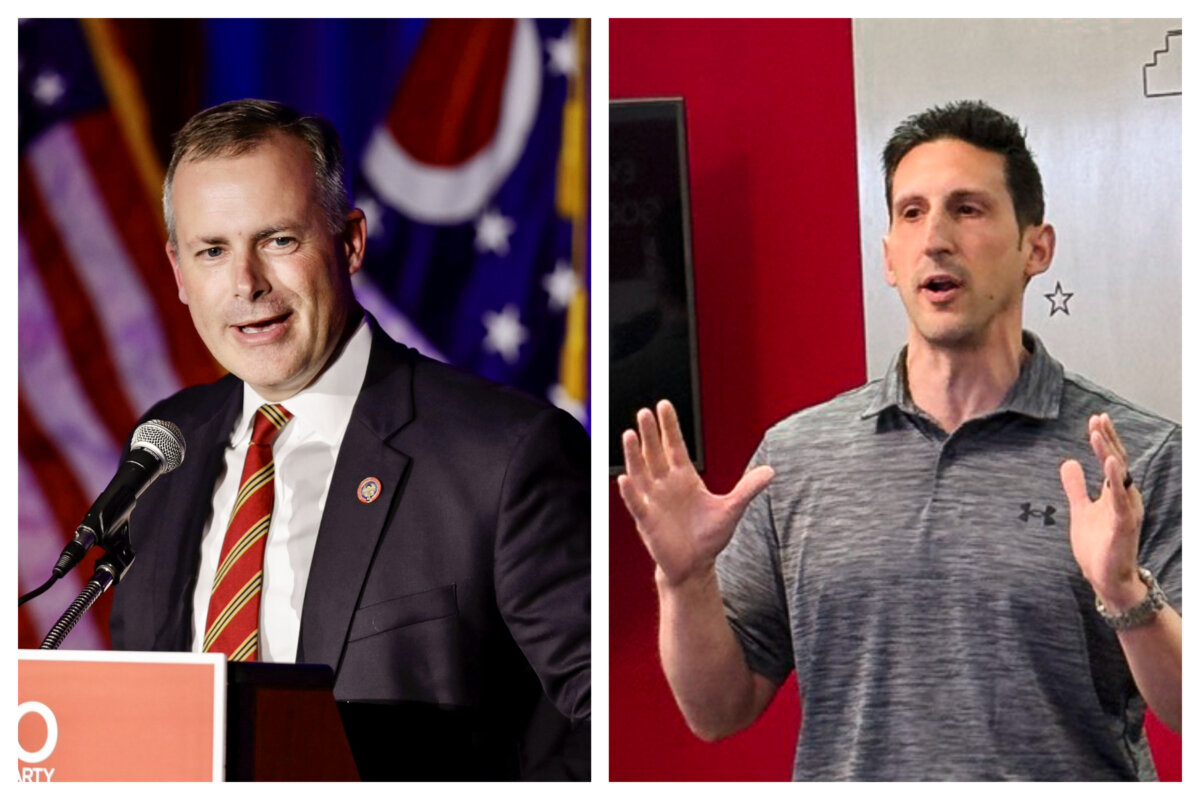
On May 5, Ohio voters will decide between Robert Sprague, who served as a state representative before his current stint as a second-term state treasurer, and Marcell Strbich, a combat veteran and former military intelligence officer.
Frank LaRose, who is finishing his second term as secretary of state, is running for state auditor.
The winner of the GOP primary will face the Democratic primary winner—either Rep. Allison Russo or Dr. Bryan Hambley—and Libertarian Tom Pruss, in the Nov. 3 general election.
America is at a crossroads on elections, Strbich told The Epoch Times. Six of 10 Americans are concerned about the accuracy of elections and don’t trust the outcome, he said, citing a Feb. 26 poll conducted by the UC San Diego Center for Transparent and Trusted Elections.
The secretary of state in Ohio is the chief elections officer, the final arbiter of ballot language, and the gatekeeper for citizen-led referendums. The office also manages business filings, serves on the Ohio Redistricting Commission, and oversees a Public Integrity division that Strbich said could anchor an anti-fraud task force that coordinates with the attorney general, auditor, and state agencies.
Both candidates prioritize election security and public confidence in results.
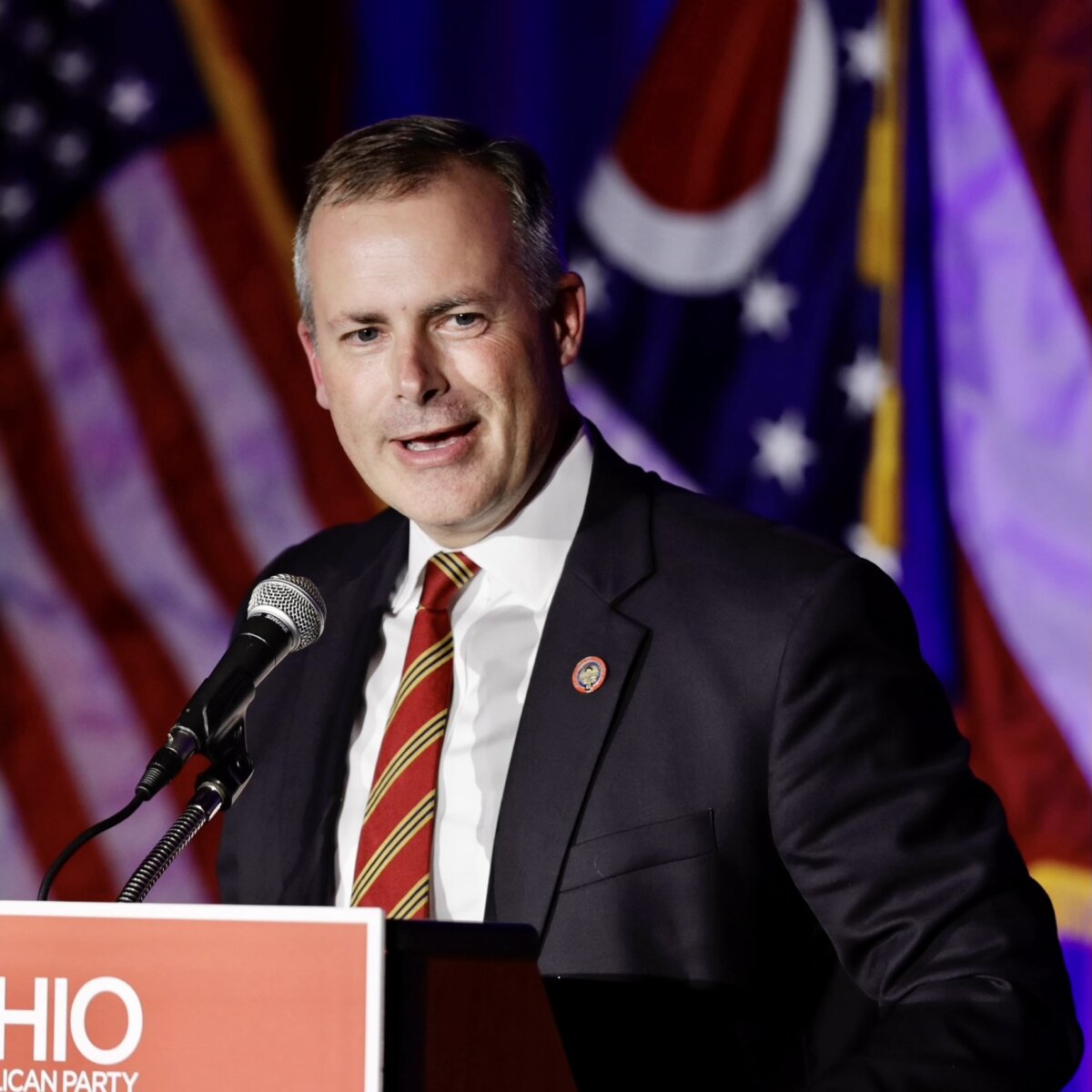
Sprague, 52, is a Findlay native who lives there with his wife and children. He served as city auditor and treasurer in his hometown before entering the state Legislature.
He graduated from Duke University, earned an MBA at the University of North Carolina, and worked as a management consultant at Ernst & Young.
Sprague told The Epoch Times that he is the only candidate in the race who has won a statewide election. He said that his experience managing a large state operation as state treasurer separates him from Strbich.
“People have trusted me with their tax dollars, and we made the office secure. My goal is to make sure we have the most secure elections in Ohio history,” Sprague said.
Ohio has a reputation for being “easy to vote and hard to cheat” under Republican leadership, Sprague said, adding that he would build on photo ID requirements.
Sprague also advocates for a more stringent auditing process.
“When you have that separate piece of paper, it creates a perfect audit trail,” he said. “We can go back and we can audit the paper, to make sure the machines aren’t rigged and they are 100 percent accurate and the elections are 100 percent accurate.”
Twelve counties use electronic-only machines, Sprague noted. Switching over would cost between $16 million and $24 million, which he said he would ask the state to cover.
“There’s a cost to running secure elections,” he said.
Strbich has an even stricter proposal for paper ballots.
“The difference between his paper ballots and my paper ballots is he qualifies paper ballots that come out of electronic vote casting machines as equal to the paper ballots that I’m talking about, which are just pen and paper marked,” Strbich said.
Half of Ohio’s 88 counties don’t offer those paper ballots, and this would require significant changes, Strbich added.
Sprague would like to implement a printout of each voter’s selections so they can take it from the voting machine and give it to poll workers. The printout is used in some counties. In most counties, he said, the voting machine only has an internal roll of paper that records the vote.
Counties that use the second piece of paper run those papers through a tabulation machine overseen by a bipartisan team when polls close. An optical scanner determines who has won and lost.
“You now have an immutable audit trail with that second separate stack of papers, as long as you don’t lose the chain of custody for those ballots, you go back and count them to make sure the machines are reflecting 100 percent accuracy,” Sprague said.
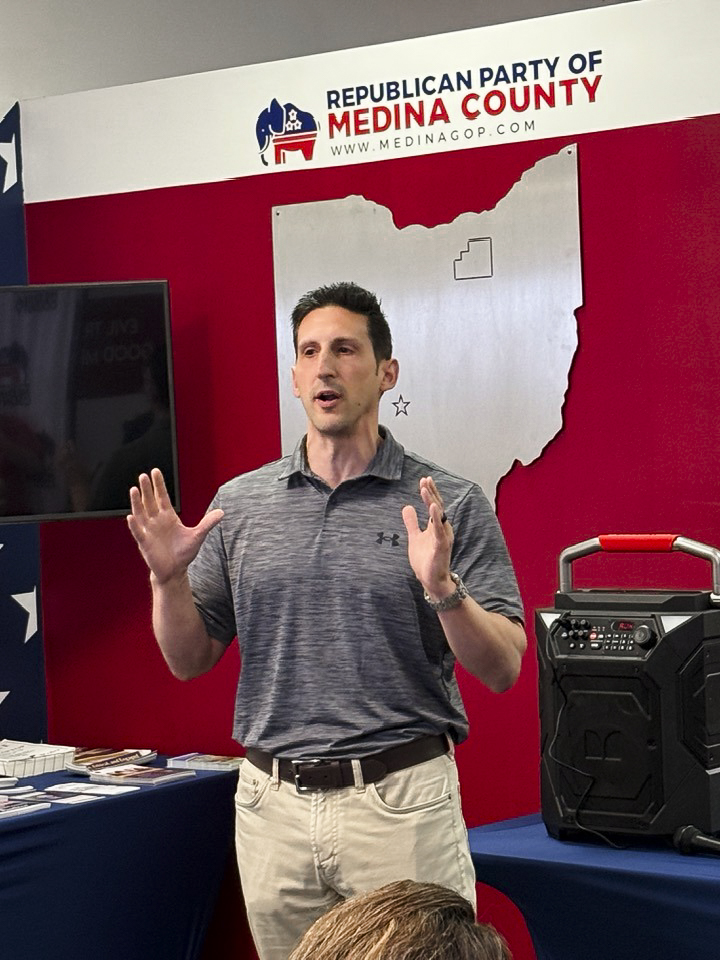
Strbich, 44, grew up in greater Chicago. He earned a bachelor’s degree from Indiana University in 2004 before beginning a 20-year career in the U.S. Air Force as an intelligence officer, “conducting threat and vulnerability assessments on critical infrastructure and directing remote‑piloted aircraft operations in Iraq and Afghanistan,” he said.
A combat veteran, Strbich deployed five times during the operations Iraqi Freedom and Enduring Freedom. He was assigned to the Pentagon in 2017. There, he advised the vice chairman of the Joint Chiefs of Staff on technology modernization and weapon system upgrades, he said.
Election systems should be treated as critical infrastructure and managed with the same intent, he said.
Among the changes Strbich would like to implement are replacing touchscreen machines as the primary method of voting with pre-printed, hand-marked, and watermarked paper ballots.
The state is “needlessly spending millions on voting machine contract updates, replacements for touchscreen systems and cybersecurity upgrades,” Strbich said.
Even with these updates, the state’s electronic voting systems are not ready to combat sophisticated cyber threats, he said.
If elected, he said, he would expand information-sharing agreements so county boards of elections can verify citizenship, identity, and residency before creating voter records.
“This will put an end to Ohio’s honor system of registration. It will be more secure,” Strbich said, also vowing to create a detection mechanism for fraud, modeled after counterterrorism targeting systems.
“Just like I built a detection mechanism to find enemy combatants in Iraq and Afghanistan, and to hunt down terrorists, it’s going to be the same thing for detecting election fraud.”
Strbich told The Epoch Times that he wants to bring citizens back into “each phase of elections, from registration and casting votes to counting votes, and auditing votes.”
Transparency and public oversight will help voters and would-be poll workers escape apathy and disengagement, he said.
Since leaving the military in 2024, he has shifted his focus to election integrity in Ohio. He won an Ohio Supreme Court case (Strbich v. Montgomery County Board of Elections), which he said enforces citizenship verification training for poll workers.
Strbich said he helped draft multiple Ohio bills related to voter eligibility and security, including HB 552 (The Voter Verification Act), which introduces a proof of citizenship requirement into voter registration; HB 472 (The Ohio Votes Count Act), which intends to ensure that boards of elections can verify eligibility up front by providing them access to data; and HB 477, which would require a copy of photo ID for all mail-in ballots.
HB 577 closely resembles the federal SAVE America Act, or Safeguard American Voter Eligibility Act, a proposed law that would require voters to provide documentary proof of U.S. citizenship when registering to vote in federal elections.
That measure is stalled in the Senate, but Strbich noted that “Ohio doesn’t need to wait on Washington because we have Republican control in the state legislature, the governor’s office, and the secretary of state’s office.”
Sprague told The Epoch Times that he supports the SAVE America Act.
Ohio is one of 28 states that permit no-excuse absentee voting, according to the National Conference of State Legislatures. Sprague said he believes that mail-in voting is prone to fraud, as does Strbich.
Strbich laments what he calls Ohio’s “musical chairs” culture in politics, where term-limited Republicans “rotate among offices with the blessing of party insiders, consultants, and major donors,” he said.
Sprague served as a state representative for eight years before he was termed out and ran for state treasurer, a post he has held since 2019. He is completing his second term in that role.
The Ohio Republican Party endorsed Sprague, which Strbich said should not have happened.
“When you endorse in a competitive primary, that candidate gets reduced mailing rates, access to field staff, and inclusion in county mail pieces. This gives a major advantage because uninformed and disengaged voters tend to choose whichever name the state party endorses,” Strbich said.
“Why not have a competitive primary where the candidates debate, and voters make their decision based on which person voters like best, and then support that candidate in the general election?”
Ohio Republican Party figures reached out to Strbich and encouraged him to drop out of the race, he told The Epoch Times.
“They’ve devoted hundreds of thousands of dollars to defeat me instead of focusing on Democrats. That shows me that my candidacy threatens the establishment. They don’t want me to win,” he said.
Strbich hasn’t aired television ads or accepted PAC money, he said.
To counter the “disadvantages” of facing an opponent endorsed by the Ohio Republican Party, Strbich said he has developed an expansive county-by-county volunteer network and has spent the past year knocking on doors and attending “every event I can to reach voters” across Ohio’s 88 counties.
“This is a cause, not a career. I want to be secretary of state because I have a detailed plan and purpose. I’m not running as a stepping stone to running for governor or Congress,” Strbich said, adding that he would serve a pair of four-year terms as secretary of state and then return to private life.
Democratic Primary Candidates
In the Democratic primary, Rep. Allison Russo was first elected to the Ohio House in 2018. A former health policy consultant, she served as House minority leader for three years before stepping down in 2025 to launch her secretary of state campaign.
Her opponent, Bryan Hambley, is a cancer doctor at the University of Cincinnati. Like Strbich, Hambley is a political outsider who said he has not taken PAC money.
Both candidates have said that LaRose has politicized the office and bent state elections to the will of President Donald Trump.
Russo said that as secretary of state, she would prioritize voter education and ensure that Ohioans aren’t distracted by “misinformation.”
“Really, any sort of progress in the state comes back to the ability of Ohioans to have their voices heard,” Russo said.
Hambley said that Democrats in general have lost touch with communities across Ohio.
“The average Ohioan doesn’t like the average Democrat in part because they don’t think the average Ohio Democrat shares their values,” he said.
 Friends Read Free
Copy
Facebook
Tweet
Friends Read Free
Copy
Facebook
Tweet