Hurricane Isaias hit the Florida Panhandle and brought devastating winds and rain across the Gulf Coast, parts of the Deep South, and Appalachia just over a week ago, and significant progress toward recovery has been made.
Florida Gov. Ron DeSantis announced on Oct. 16 that his state’s emergency management division deployed its vast stock of resources on more than 1,600 response missions and had opened 11 points of distribution across the Panhandle.
As of Oct. 16, Florida had distributed more than 270,000 shelf-stable meals, nearly 225,000 gallons of fuel, nearly 500,000 boxes of water, and more than 26,000 tarps and bags of ice.
Those numbers follow a rapid, immediate response effort through the holiday weekend in which nearly all of the state’s estimated 500,000 registered utility customers have their power restored, and more than a thousand miles of roads cleared by Tuesday, Oct. 13—including all of I-10 and US-98, which was cleared by 6 a.m. local time the morning after the storm hit.
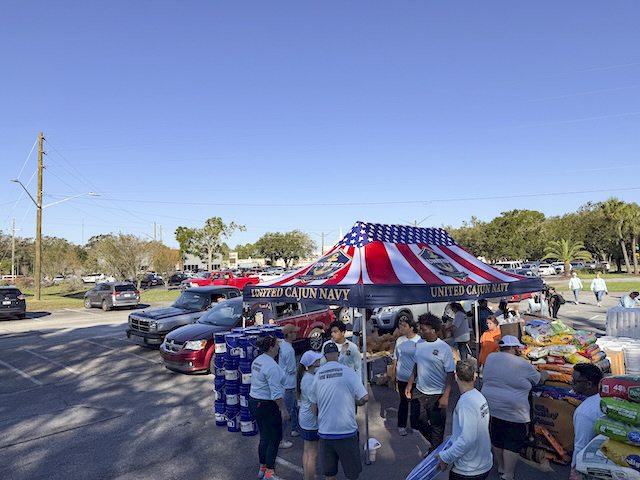
This work continues to be supplemented by private citizens and nonprofits who coordinated with local officials to expedite the recovery by providing their own points of distribution, performing wellness checks, and forming chainsaw crews to clear debris and allow people to access their homes—or be able to leave them for the first time since the storm hit.
Those nonprofits include United Cajun Navy, Team Dominator Storm Recovery, Operation BBQ Relief, Samaritan’s Purse, Chainsaws for Christ, the American Red Cross, and the Wal-Mart Foundation.
DeSantis also announced that the state was partnering with Emergency RV to provide temporary housing to Floridians.
Now, the state awaits approval of a Major Disaster Declaration request it submitted to the federal government. It seeks additional federal resources to support communities impacted by the hurricane. This includes public assistance for 15 counties along Northwest Florida and individual assistance for another eight counties.
Counties that could receive public assistance include Calhoun, Liberty, Jackson, Jefferson, Franklin, and Wakulla counties. Meanwhile, the declaration requests both public and individual assistance for Bay, Escambia, Gulf, Holmes, Okaloosa, Santa Rosa, Walton, and Washington counties.
The governor’s office stated in a press release that the public assistance would help eligible state and local governments, as well as certain nonprofit organizations, offset costs of disaster response and recovery. This includes costs of debris removal, critical infrastructure repairs, and necessary emergency response operations.
“This funding is particularly important for Florida’s smaller and fiscally constrained counties, where the financial burden of responding to and recovering from a major hurricane can significantly strain local resources,” the governor’s office stated.
Meanwhile, approved Individual Assistance could provide funds for essential personal property, basic home repairs, temporary housing, and necessary disaster-related expenses.
“The program is designed to help residents address uninsured or underinsured losses and begin the recovery process,” the governor’s office stated.
Hurricane Isaias made landfall near Destin, Florida, on the night of Friday, Oct. 9, as a Category Two hurricane with maximum sustained winds exceeding 100 mph and dispensing storm surge more than five feet high.
It dissipated into a tropical storm but still produced significant rain and wind across the surrounding states, including Alabama, Georgia, and North Carolina.
Georgia Gov. Brian Kemp spoke with the Federal Emergency Management Agency immediately following the storm on Oct. 10, and on Oct. 14, Alabama Gov. Kay Ivy extended the state of emergency until Oct. 28.
“I am grateful to the emergency management officials, as well as first responders, law enforcement, power crews, and all involved in storm cleanup,” Ivy said in an X post.
“Our outstanding private sector partners and volunteer organizations are doing good work to help our people.”
 Friends Read Free
Copy
Facebook
Tweet
Friends Read Free
Copy
Facebook
Tweet