
The federal government this past week set legal precedent by applying a terrorism law—typically used against foreign terrorist organizations—to successfully prosecute a Texas Antifa cell for homegrown political violence.
The March 13 mixed verdict is expected to deter terrorist groups such as Antifa and facilitate future prosecutions.
Eight defendants were convicted in the Fort Worth, Texas, trial of supporting terrorists, carrying explosives, and rioting.
Benjamin Song was the only defendant convicted of attempted murder and discharging a firearm during a violent crime. Prosecutors said Song fired 11 shots until his AR-style rifle jammed, hitting an officer in the neck who had responded to a 911 call.
The convictions were seen as a victory for the Trump administration and followed President Donald Trump’s executive order on Sept. 22, 2025, designating Antifa as a domestic terrorist organization.
The case received national attention as it was the first time members of Antifa, short for anti-fascist, were charged with terrorism-related offenses, despite their involvement in protests that have sometimes turned violent.
Federal prosecutors convinced the jury in the U.S. District Court for the Northern District of Texas that on July 4, 2025, the defendants launched a planned attack on the Prairieland Immigration and Customs Enforcement (ICE) facility outside Dallas.
The defense argued that their clients staged a “noise demonstration” at the ICE facility with fireworks and a bullhorn to support illegal immigrants, claiming that they never intended to harm anyone.
‘Sends a Signal’
Jonathan Hullihan, general counsel at Texas’s Remnant Law Firm, compared the Antifa case to the Oklahoma City bombing—in which attackers killed 168 people in a government building in 1995—but noted that the government did not use terrorism laws in the prosecution.
In the Texas case, the government used the criminal statute 18 U.S. Code 2339A, which prohibits providing material support to terrorists, to argue that the defendants’ actions constituted domestic terrorism. The 1994 law prohibits knowingly or intentionally providing material support or resources such as personnel, transportation, equipment, or aid that will be used to carry out terrorist activity.
Only rarely has the law been used to prosecute purely homegrown terrorists, unlike its companion the 2339B statute, which targets designated foreign groups. Typically, 2339A has been applied in cases with a foreign terrorist organization nexus, such as cases involving material support for ISIS terrorist group plots, said Hullihan, who has experience in national security law.
“This is a legit, good conviction,” he told The Epoch Times. “It sends a signal that domestic terrorism, no matter how loosely affiliated, when you commit terroristic acts, and you coordinate them, you’re going to be prosecuted under the material support statute.”
The win offers a blueprint for future domestic terrorism cases, he said, noting that the government had previously hesitated to prosecute groups such as Antifa. The concern is how legal precedent might be used against free speech in the future, he said.
After the verdict, Attorney General Pamela Bondi suggested that more cases against Antifa could be on the horizon.
“Today’s verdict on terrorism charges will not be the last as the Trump administration systematically dismantles Antifa and finally halts their violence on America’s streets,” she said on X.
Lawful Protest Versus Criminal Activity
Scott Mechkowski, a retired ICE agent and advisory board member of the National Immigration Center for Enforcement, said the government’s case draws the line between activism and crime.
“I think it’s a huge victory for the government,” he told The Epoch Times. “The trial was important because it clearly distinguished between lawful protest and organized criminal activity.”
Mechkowski said the case marks a shift away from viewing violent protests as mere activism.
“The courts, you know, in this case, are treating it with the gravity it deserves,” he said.
ICE agents have faced similar organized violence in other cities over the past year, most recently in Minnesota.
Agents with whom he spoke after the verdict felt encouraged, Mechkowski said.
However, the verdict may not affect Democrat-run states and cities because of more liberal judges and jury nullification, in which jurors acquit for ideological reasons despite believing that the defendant is guilty beyond a reasonable doubt, Mechkowski said.
Ammon Blair, a former Border Patrol agent and senior fellow for the Texas Public Policy Foundation’s Secure and Sovereign Nation Initiative, said the government’s hesitation to take on Antifa allowed the cells operating in the United States to become stronger.
Blair, who is also a security consultant, said there is evidence that left-wing groups working to stop ICE deportations in Minnesota had ties to Antifa. Meanwhile, in Chicago, Mexican cartel subcontractors were defending illegal immigrants by putting bounties out for Border Patrol agents.
“So you have a hybrid threat environment that you would typically see in a Third World nation, not in the United States, because of this hesitation,” he told The Epoch Times.
The jury verdict gives the federal government a clear mandate to dismantle Antifa as a domestic terrorist group, he said. If citizens can hack into Signal chats and expose “domestic terrorist” campaigns against ICE, then it should not be difficult for the FBI, he noted.
Mass arrests are needed, according to Blair, to break up what he sees as an insurgency against the government.
Free Speech Concerns
However, critics said the Antifa prosecution chills political speech and erodes First Amendment rights.
“That opposition is something that the government wants to squash, so a case like this helps the government kind of see how far they can go in criminalizing constitutionally protected protests and also helps them kind of intimidate, increase the fear, hoping that folks in other cities then will think twice over protesting,” said Suzanne Adely, interim president of the National Lawyers Guild, a left-wing legal group known to aid activist protesters.
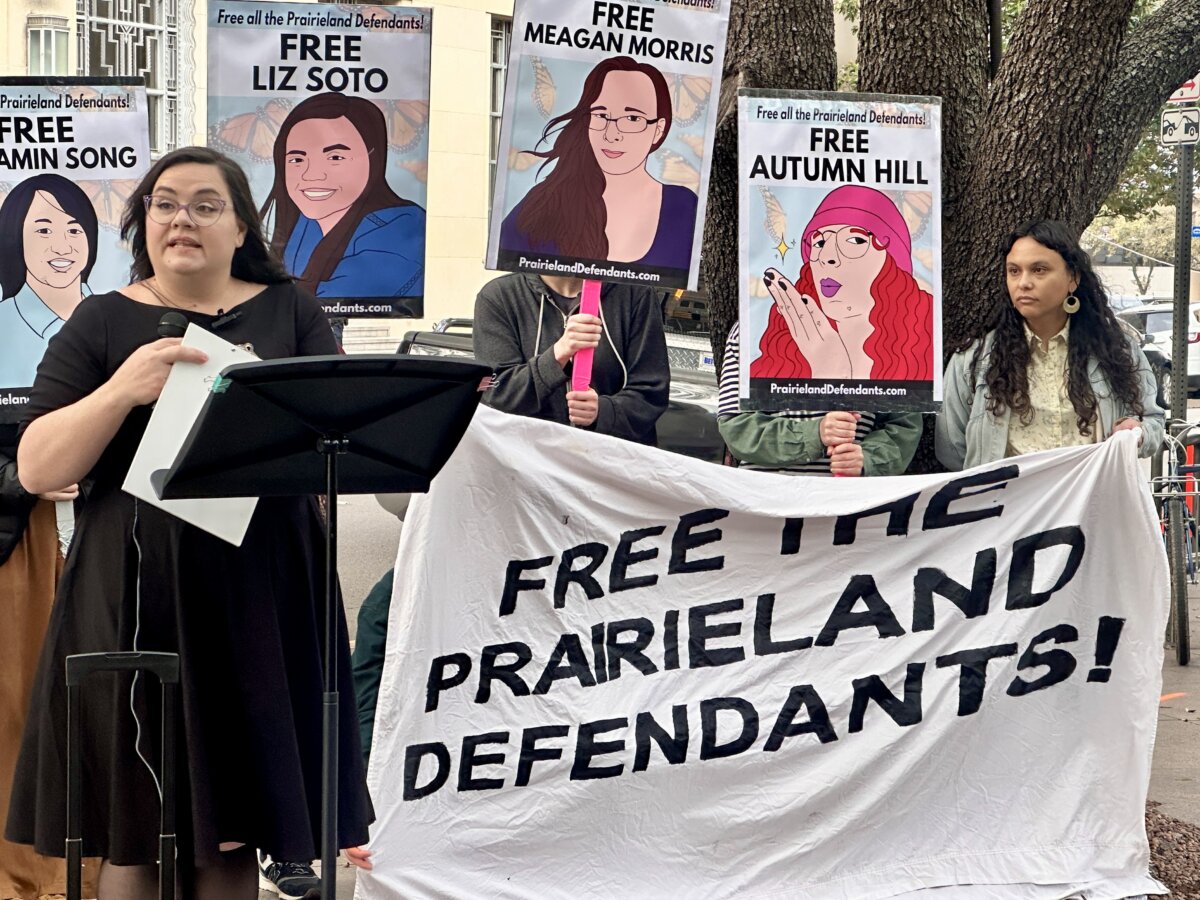
Support the Prairieland Defendants, a group supporting the individuals on trial, agreed in a March 13 post on its website that the government’s goal was intimidation.
“Everything about this trial from beginning to end has proven what we have said all along: this is a sham trial, built on political persecution and ideological attacks coming from the top,” the group stated.
During the trial, defense attorneys called Antifa an ideology, not an operational group, a sentiment expressed by many Democrats in the past.
Antifa, a far-left extremist group, is modeled after a violent arm of the Communist Party of Germany in the 1930s. It is a loose group of anarchists, communists, and socialists operating under one banner, according to an expert on extremist groups who testified for the government.
Prosecutors presented evidence that the defendants scouted out the facility before the attack, used encrypted text messages to execute their plan, brought AR-style rifles and medical kits to the scene, and put their phones in Faraday bags to block anyone from tracking their cellphones.
Afterward, members identified the shooter and tried to conceal Antifa-related pamphlets, according to the prosecution.
The eight defendants included Song, Cameron Arnold (also known as Autumn Hill), Zachary Evetts, Bradford Morris (also known as Meagan Morris), Maricela Rueda, Savanna Batten, Elizabeth Soto, and Ines Soto.
The ninth defendant, Daniel Rolando Sánchez-Estrada, was found guilty of two charges: concealing documents and conspiracy to conceal.
The Associated Press contributed to this report.
 Friends Read Free
Copy
Facebook
Tweet
Friends Read Free
Copy
Facebook
Tweet