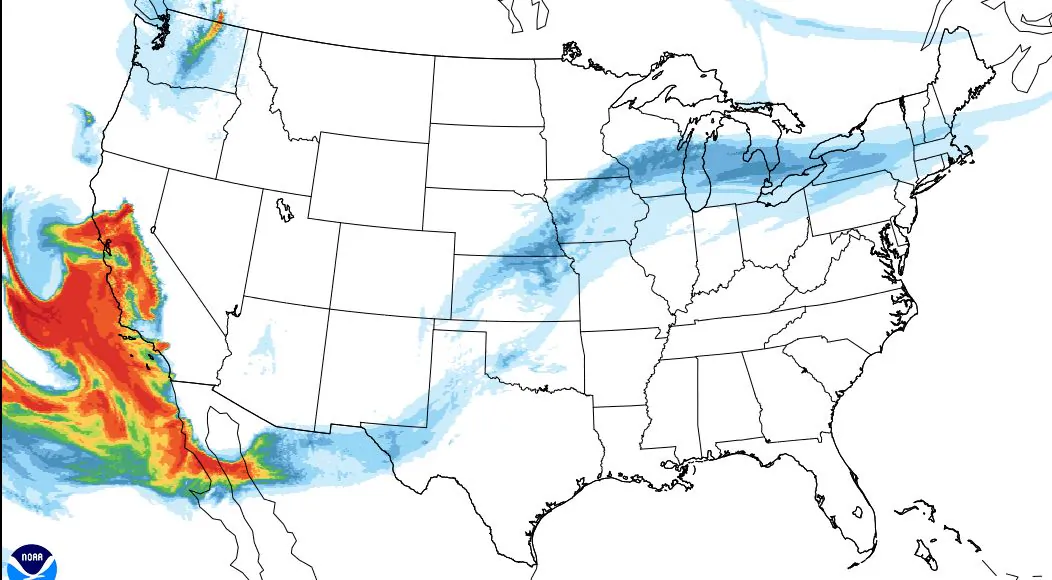
Smoke from the California wildfires has reached all the way to the East Coast, according to the National Oceanic and Atmospheric Administration (NOAA).
As of Nov. 12, the smoke had reached the northern Atlantic Ocean off the coast of Maine, according to the NOAA’s maps.
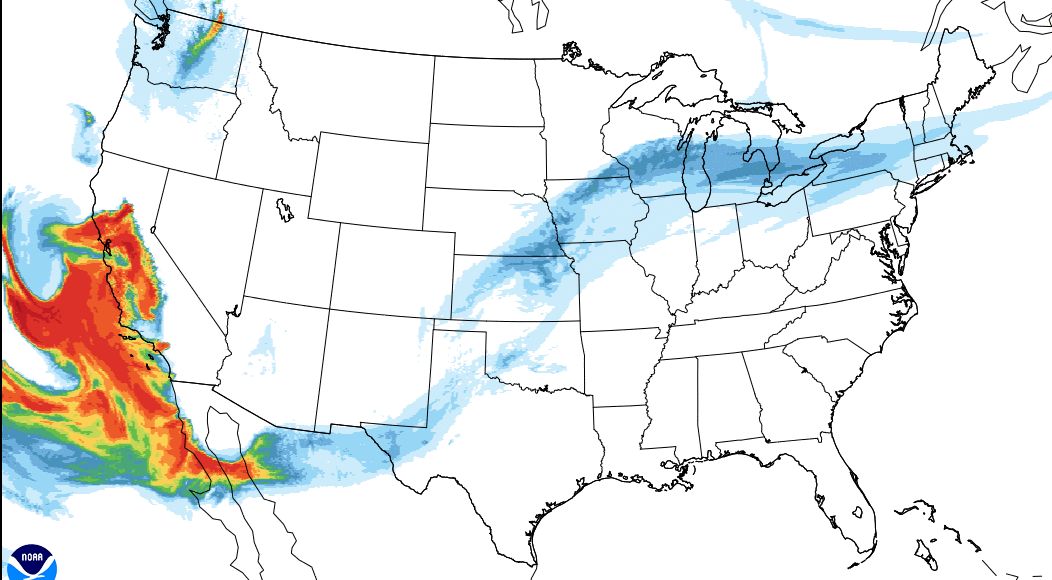 Maps from the National Oceanic and Atmospheric Association show smoke from California wildfires reaching the East Coast. (NOAA)
Two wildfires are currently burning in Southern California and another is raging in Northern California as of Monday, said officials At least 31 people have died, including 29 in Northern California and two in Southern California, and at least 228 people missing, The Associated Press reported.
An image from Nasa’s Terra satellite on Nov. 9 shows the wildfires raging on both sides of the state.
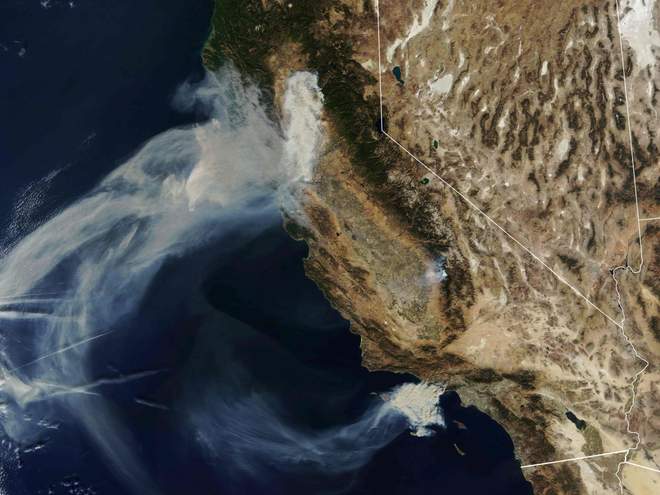 Nasa Earth Observatory satellite image captured on Nov. 9, 2018, shows the Camp Fire (top) burning in Paradise, California, while the Hill and Woolsey Fires (bottom) burn in Northern California (Joshua Stevens/NASA Earth Observatory/AFP/Getty Images)
At least 8,000 firefighters are working to contain the blazes as about 150,000 were ordered to evacuate.
The Camp Fire in Northern California has been the most devastating, burning 113,000 acres and totally ravaged the city of Paradise, Cal Fire said. It’s only at around 25 percent containment.
The New York Times noted the Camp Fire already matched the deadliest fire in California state history
In Paradise, more than 6,400 homes were destroyed.
“Paradise is an old, wooded town with narrow surface streets—and it’s a retirement community,” said Scott McLean, the deputy chief of Cal Fire, told the paper.
He added: “The winds were phenomenal, pushing everything down across the roadways. Roads were simply blocked. People ran out of gas. It was an accumulation of everything all at once.”
And forecasters say the weather is likely only to get worse.
Harsh, dry winds are expected to fan the flames of the Camp Fire, said officials, Reuters reported. Winds are also expected in Southern California and could help fuel the Woolsey Fire.
“Winds are already blowing,” Chief Daryl Osby of the Los Angeles County Fire Department told the news agency. “They are going to blow for the next three days. Your house can be rebuilt, but you can’t bring your life back.”
The Woolsey Fire has burned at least 91,572 acres and destroyed 370 buildings so far, and it’s only 20 percent contained, Reuters reported. “Favorable overnight weather conditions contributed to minimal fire growth, which allowed crews to reinforce containment lines,” Cal Fire said on Nov. 12.
The Southern California Edison Company, meanwhile, stated it had experienced an outage at a substation in the San Fernando Valley just minutes before the Woolsey Fire started.
 Friends Read Free
Copy
Facebook
Tweet
Friends Read Free
Copy
Facebook
Tweet