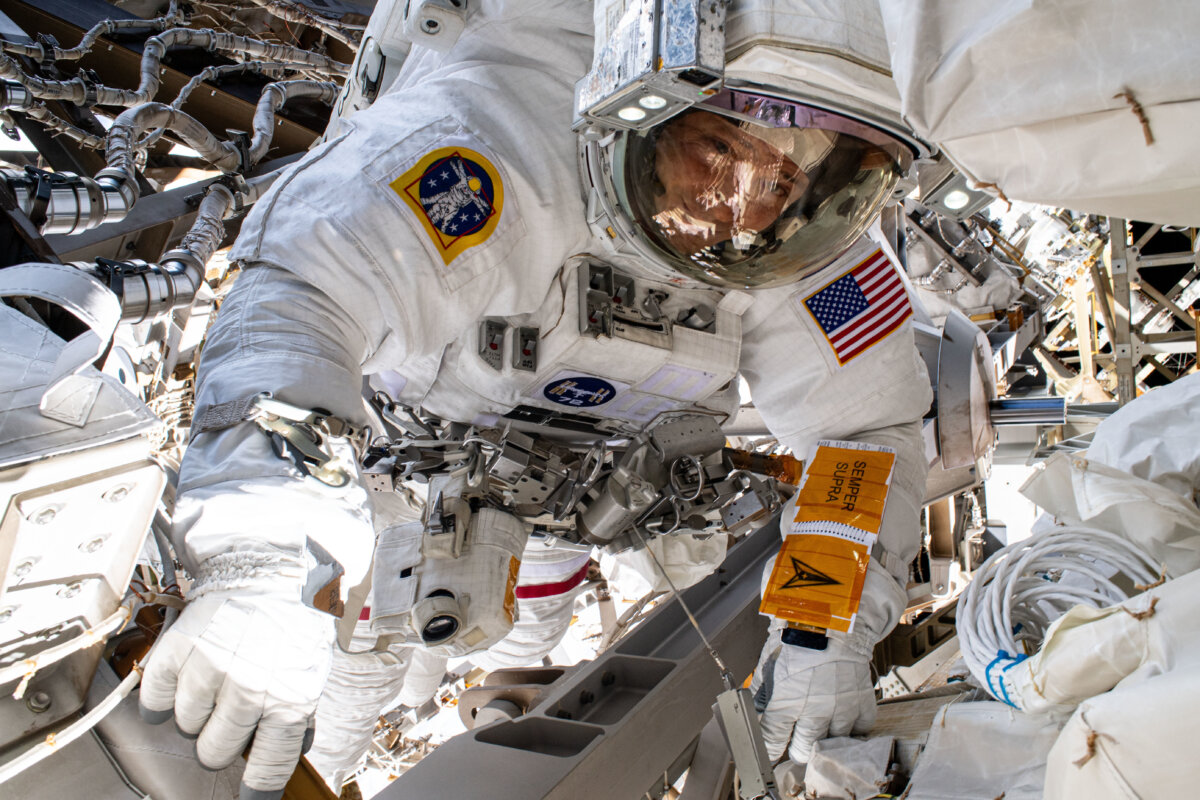

Not only does the United States have weapons deployed in outer space, but the U.S. Space Force is already utilizing the final frontier in its war fighting.
These are two realities Air Force and Space Force leaders reiterated to civilians and servicemen and women in their respective branches during a joint conference Sept. 14–16, and they said the overall scale of those capabilities was only going to advance.
But what does operating tools and weapons in space during a battle actually look like?
A panel of three Space Force generals shed some light on the current state of what they call space war fighting on Sept. 16, and it appeared to be one focused on survival and sustaining supremacy of operations of both the spacecraft in orbit and the personnel on the ground.
“We have an environment where we have anti-satellite missiles, you know, poised on the ground, ready to strike spacecraft in orbit,” Space Force Lt. Gen. Dennis Bythewood, commander of U.S. Space Forces–Space, explained. “We have directed energy and jamming systems on the ground ready to impact space systems on-orbit. We have co-orbital systems that are holding our spacecraft at risk daily.
“On top of that, we’ve got terrestrial warfighters who demand access to space capabilities in their daily operations,” he added. “And so, when we think about space war fighting in the domain, the on-orbit domain now, we think about all of those things.”
These unmanned spacecraft provide essential capabilities that enhance warfighters on the land, air, and sea.
The U.S. Space Force has participated in several joint-force missions since its inception, including satellite communication and geolocation tracking during the capture of former Venezuelan dictator Nicolás Maduro.
The Space Force members, or Guardians, operate those systems on the ground, and they are often on the front lines with the ground, air, and naval forces they are supporting.
But the generals pointed out that it is not just the physical spacecraft and personnel that are being targeted. The Space Force also fights its battles along the radio frequencies and cyberspace for control of communications, networks, and information links between space assets and America’s warfighters.
Likewise, they stressed that the U.S. Space Force must continue to have the capacity to not only defend its assets but also launch its own offensive strikes against those of its adversaries.
“It looks no different than any other type of warfighting,” said Brig. Gen. Todd Benson, combined forces space component commander for CENTCOM. “We have adversaries, we have objectives, we have capabilities. It is no different than any other piece of the toolkit.
“I think we’ve seen space war fighting reach parity with what the other domains have done for centuries,” he added.
As access to space becomes more and more affordable, and technologies such as artificial intelligence are evolving far faster than several Air and Space Force leaders expected, the domains of space and cyberspace are only going to get more and more complex, the speakers said. It will also continue to be the responsibility of all the other armed service branches to step up and support the Space Force as it supported them.
Benson said that the days of single-domain fighting are over. That is, battles only fought on the ground, in the air, or on the sea. Each fight will happen on multiple domains, especially in the domain of space.
“There are multiple times when each component and each domain has taken the lead, or they have followed in support, and this domain and this fight is no different,” he said. “I’ve had Army, Navy, Marine, Special Operations, all supporting space objectives, and we have also returned and done the same for them. So this has been a pretty exciting time for space.”
 Friends Read Free
Copy
Facebook
Tweet
Friends Read Free
Copy
Facebook
Tweet