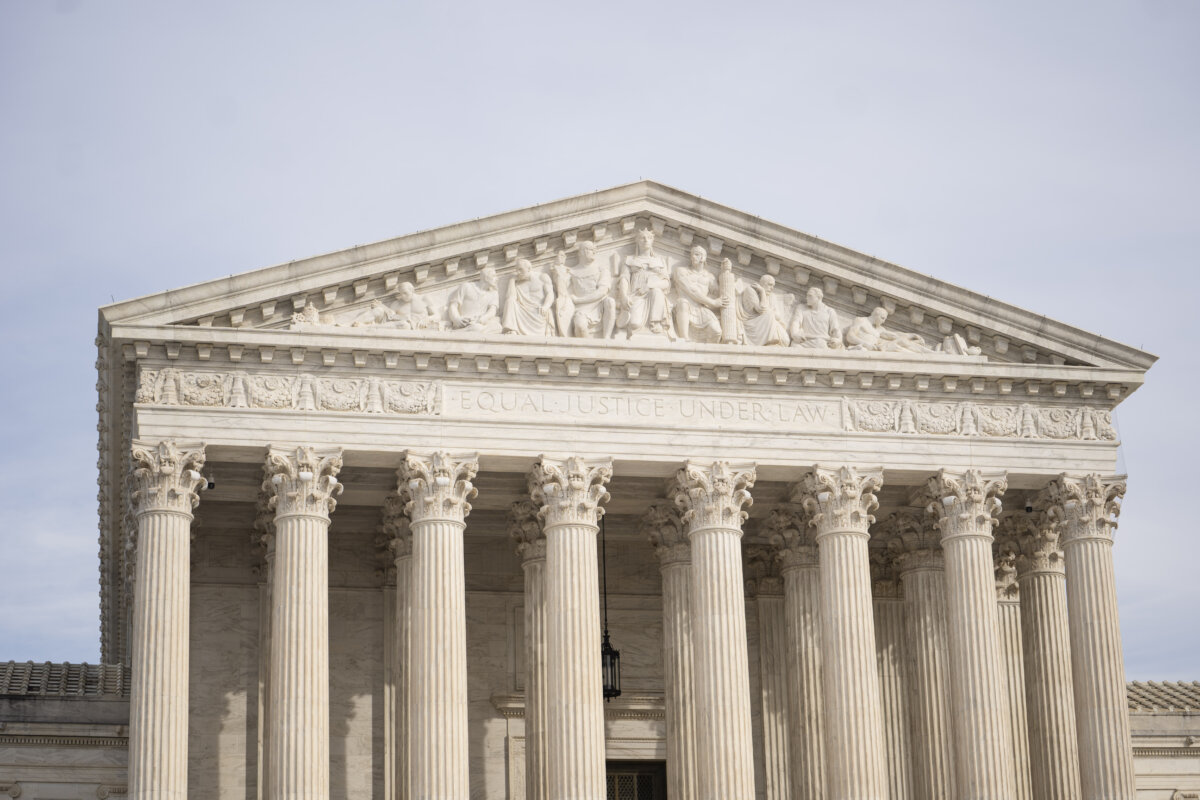

The Supreme Court has revived an injured veteran’s lawsuit attempting to hold a defense contractor liable for a 2016 terrorist attack in Afghanistan.
The contractor, known as Fluor Corp., argued that a federal law granting the government immunity should apply to companies such as it. In a 6–3 decision on April 22, the court rejected its argument, saying that “federal contractors do not automatically share the Government’s immunity merely because they perform services for it.”
Justice Clarence Thomas penned the majority opinion, in which he said that the U.S. Court of Appeals for the Fourth Circuit erred in allowing Fluor to avoid the lawsuit.
Justice Samuel Alito filed a dissenting opinion that was joined by Chief Justice John Roberts and Justice Brett Kavanaugh.
The case, Hencely v. Fluor Corp., was brought by U.S. Army Spc. Winston Hencely, who was left with permanent, life-altering injuries after a terrorist attack in 2016. He alleged that Fluor Corp., whose subcontractor employed the terrorist, failed to take adequate measures to prevent the attack.
The Fourth Circuit said the case shouldn’t proceed based on a law known as the Federal Tort Claims Act, which limits the ways people can sue the federal government for alleged wrongdoing. One of its provisions bars claims “arising out of the combatant activities of the military or naval forces, or the Coast Guard, during time of war.”
Hencely had sued the military under state law in South Carolina, but Hencely said that the Federal Tort Claims Act took precedence because of a legal doctrine known as preemption, which allows federal laws to govern legal disputes if there is a conflict with a state law.
The appeals court ruled in Fluor’s favor. It said that even though Fluor was a contractor, it was taking directions from the U.S. military.
In Thomas’s majority opinion, he said Fluor was being sued over conduct that was purportedly not authorized by the military.
“The Fourth Circuit’s decision held Hencely’s claims preempted even though the conduct complained of was neither ordered nor authorized by the Federal Government,” he wrote. “No provision of the Constitution and no federal statute justifies that preemption of the State’s ordinary authority over tort suits.”
Alito argued that Hencely’s lawsuit violated a “cardinal principle” that states may not intrude on the federal government’s war-making powers.
“Under the Constitution, the power to make war and conduct combat operations is entrusted exclusively to Congress and the President,” he said.
Fluor Corp. has denied liability. The Supreme Court’s decision sent the case back to a lower court for further consideration.
The decision came a decade after the attack at Bagram Airfield in 2016. Hundreds of troops had gathered on the base for a Veterans Day 5K run when Hencely saw the terrorist, Ahmad Nayeb, approaching suspiciously.
When Hencely and others confronted Nayeb, the Afghan employee detonated his suicide vest, leaving Hencely with permanent and life-altering injuries.
According to court papers, Nayeb was able to construct his bomb on the military base while using the contractor’s own tools and components. The Army has described Fluor’s actions as “the primary contributing factor” to the bombing.
Both the Fourth Circuit and Fluor emphasized how entwined the contractor was with the U.S. military.
Fluor also said the Army screened Nayeb and authorized his employment despite knowing his history as a Taliban member.
 Friends Read Free
Copy
Facebook
Tweet
Friends Read Free
Copy
Facebook
Tweet