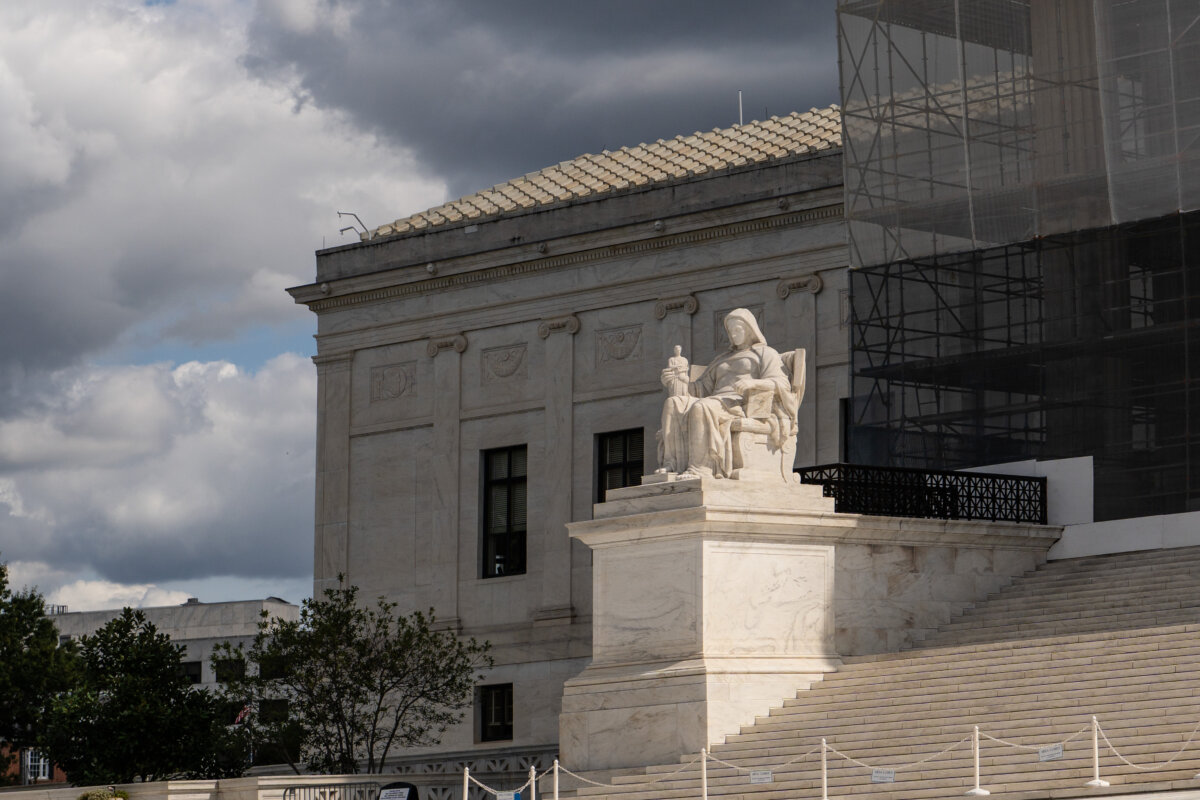

The Supreme Court returns on Oct. 6 for its new term, when it will consider a range of high-profile issues, such as gender and redistricting, and challenges to President Donald Trump’s policies.
The court’s first week of oral argument starts Monday and will feature arguments about so-called “conversion therapy” bans as well as an elected official’s attempt to challenge the counting of ballots after election day.
Trump Cases
In November, the court is expected to hear its first major Trump case of the term—this time over whether Trump’s tariffs violate law known as the International Emergency Economic Powers Act. Trump had invoked the law, which allows presidents to regulate imports under certain emergency circumstances. Oral arguments are set for Nov. 5.
So far, multiple federal courts have said Trump exceeded his authority under the law, so the Supreme Court’s eventual decision could prove pivotal to the success of his economic agenda.
Other aspects of Trump’s agenda are expected to reach the court as well after months of the justices temporarily halting lower court blocks through a procedure known as the emergency docket.
Roughly two weeks before the first oral argument, the court said it would take one of those cases up for more thorough consideration. In a case known as Trump v. Slaughter, the Supreme Court is expected to consider whether Trump illegally fired Rebecca Slaughter, a member of the Federal Trade Commission (FTC).
The case is just the latest from lower courts to challenge Trump’s firings of high-level bureaucrats and could affect plans by Trump and his successors to shape key agencies within the executive branch. Lower courts have repeatedly pushed back on Trump’s firings by citing a major precedent known as Humphrey’s Executor v. United States, which limited presidents’ ability to fire members of certain types of agencies.
A specific date has not been set for oral arguments, but the court said it would hear the case in December. It’s expected to consider whether Congress unconstitutionally restricted Trump’s ability to fire members of the FTC and whether the Humphrey’s precedent should be overturned.
Related to that case is one the Supreme Court said it would hear in January regarding a member of the Federal Reserve Board of Governors named Lisa Cook. This case could lead the justices to consider what constitutes a legitimate cause for removing members of the board. Trump invoked a law known as the Federal Reserve Act, which allows presidents to remove members “for cause,” when he fired Cook.
Cook has denied the allegations of mortgage fraud that served as the basis of Trump’s firing and more generally argued that his purported cause for firing her was illegal.
Elections and Social Issues
Outside of Trump’s policies, other cases the justices have taken up focus on gender, election law, and the death penalty.
One of those cases—Louisiana v. Callais—is a repeat from the previous term. The case focuses on Louisiana’s redrawing of its congressional map in 2022 and whether it illegally diluted blacks’ voting power. After hearing oral argument in March, the Supreme Court decided it needed more briefing and arguments on the issue. It’s expected to hear oral arguments in the case on Oct. 15.
Like redistricting, campaign spending is a recurring issue before the court. This term, the justices are expected to consider a case brought by then-Senate candidate JD Vance and a former member of Congress who argued that Congress violated the First Amendment with its restrictions on campaign spending. More specifically, they challenged a portion of the Federal Election Campaign Act that limits how much political parties and candidates can coordinate their spending.
Together, these cases could help determine which candidates win future elections and impact major policy decisions on contentious issues such as gender.
Two gender policies in particular have made their way to the Supreme Court and could shape the future of girls’ athletics. Appeals courts have ruled that both Idaho and West Virginia violated the Constitution with attempts to keep boys off of girls’ sports teams. The Supreme Court is expected to consider whether those types of policies violate the equal protection clause of the 14th Amendment, as well as a civil rights law governing federal funding for educational institutions.
The Eighth Amendment is also expected to receive some attention at the court this term as the justices consider how judges should weigh IQ scores in determining whether someone should receive the death penalty. That’s because the court previously held that executing intellectually disabled individuals violated the constitution’s bar on cruel and unusual punishment. In the case Hamm v. Smith, the Supreme Court is expected to review how an appeals court analyzed multiple IQ scores for a man convicted of murder.
Stacy Robinson contributed to this report.
 Friends Read Free
Copy
Facebook
Tweet
Friends Read Free
Copy
Facebook
Tweet