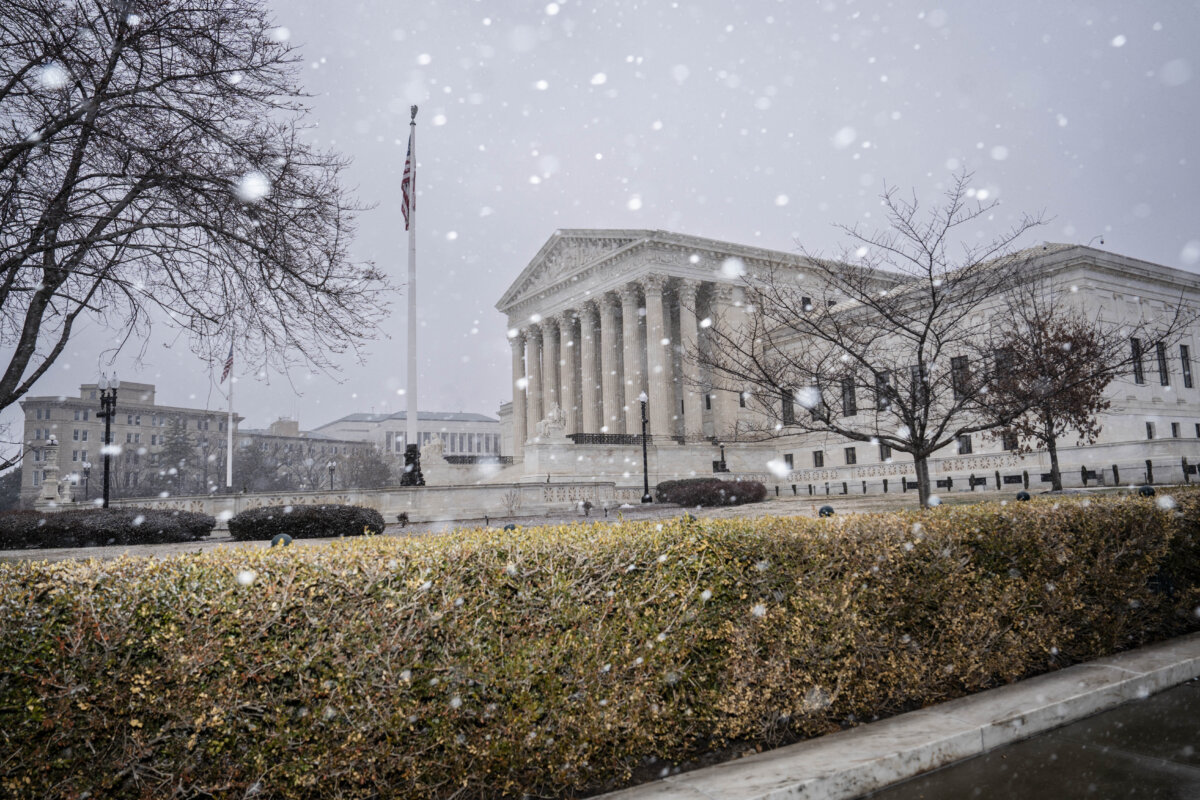

The Supreme Court ruled on March 25 that Cox Communications was not liable for providing internet service to users who illegally downloaded or uploaded copyrighted music.
In a 9–0 decision, the court held that a lower court had erred in finding Cox was liable in providing service to individuals it knew would use it to infringe on copyrights. Instead, the Supreme Court said that companies like Cox could be liable only if they induced the infringement or provided a service that was tailored to that infringement.
“Under our precedents, a company is not liable as a copyright infringer for merely providing a service to the general public with knowledge that it will be used by some to infringe copyrights,” Justice Clarence Thomas wrote for the majority.
Justice Sonia Sotomayor, joined by Justice Ketanji Brown Jackson, concurred with the majority’s judgment but for a different reason. She said her colleagues went too far in limiting the scope of liability for companies like Cox.
The decision followed a verdict awarding Sony $1 billion in damages. Sony had enlisted a program called MarkMonitor to track copyright infringement and had sent Cox more than 160,000 notices identifying IP addresses that were associated with infringement.
The jury found that Cox was liable for infringement of more than 10,000 copyrighted works under two theories of liability. One theory, known as vicarious liability, requires that a provider profits from the infringement and has an ability to supervise the infringer.
The U.S. Court of Appeals for the Fourth Circuit said that Sony failed to show that Cox profited from the infringement. Although the appeals court dismissed the vicarious aspect of the verdict, it affirmed another theory known as contributory liability. Among other things, it pointed to the notices sent by MarkMonitor as evidence that Cox had knowledge indicating that type of liability.
The Supreme Court said on March 25 that the appeals court incorrectly applied the theory of contributory liability.
“This holding went beyond the two bases for contributory liability recognized in the Court’s precedent and conflicted with the Court’s repeated admonition that contributory liability cannot rest only on a provider’s knowledge of infringement and insufficient action to prevent it,” the Supreme Court said.
The decision was partially based on a law known as the Digital Millennium Copyright Act, which Congress passed in 1998. The law criminalized the dissemination of copyrighted works but also provided some protection for internet service providers under a “safe harbor” provision.
Thomas said that Sony misinterpreted the safe harbor provision.
“Sony argues that Congress must have enacted the [Digital Millennium Copyright Act] on the presumption that Internet service providers could be held liable in cases such as these,” he said. “Sony overreads the DMCA.”
Sony did not respond to a request for comment before time of publication.
Sony had argued that the appeals court followed the Supreme Court’s precedents and that Cox should have been held liable if it knew a particular user would engage in copyright infringement.
“Cox made a deliberate and egregious decision to elevate its own profits over compliance with the law,” Sony said in a brief to the Supreme Court.
Cox told the justices that it didn’t want users to infringe on copyright and that its terms of service prohibited such conduct.
In a statement provided to The Epoch Times, Cox praised the decision.
“The Supreme Court’s unanimous opinion is a decisive victory for the broadband industry and for the American people who depend on reliable internet service,” the company said in a statement.
“This opinion affirms that Internet service providers are not copyright police and should not be held liable for the actions of their customers—and after years of battling in the trial and appellate courts, we have definitively shut down the music industry’s aspirations of mass evictions from the internet.”
 Friends Read Free
Copy
Facebook
Tweet
Friends Read Free
Copy
Facebook
Tweet