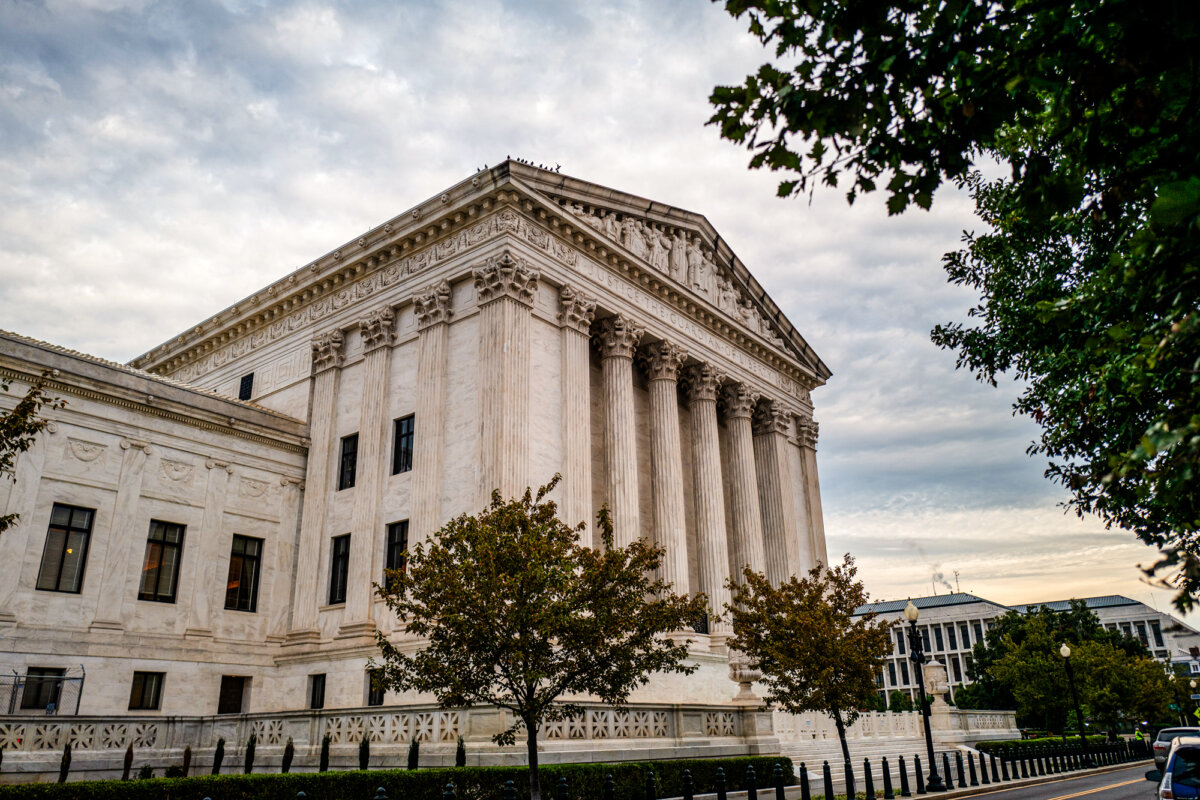

The Supreme Court seemed skeptical of arguments on Oct. 15 that officers should have probable cause before entering someone’s home during a potential emergency.
Instead, the justices seemed sympathetic to police officers’ decision to enter the home of a Montana man who was thought to be on the brink of suicide. Oral argument in the case, known as Case v. Montana, focused on the level of suspicion or certainty authorities should have under the Fourth Amendment of the Constitution when confronting that type of situation.
The Fourth Amendment states: “The right of the people to be secure in their persons, houses, papers, and effects, against unreasonable searches and seizures, shall not be violated, and no Warrants shall issue, but upon probable cause, supported by Oath or affirmation, and particularly describing the place to be searched, and the persons or things to be seized.”
According to court filings, William Case told his former girlfriend in September of 2021 that he was going to kill himself and “was going to get a note.” During a phone call, the girlfriend heard a noise that she thought was the cocking of a gun. After Case threatened to shoot police if they came, the girlfriend heard a “pop” and received no further response after yelling his name.
Three Anaconda-Deer Lodge County police officers eventually arrived on the scene and entered Case’s home after seeing a holster and notepad that purportedly corroborated his girlfriend’s account of a suicide threat.
One of the officers found Case in an upstairs bedroom and fired on him when Case opened a curtain covering a closet where he was hiding. The officer saw Case with an object, and it was later confirmed via body camera that Case held a handgun pointed at the officer, according to Montana’s brief to the Supreme Court.
When Case went to court on a charge of assaulting a peace officer, he attempted to exclude evidence obtained from a purportedly illegal search of his house. The trial court, however, rejected his motion to exclude the evidence and he was found guilty. After losing in an appeal to the Montana Supreme Court, Case asked for the U.S. Supreme Court’s intervention.
During oral argument on Oct. 15, Case’s attorney, Fred Rowley, told the justices that the officers shouldn’t have entered the home without a warrant unless they had probable cause to believe an emergency existed. The Justice Department and the state of Montana disagreed.
Montana Solicitor General Christian Corrigan told the justices that officers just needed an “objectively reasonable” belief that intervention was necessary. Requiring “probable cause,” he argued, was too high of a bar in that it “would force officers to stand outside a dying man’s door, calculating legal thresholds instead of saving his life.” Instead, Corrigan said, the framers of the Constitution enshrined a tradition of reasonableness rather than something more rigid within the Fourth Amendment.
Assistant to the Solicitor General Zoe Jacoby, who represented the Trump administration, said Case’s argument had “no basis in the Fourth Amendment’s text, which links probable cause to warrants, not to searches in general.”
Justice Samuel Alito was perhaps the most critical of Rowley’s arguments. “It seems to me that if the police could not enter this house based on the facts that they knew, then I don’t know when the police are ever going to be able to enter a house to prevent somebody from committing suicide,” he said.
Alito later asked, “What more would they need here? Would they need to be able to look through the window and see him with a gun pointed to his head or they need to see a dead body on the floor?”
Part of Rowley’s argument focused on the fact that the police officers had already known Case and his history of suicidal tendencies. The officers, Rowley said, doubted he would actually commit suicide and instead perceived that Case was attempting to provoke a confrontation with police.
Justice Ketanji Brown Jackson told Rowley she thought the officers having a lot of information about Case “actually hurts your cause, not helps you.”
After noting Case’s history of threatening suicide, Jackson said: “We have a long conversation, detailed, specific, with the girlfriend about circumstances that look like they’re creating a pretty significant emergency.”
Justice Neil Gorsuch wondered “if this is just a labeling exercise” and suggested that Rowley’s argument would give officers fewer rights to intervene than private citizens in rendering assistance.
A previous version of this article misspelled Fred Rowley’s last name on several instances. The Epoch Times regrets the error.
 Friends Read Free
Copy
Facebook
Tweet
Friends Read Free
Copy
Facebook
Tweet